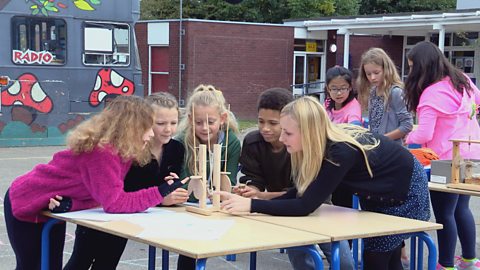
Hi, I'm Yasmin and I'm a chemical engineer working on North Sea gas development. Today I'm with pupils from Barnes Primary School in London who are going to design and make a night-light for toddler Elodie. First, we need to ask Elodie's mum, Camilla, what kind of night-light Elodie would like.
Connie: Does Elodie like any patterns or animals that we could include on the night-light?
Camilla: She does, she loves animals and she also loves looking at things like stars or different patterns.
Yasmin: We go into Elodie's bedroom to get some more design ideas then it's back to school to look at some existing lights. Shall we have a look at these lights and get some ideas of what we want to make?
Connie: Camilla said that it takes a while for Elodie to get to sleep and to get her to sleep faster she likes to look at things.
Yasmin: OK. So maybe a light that could create patterns.
Yasmin: That's a good idea. So how could we make something like this? What kind of materials can we use?
Joe: We need see-through plastic.
Yasmin: See-through plastic?
Joe: Yes.
Yasmin: Can you think of anything that you could recycle?
Children: Um…
Gwen: Plastic bottles.
Yasmin: That's cool. We have lots of good ideas so we split into two teams and sketch two different designs. Can you guys talk me through what you've drawn? Explain the design to me.
Edward: In her room, Elodie quite likes butterflies. These three butterflies are going to be hooked up from this base here and these two wires are going to come up, lighting up the wings and maybe a bit of the antenna.
Yasmin: So you have a light bulb inside the butterfly at the top?
Edward: Yes.
Yasmin: That's cool. Do you know how you might do that?
Jo: No.
Yasmin: No? You can work it out.
Edward: Going to work it out!
Yasmin: OK, can you talk me through your design and what you've come up with?
Connie: So, the main sides around here it's going to be a bit like a safari scene so we're going to have elephants all around the bottom and trees between every one and then up here, right at the top we're going to have a couple of clouds, blue sky and a sun right in the middle.
Yasmin: OK. Which design do you think is best for Elodie?
Grace: I prefer this design because I think it will be more stable and it will stand up, as this design with the butterflies, the wire or the things that are supporting them might not be strong enough.
Yasmin: So we've chosen our design. Now what materials do you think we can use to make it?
Connie: I think we should use one of these pots so we could fit all the design all the way around.
Gwen: We could also use this see-through plastic, cut some shapes out and stick them on.
Yasmin: So we get down to work, cutting out our coloured shapes. Now we have to work out how to control the actual lights.
Joe: These LEDs are controlled by these plugs so each one controls these lights.
Yasmin: This is a light-dependent resistor.
Jaikalin: So this is a sensor, which acts as a switch to turn these LEDs on.
Yasmin: OK. So if I put my thumb on it, it will light up, and then if I take it off, it doesn't.
Yasmin: Once we have the design, the lights and the sensor we need to write a set of instructions to operate it. This is called coding.
Edward: Well, basically, you see these little icons on the side? You drag them on to start coding to this circuit and on this circuit you can see all the plugs and switches that go and control the sensor, and these wires that go up to the lights.
Yasmin: This is really clever. You've used a salad box to make the base and you've got this for the top but how are you going to stick it all together?
Jaikalin: We're going to cut slits into the top piece and then we're going to cut a hole into the bottom and then the slits should stick onto the bottom of the base.
Camilla: I think it's absolutely fantastic and you're done a brilliant job. I understand it's got the sensor so that it comes on when it gets dark and it goes off again when it's light, which is a brilliant idea. I really love the fact that you've got animals and nature. I can see elephants and butterflies and look, Elodie, the tree and the sun and the flashing lights and the different colours are great because that will really hold Elodie's attention.
Elodie: Elephant!
Camilla: Elephant, that's right!
Yasmin: We've achieved all of our night-light design aims. Well done teams!
Video summary
Engineer Yasmin Ali helps a team of children to research, design and make a nightlight for a toddler using recycled materials.
The children go to meet little Elodie and her Mum to research the design requirements.
Having looked at a variety of existing nightlights they split into groups to sketch a couple of different ideas, then choose the best and make a prototype, using a light-dependent resistor as a switch.
They write a code to tell the circuit how to operate, before getting feedback on the prototype from Elodie’s Mum.
This clip is from Design Challenge, a series in which groups of children tackle some difficult creative projects with the help of talented young engineers.
Teacher Notes
This clip could be used to introduce and support the delivery of a designing, making and evaluating project for children to develop a nightlight for a toddler.
It could stimulate class discussion and learning in areas such as initial research, product evaluation, designing and making.
Sections of the clip can also be used to increase children’s technical knowledge and understanding of the use of electronic circuits, sensors and LEDs.
This clip will be relevant for teaching Art and Design and Design and Technology at KS2 in England, KS1 and KS2 in Northern Ireland, Design and Technology at KS2 in Wales and at 2nd Level in Scotland.
How to design and make a rainwater harvester. video
Engineer, Marie Adeyemi, helps a team of children design and make a rainwater harvester.
How to design a portable bird hide for children to use at a nature reserve. video
Engineer, Abbie Hutty, helps a team of children to design a portable bird hide.
How to design packaging for soft fruit using 2D and 3D software video
Marie Adeyemi helps a team of children to design some packaging for soft fruit.
How to design and make a swimming bag. video
Engineer, Yasmin Ali, helps a team of children to design and make a swimming bag.
How to design and make a moving shop window display. video
Engineer, Abbie Hutty, helps a team of children to design a moving shop window display.