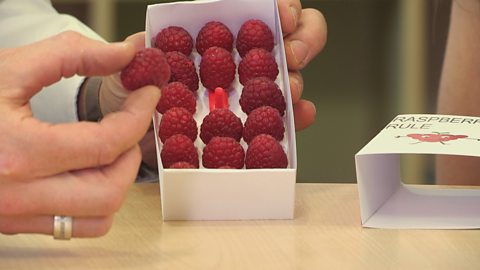
MARIE ADEYEMI: Hi, I'm Marie and I'm a mechanical engineer working on a nuclear energy project. Today I've come to Wrington Primary School in Bristol where their vegetable patch is in a sorry state. The problem is at the moment the children have to water the plants using tap water and watering cans. This is a waste of expensive treated water, where we could use rainwater, which is free.
Our challenge today is to harvest rainwater and make an irrigation system for the school garden.
AMY: We do have two roofs, which the rainwater falls onto.
MARIE: But how can we get from the roof down to the garden patch?
ELEANOR: We could use the guttering and the pipes.
MARIE: I've just come back from Kenya in Africa. Here, water is very precious and these people are experts in rainwater harvesting. What can we learn from them? What does your one show?
AMY: They have a water butt on a stack so it's high enough for them to wash their hands in and a bucket underneath so they don't waste any of the water they've got.
MARIE: What does your one have?
TOM: My one's got a giant water butt on it on a stone, concrete base to keep it high enough so they can fit their buckets and things under the tap.
MARIE: We need to make sure our design needs to be at height as well. What have you got there?
EUAN: This is the water butt and the pressure is watering all the plants to make them grow well.
MARIE: So it's a bit similar to what we need to do isn't it? Because we need to irrigate our garden patch. We split into two teams to sketch our ideas.
CAMERON: Shouldn't we have some sort of mesh or chicken wire to stop things like leaves blowing into it?
TOM: If the water is coming along this pipe we can use soaker hoses here, because they've got holes in them and the water will come straight out of them.
MARIE: We like both designs and decide to incorporate the best ideas from each into our model. First we attached the guttering to our shed model.
EUAN: And this is our water butt. And these are the irrigation pipes.
MARIE: This is a great model. It's a really good and workable design. We start by making the wooden beams which will support our guttering. Next, we have to put our water butt in place.
SARAH: Is it straight?
ELEANOR: Looks like it.
MARIE: The chicken wire will keep fallen leaves out. And the black soaker hose will irrigate our plants. Now we're attaching the guttering to a downpipe which leads to our water butt. OK, we're going to go test it now. Are you excited?
ALL: Yeah!
MARIE: Let's try it out. We put the water like it's the roof. We're using tap water for now but the rain will behave exactly the same. It's falling in now. Can you see it all? Now, let's see if all our hard work has paid off. So look, the water's going through. This is so much better. It's all working really well.
ELEANOR: We don't need to use the water from the classroom any more cos we can use the rainwater.
MARIE: What can we do to improve our rainwater harvester? You've got a great design but as you can see, the water is coming out from the end.
AMY: We need to change the level of the pipes so the water flows more easily.
MARIE: We've achieved almost all our aims. Except we need to make our water collection more efficient by sealing the end of the gutter and by making it slope down a little more. This will be easy to fix. Well done teams!
Video summary
Engineer Marie Adeyemi helps a team of children to research, design and make a rainwater harvester to irrigate their school garden.
They assess the garden to see if there’s any obvious way of collecting rainwater and look at photographs of rainwater harvesters in Africa, to find out the key features they need to include.
They sketch their initial ideal, build a model and then make and test a prototype.
Finally, the children discuss how they can improve their design.
This clip is from Design Challenge, a series in which groups of children tackle some difficult creative projects with the help of talented young engineers.
Teacher Notes
This clip could be used to introduce the process of designing a project, and as a prompt for class discussion and learning in areas such as initial research, investigating products, designing, making and improving on a design.
This clip will be relevant for teaching Art and Design and Design and Technology at KS2 in England, KS1 and KS2 in Northern Ireland, Design and Technology at KS2 in Wales and at 2nd Level in Scotland.
How to design a nightlight for a toddler. video
Engineer, Yasmin Ali, helps a team of children design and make a nightlight for a toddler.
How to design and make a moving shop window display. video
Engineer, Abbie Hutty, helps a team of children to design a moving shop window display.
How to design a portable bird hide for children to use at a nature reserve. video
Engineer, Abbie Hutty, helps a team of children to design a portable bird hide.
How to design and make a swimming bag. video
Engineer, Yasmin Ali, helps a team of children to design and make a swimming bag.
How to design packaging for soft fruit using 2D and 3D software video
Marie Adeyemi helps a team of children to design some packaging for soft fruit.