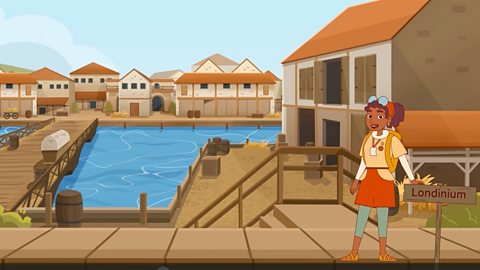
Exploring the formidable Roman Army - its organisation, tactics and influence.
JULIA: I just found this fragment of rusty metal. It doesn’t look like much but this was once a sword. A sword known as…the gladius!
The gladius was part of the Roman soldier’s equipment which included…a tunic…woollen trousers…a belt for hanging a dagger from…sandals…a scarf…armour…a cloak…a shield…and a helmet! Which is handy for me because women weren’t allowed in the army!
Soldiers swore an oath of allegiance - a promise to serve the republic and later the emperor. Once they had joined the army, they had to serve for 25 years! And if they ran away, or failed to do their duty, they could be killed.
There were different types of soldiers in the Roman army and they were split into different groups, which made them easier to organise. There were the legionaries who were citizens of Rome and the auxiliaries who weren’t Roman, but came from places within the Roman empire, including Europe, North Africa and the Middle East. They were treated very differently. Legionaries were often given benefits, like land to farm when they completed their 25 year service. But for a long time, auxiliaries were only allowed to become Roman citizens after they completed their service. Legionaries were also paid more.
Centurions were officers, and they commanded groups of around 80 to 100 men. There was also cavalry and archers.
The army was grouped into legions of about 4,800 men, and each legion was made up of ten cohorts. The largest cohort held the legion’s silver eagle standard. The honour of carrying the standard was reserved for the standard bearer.
For nearly a thousand years, the Roman army was the most feared fighting force in the world, and it helped to grow the empire by conquering lands from Spain and North Africa to Northern England and Syria.
They did it by being well-trained and using clever tactics - like the testudo, or tortoise - where soldiers arranged their shields to make four walls and a roof around themselves. Or by throwing a type of spear, called a pilum. If it didn’t hit you, it would often stick into your shield, making it impossible to use.
They had formidable weapons like catapults…and ballistas which were like huge cross-bows. They weren't just for attack. They also used them to defend the many fortifications that were built across the empire. Like this one in what’s now northern England. It’s similar to the many hundreds of forts across Ancient Rome, with its rectangular layout, rounded corners and ditches around its perimeter. Forts were often near towns and linked together by a network of roads.
And boy, did the Romans love building roads! By the end of the empire, they had completed over 80,000 kilometres of roads, all of them using nearly the same design of straight lines and a curved surface to help drain water away. The roads helped the movement of troops, equipment and, most importantly, trade, which raised money and taxes, making Rome even richer and in turn helping it to pay for its enormous army.
The desire for wealth was one of the reasons the Romans invaded Britain, as it was rich in natural resources like tin, lead and copper; wheat was plentiful, and it was also sadly a place where slaves could be captured and taken back to Rome.
The Roman army was a vital part of ancient Roman life, affecting everything from the way it was governed to how it made its money. Without the Roman army, there would be no Roman Empire.
3. The Roman army
Julia discovers a fragment of metal - part of a Roman sword, called a gladius. Julia describes how the gladius was a standard part of a Roman soldiers uniform and equipment which also included sandals, leggings, a dagger, a scarf, a cloak and a helmet.
Julia goes on to describe how the Roman army was organised into cohorts and legions. The soldiers swore and oath to the republic and later the emperor and served for 25 years. A centurion was a commander in charge of 80 to 100 soldiers. Legionaries were soldiers who were citizens of Rome, who enjoyed benefits such as being given land to farm on retirement. Auxiliaries were soldiers drawn from across the empire, who did not enjoy the same benefits as legionaries. The standard-bearer had the honour of carrying the legions standard.
Roman army well-trained and disciplined. Its tactics included the testudo ('tortoise') when the soldiers would place their shields side-by-side and overhead to create a defensive wall, like the shell of a tortoise.
Duration: 4' 01"
Final words: '…there would be no Roman empire.'
Video questions
- What was the sword of a Roman soldier called? (A gladius)
- How many soldiers did a centurion command? (80 to 100)
- What was the main difference between legionaries and auxiliaries? (Legionaries were citizens of Rome, whereas auxiliaries were enlisted from across the empire; legionaries were paid more and enjoyed other benefits)
- What was the testudo or 'tortoise'? (A tactic in which the soldiers used their shields to create a defensive 'shell')
- What was the standard-bearer? (The person in the largest cohort who carried the eagle standard)
- How many kilometres of roads did the Romans construct? (A network of 80,000 km)
- Can you name three of the Roman weapons that are named in the film? (The catapult; the balista (like a giant cross-bow) and the pilum (a type of spear)
This film is relevant for teaching History within the National Curriculum at KS2 in England and Northern Ireland and equivalent levels in Scotland and Wales.
Further resources
Teacher Notes. document
Download / print the Teacher Notes prepared in partnership with Classroom Secrets (pdf)
Transcript
Click to download / print the episode transcript

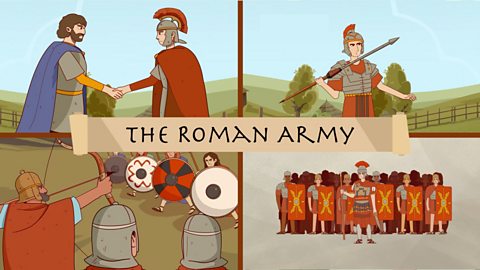
Song: 'The Roman Army' video
A catchy song to consolidate key information about the Roman army - weapons, tactics, organisation.

2. The Roman Empire. video
Exploring the government of Ancient Rome and how the republic became an empire.
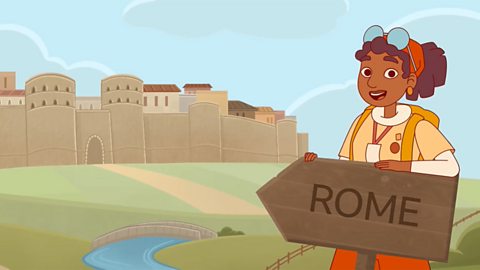
4. The Romans in Britain. video
Exploring the Roman invasion and settlement of Britain, including resistance by Boudica and the Iceni.
5. The legacy of Ancient Rome. video
Exploring the enduring influence of Ancient Rome on modern Britain and countries around the world.