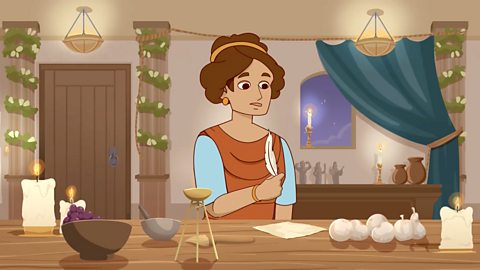
Exploring the enduring legacy of Ancient Rome on modern Britain and countries around the world.
JULIA: I’m at a Roman bathhouse in Bath in the south west of England. It was built by the Romans nearly two thousand years ago. These stacks of tiles are part of a very clever Roman invention, the hypocaust. The hypocaust was a space under the floor where the air would be heated by a small fire. The floor was raised up by stacks of tiles called pilae, and the hot air beneath it would make it warm and heat the room. I think it’s getting a bit hot for me! It’s one of hundreds of sites that remain long after the Romans left Britain, and just part of the legacy of Ancient Rome.
Now Bath was named after the Romans left. But there are plenty of towns and cities in this country that got their names from the Romans. Colchester, Manchester and Winchester all have the word ‘chester’ in, which comes from the Latin word castrum, meaning 'fortress'. And in Wales, many place names that start with ‘Caer' or 'Car’ - meaning ‘fort’ - refer to the Roman forts that were built there. Places like Caerwent, Cardiff and Carnarvon. London - or ‘Londinium’, as it was called back then - was even founded by the Romans shortly after they arrived in Britain.
Some of the roads we use today follow the same routes as old Roman roads.
And they didn’t just leave their mark on the landscape. Languages like Italian, French and Spanish are thought to come from Latin spoken by the Romans.
Much of the English language comes from Latin too. Words like…'mountain' from mons…'magnify' from magnificare…'magic' from magicae.
The Romans taught the world a lot about building too, whether it was underground sewers…aquaducts…or amphitheatres - many of which used arches, a Roman invention that is much stronger than flat beams.
And none of this would have been possible without their super strong concrete, which had a secret ingredient…seawater! They used concrete everywhere…like here at the Pantheon. This looks like it could have been built yesterday!
Artists have been inspired by Roman art and painted Roman legends hundreds of years later.
Shakespeare wrote his ‘Roman plays’ - Anthony and Cleopatra, Coriolanus, Julius Caesar and Titus Andronicus.
Even our calendar is Roman. April is from the Latin word aperirer, meaning to ‘open’ - like flowers in spring! June is named after the goddess Juno. The rulers Julius and Augustus added the months ‘July’ and ‘August’, which is why September, October, November and December were named after the Roman numbers seven, eight, nine and ten…even though they’re 9th, 10th 11th and 12th months!
The way we use law comes from ideas the Romans thought of too…like having important people to hear a case, like a judge and witnesses. In fact, the way some countries are run is based on Roman ideas, like having a senate with senators who make important decisions for the country…and who are elected, which means they are chosen by the people.
Many countries have stopped being ruled by kings and queens and have become republics, just like Rome did hundreds of years before.
In Britain, the Romans have influenced our daily lives, from our place names to the words we speak. And in many places around the modern world their ideas have shaped the way we live, and will do so for many years to come.
5. The legacy of Ancient Rome
Julia begins at a bath-house in Bath, built by the Romans about 2,000 years ago. She describes a key Roman invention - the hypocaust - a form of underfloor heating.
Bath was named after the Romans left Britain but many of the names of the towns and cities across England and Wales indicate Roman origins. Colchester, Manchester and Winchester all include 'chester' - which comes from the Latin word castrum, meaning 'fortress'. Places names in Wales that begin 'Caer' or 'Car' are also named after Roman forts.
Many of the roads in England follow the route of ancient Romans roads. And many of the words we speak also have their origins in the Latin spoken by the Romans.
Roman concrete benefitted from the addition of seawater and their structures often included arches, a form of support that is much stronger than flat beams.
Roman culture has influenced artists and writers across the centuries, including William Shakespeare who write several 'Roman plays' - including Julius Caesar and Anthony and Cleopatra.
The months of the year are named after Roman words - including 'June' from the goddess Juno, 'July' from Julius (Caesar) and 'August' from Augustus (Caesar).
Ancient Rome has also influenced the legal system of many countries - including Britain - and many countries model their government on Ancient Rome, choosing to be republics with elected senators serving in a senate.
Duration: 3' 47"
Final words: '…and will do so for many years to come.'
Video questions
- What is the name of the Roman underfloor heating system? (Hypocaust)
- Can you name three cities in the UK that include 'chester' in their name? (Mentioned in the film: Colchester, Manchester, Winchester. Among the many others: Bicester, Chester, Chesterfield, Dorchester, Rochester)
- What does the word 'chester' mean? (Fortress)
- What English words are mentioned in the film that come from Latin words? ('Mountain' from mons; 'magnify' from magnificare; 'magic' from magicae)
- What architectural feature did the Romans invent that was stronger than flat beams? (Arches)
- What did the Romans add to concrete to give it greater strength? (Seawater)
- Who wrote several plays about Ancient Rome? (William Shakespeare)
- Who are the months June, July and August named after? (The Roman goddess Juno; Julius Caesar; Augustus Caesar)
- What is a 'republic' (a country which is governed by the elected representatives of the people…not a monarch)
This film is relevant for teaching History within the National Curriculum at KS2 in England and Northern Ireland and equivalent levels in Scotland and Wales.
Further resources
Teacher Notes. document
Download / print the Teacher Notes prepared in partnership with Classroom Secrets (pdf)
Transcript
Click to download / print the episode transcript

4. The Romans in Britain. video
Exploring the Roman invasion and settlement of Britain, including resistance by Boudica and the Iceni.
6. Growing up in Ancient Rome. video
Julia introduces a narrative episode about Augusta and Felix - two children growing up in Ancient Rome.
7. Letters from Vindolanda. video
Exploring everyday life for those at Vindolanda fort, based on the Roman letters discovered there.