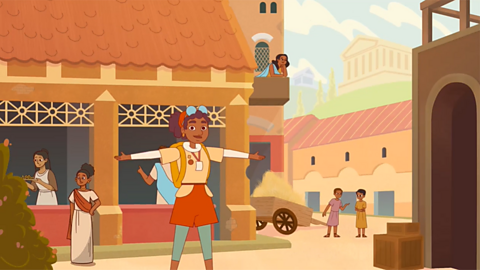
Exploring daily life at a Roman fort - Vindolanda, in northern England - from the letters discovered there.
JULIA: I’m at Vindolanda in the north of England. It’s a Roman fort and village near Hadrian’s Wall.
In 1973 archaeologists found something astonishing here. It wasn’t gold, or coins…but letters and notes written on thin bits of wood, which the Romans often used instead of paper. They were written by people who lived here nearly two thousand years ago, and what makes them unique are the details of everyday life written by the people at the time.
The letters include birthday party invitations, requests for money, and even homework! Reading letters and notes like these helps us to imagine the lives of the people living here. Like the archers who had come all the way their home in sunny Syria to serve in the army in a cold and rainy Britain…
BARATES: We fought in many wars across Europa. We fought Boudica and the Iceni. We fought the Picts at the Antonine Wall. But this is the worst enemy of all…the rain. It’s relentless. I prayed for the rain to stop, but to no avail. The local tribes don’t like us much.
VOICE OFF SCREEN: Go back to Rome!
BARATES: I wish. I’m not even from Rome! I want a horse like the equitatae, but I just can’t get the hang of horse-riding.
JULIA: One Roman invention that didn’t stand the test of time were their saddles. There were no stirrups to put your feet in, so the riders weren’t very steady.
BARATES: We’re mostly auxiliary troops up here from across Europe, Syria and North Africa. We’re paid less than the legionaries but we're no less brave or skilled. It’s cold here, but there is one thing that warms my heart, Regina. She is from the local village, and my ray of sunshine, no matter what the weather.
JULIA: In fact, we know people from different parts of the Roman Empire met and married near Hadrian’s wall from stone carvings found nearby. The tablets at Vindolanda also show that some Roman soldiers actually brought their wives and children with them to Britain. Just imagine what it must have been like leaving Rome to follow your husband to the far reaches of the Empire.
ADRIANA: Dear Aunty, ever since we left Rome for Britain, things haven’t quite been the same. On the way to the fort, we stopped off to watch gladiators at the arena in York, but I am really not a fan.
ADRIANA: So what’s that man doing with the net and the trident?
HUSBAND: That’s the retiarius. He’s trying to catch the man in the net.
ADRIANA: And who’s the man in the funny fish helmet?
HUSBAND: That’s the murmillo.
ADRIANA: Now we’ve arrived at the fort, he is out all the time, gets back late and is just exhausted.
Don’t stand there dear. You’ll get blood on the mosaic.
He says he’s having a tough time, but I think he just misses the warm weather back home. Which reminds me, can you send some woollen socks?
Don’t get me wrong, there are things to do here…there’re board games. But once you’ve played ludus latrunculorum a hundred times, it loses its appeal! And you do meet lots of people from interesting places. There’re Tungrians from Gaul, Asturians from Spain and Hamians from Syria!
It’s nearly 17 December and you know what that means! Saturnalia festival! It is my favourite time of year where I can really let my hair down and party! I’ve bought all the presents and the decorations.
JULIA: Sound familiar? Many people think the Saturnalia festival and the tradition of giving presents at the end of December led to the way Christmas is celebrated.
ADRIANA: I’m not sure I like the custom of allowing slaves to say and do what they want for the week…
It’s okay, I’ll do it!
7. Letters from Vindolanda
Julia introduces a second narrative episode, this time piecing together the lives of two Romans staying at Vindolanda from letters written nearly 2,000 years ago that were found there.
Vindolanda was a Roman fort and village close to Hadrian's Wall and today is a museum. In 1973 archaeologists studying the remains of the Roman settlement discovered a number of letters written on thin strips of wood, which the Romans often used instead of paper. The letters were written in Latin by those staying at Vindolanda - soldiers, wives, merchants, slaves, children - and cover every kind of topic from the strength of the garrison to requests for warm socks.
In the first story we meet Barates, an archer from Syria. Barates has fought for the Roman Empire across Europa…but his greatest enemy is the British weather. His 'ray of sunshine' is Regina, who he has met at the local village. The marriage of the real Barates and Regina is recorded on a tombstone in South Shields.
In the second story we meet Adriana - the wife of a Roman officer travelling to Vindolanda from Rome. She reflects on how different her life will now be and looks forward to Saturnalia - the festival that Christmas would replace in Christian times.
Duration: 4' 05"
Final words: '…It's okay. I'll do it!'
Video questions
- What is Vindolanda? (A Roman fort and village close to Hadrian's Wall in the north of England - now a museum)
- What was discovered there? (Various letters written on thin strips of wood)
- What country does the archer come from? (Syria)
- Who does he say he has fought against? (Boudica and the Iceni; the Picts at the Antonine Wall)
- What does he say is his worst enemy? (The rain)
- Where does Adriana travel from? (Rome)
- What does she do on the way to Vindolanda? (Watch the gladiators fight)
- What festival is she looking forward to? (Saturnalia - a sort of pagan Christmas)
- What tradition of Saturnalia does Adriana mention? (Allowing the servants time off)
This film is relevant for teaching History within the National Curriculum at KS2 in England and Northern Ireland and equivalent levels in Scotland and Wales.
Further resources
Teacher Notes. document
Download / print the Teacher Notes prepared in partnership with Classroom Secrets (pdf)
Transcript
Click to download / print the episode transcript

Song: 'Is that a fact?' video
Learn a song about assessing historical evidence from our musical 'Rocking Romans!'
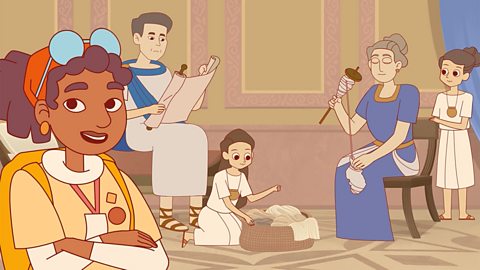
6. Growing up in Ancient Rome. video
Julia introduces a narrative episode about Augusta and Felix - two children growing up in Ancient Rome.
8. The slave and the architect. video
Exploring the life of a slave working for an architect in Ancient Rome and waiting for his freedom.
1. Society and culture. video
Exploring everyday life in Ancient Rome with Julia - our animated guide.