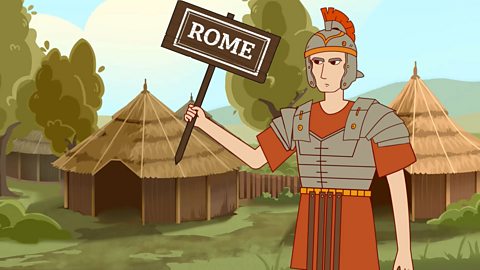
Exploring government and society in Ancient Rome and how the republic became an empire.
JULIA: I’m helping out with this archaeological dig at Hadrian’s Wall in the North of England. This wall was built nearly two thousand years ago by the Romans, and the things found here tell us a lot about life at the time. Wow! A coin!! It’s got a head on it!It’s emperor….Trajan. Finding a coin like this is like finding treasure. Not because it’s worth a lot of money, but because of what it tells us about the past. In fact, if you want to learn about Ancient Rome, then follow the money!
Emperor Trajan was born in what is now Spain. But how does a ruler that was born in Spain and lived in Italy end up on a coin that was used in the North of England?
Well, at that time all these places were part of the Roman Empire. An empire is a group of lands all ruled from one place…and the Roman Empire was ruled from Rome.
It all began about two thousand five hundred years ago. Back then, the Romans were just one of many groups of people living in what we now call Italy. They didn’t have an empire, or an emperor. Instead, they were ruled by kings. When countries are ruled by kings or queens, it’s called a ‘monarchy’.
The first six kings were ok, but the seventh, Lucius Tarquinius Superbus, was a nasty piece of work. He treated the people of Rome very badly, so in 509 BCE, they decided they’d had enough of the monarchy.
They formed a republic, which is when the country is run by its people, and not just one person or family. Instead of a king, they had two men called consuls, who were chosen by some of the people. Women weren’t allowed to be consuls! And unlike kings, who stayed in charge until they died, consuls were only allowed to be in charge for one year and because there were two of them, one person didn’t have too much power. They got advice from the senate, a group of people, called senators, who came up with ideas about how to run the republic. And just like the consuls, only men were allowed to be senators.
Over two hundred years and many wars and battles later, the Roman Republic grew to take over most of what is now Italy…and by 100BCE it had grown even larger, reaching Asia and North Africa. All these new lands paid taxes to Rome which became richer than ever before.
But not everyone was having a good time. It was great if you were in power, but for many people their lives had got harder, even though Rome had become wealthier and more powerful. Fighting broke out when ordinary people without power tried to change how Rome was governed.
But for one man this was just another opportunity. Julius Caesar had already made a name for himself conquering the land of Gaul in what is now France. He wanted to take control of the republic and marched his armies from Gaul to Rome, causing a war between the people of Rome that lasted nearly five years. When Julius Caesar finally won the war, he let the senate continue, but he really took all the power for himself. The senators were not happy and some decided the only thing they could do was to kill him.
But it wasn’t long before the people of Rome were fighting each other again! Until Gaius Octavius took power, becoming the first emperor, Emperor Augustus, which is when the republic became an empire. The senate still gave advice, but the emperor, rather than the people had the real power. The empire lasted over five hundred years, but after losing control of some of its lands, Rome gradually lost its power altogether and it’s empire was broken up. But it’s story lives on!
2. The Roman Empire
Julia is taking part in an archaeological dig at Hadrian's Wall when she discovers a coin from the time of Emperor Trajan (53 - 117 CE). The coin leads Julia to consider the size and diversity of the Roman Empire.
Julia goes on to consider that Rome wasn't always ruled by emperors. At first Rome was ruled by kings; thus was a monarchy. However, the final king - Lucius Tarquinius Superbus (d 495 BCE) - was overthrown by the people and replaced with a republic:
Rome was now ruled by two officials called consuls, who were advised by a senate. A period of civil strife led to Julius Caesar becoming the most powerful person in Rome. Then, in the four year period between 31 and 27 BCE, Gaius Octavius gradually took all power for himself, becoming Emperor Augustus, ruler of the Roman empire.
Duration: 3' 57"
Final words: '…but it's story lives on!'
Video questions
- Julia discovers a coin showing the head of which Roman emperor? (Emperor Trajan)
- What do we call the form of government by kings or queens? (A monarchy)
- What do we call the form of government by 'the people'? (A republic)
- Who marched an army from Gaul to Rome to take power? (Julius Caesar)
- What was the name of the very first emperor of Rome? (Emperor Augustus - formerly Gaius Octavius)
This film is relevant for teaching History within the National Curriculum at KS2 in England and Northern Ireland and equivalent levels in Scotland and Wales.
Further resources
Teacher Notes. document
Download / print the Teacher Notes prepared in partnership with Classroom Secrets (pdf)
Transcript
Click to download / print the episode transcript

Song: 'Gladiators - Into the arena' video
Learn a song about gladiatorial combat from our musical 'Rocking Romans!'
1. Society and culture. video
Exploring everyday life in Ancient Rome with Julia - our animated guide.
3. The Roman army. video
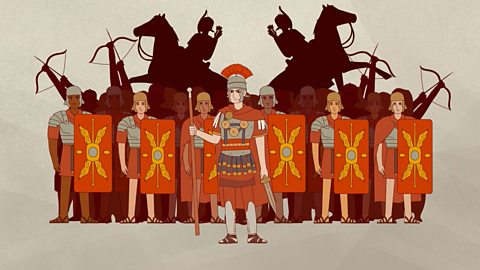
Exploring the formidable Roman army - its organisation, tactics, weapons and influence.
4. The Romans in Britain. video
Exploring the Roman invasion and settlement of Britain, including resistance by Boudica and the Iceni.