Exploring different jobs and careers in the Indian city of Bangalore - known as the Silicon Valley of India.
NARRATOR: Three 13-year-olds from the UK are on their way to explore the geography of India. Dua, Amalia and Nayan are on a ten hour flight to India, a country of one and a quarter billion people - twenty times the population of the UK. Nineteen hours after leaving London, Heathrow they’ve finally reached their destination. They’ve come half-way across the world and a huge adventure awaits them.
Bangalore is known as the Silicon Valley of India and is expanding rapidly. Young people from all over India flock here to make their fortune. Nayan, Dua and Amalia are each spending a day discovering what working life is like in this city. Amalia’s joining 32-year-old Neha in the morning rush hour.
AMALIA: It’s a lot of traffic.
NEHA: Yes. This is like the traffic time in Bangalore. Like in any city in India, this must be the traffic time. In an hour’s time I’m at the office but in the evenings it usually takes me around one and a half hours.
NARRATOR: Neha works as a public relations manager for one of India’s biggest multinational companies: Mahindra. Here in Bangalore, they assemble electric cars.
NEHA: So we are approaching an area called Koramangala. This is where I told you Forum Mall was, one of the biggest malls here. This was the first mall that came up in Bangalore and people just went gaga over it. [Humming a tune] Have you heard that song of Ed Sheeran?
That heart is so cold all over my…
AMALIA: Yeah.
NEHA: Really nice.
AMALIA: It was actually written … Do you know Ellie Goulding?
NEHA: Yeah, Ellie Goulding.
AMALIA: It was written about her.NEHA: Yeah?
NARRATOR: Nayan’s accompanying 28-year-old Suman, who designs computer games. Suman’s an entrepreneur who set up his own company two years ago. It sells games to India, Europe and the US.
SUMAN: So you never wanted to become an entrepreneur?
NAYAN: I didn’t really understand what to do … cause there’s risks like … what happens if your business fails?
SUMAN: This sort of risk in entrepreneurship … it’s always there. When I was as young as you I wanted to be a cricketer. Seriously, I wanted to be a cricketer. But then I realised I couldn’t, for various reasons. I was playing games. I used to like Mario and Age of Empires. So I grew up playing these kinds of games.
NARRATOR: Meanwhile, Dua’s on an industrial estate in the east of Bangalore where over 30 companies employ thousands of workers manufacturing chemicals, cars and plastics. She’s meeting 29-year-old Shiva who comes from a village 300 km away. Shiva spotted an opportunity to set up a shop selling snacks, tobacco and drinks to the local workers. Dua is able to communicate with Shiva in Hindi.
SHIVA: When I came here there was nobody here. There were no shops so I thought if I opened a shop here it would do very well. Considering the number of people coming to work every day there was the potential to make a lot of money. My sales used to be slow but now business is good. I used to make between two and five pounds a day. Now, I earn 30 to 40 pounds a day.
The workers have been coming to my shop for around five years. We know each other and they like my food. I also sell on credit, some people pay me on a monthly basis and I keep accounts in my notebook. At the end of the month, they make the payments to me.
DUA: What would you like to do in the future?
SHIVA: I’ve already built a house with my earnings. I don’t travel back to my house every day. I’ve taken a small room here and I pay £35 a month in rent.
SUMAN: Right now our prime focus is to reach a more global market. So basically the company development happens in India. And we have a few people in sales in the US. If you see 20 to 30 years back, in India entrepreneurship was not that great. This Indian mentality, it’s good but they all want their sons to be on the safer side. People were not ready to start something of their own. They always wanted to look for government jobs. But now slowly the trend is changing. That fear factor is gone now.
SHIVA: [Showing pictures on his phone] Let me show you the house I built with my earnings. This is my house in our village. This is my mum, she doesn’t live with me, but she lives in the village. I provide for everybody in my family, including my mum. Whatever they ask for, I provide for them. I’m not very educated. I know some Hindi. I can speak some Tamil, and Kannada and also some Malayalam. I can speak five languages … [Phone rings and he answers] Hello? Hi mum. Hi.
NARRATOR: The electric vehicles produced by Mahindra use innovative technology. Unlike traditional cars, they don’t emit carbon dioxide. The parts are all manufactured in other factories and bought in.
NEHA: Our plant is more like an assembly plant. This is the entire assembly line basically so all the parts come together here. This is your battery. So every time you press the brake the energy goes back into the battery so it charges itself.
AMALIA: So on a daily basis, what do you do? Like what do you do when you arrive at work?
NEHA: I take care of PR and communications so basically I’m the manager here. So everything that is related to talking to media, doing shoots with media.
AMALIA: How do you go about raising awareness?
NEHA: We take these customers from Mahindra e2o, and we talk about the story of how they saved on fuel, how they saved on not polluting the environment. So we take these stories to the media and we write about them to create more awareness so more people read it in the magazines read about it in the newspapers and then they go and buy.
DUA: You were telling me you had a sister who got married and you helped her?
SHIVA: Yes, my brother-in-law used to work with a company but I advised him to give up his job and I opened up a shop for him. They’re also now very happy after opening up their own store. They built their own house and are able to pay for their children to go to school.
DUA: Is your mother happy that you’ve done so well?
SHIVA: Yes, after I opened this shop my family were very proud of me. My mum’s very happy that I’m making a living, she’s got no worries. My family have no worries now.
DUA: If I walked past this store any day I would not think about how much business he does. He is such a busy man and the amount of customers he gets it’s just unbelievable. It’s not this poor country that doesn’t have much, it is full of opportunities, it is full of life, honestly.
AMALIA: The factory really surprised me because of how advanced the technology they were using was. It was really innovative and I didn’t expect that. I didn’t think that for a woman her age, like she’s still pretty young that she could have such a good job. She’s really successful and she’s still young and she’s a woman.
NAYAN: Well what I saw was a company that started with only three people and now has gone up to 60 in two years, that is a lot of people in two years! Think of it in ten years time, there could be 600 people and this company could go worldwide!
Video summary
Download/print a transcript of the video.
Three 13-year-old UK students are in the city of Bangalore (Bengaluru), India, to explore employment and career opportunities.
Bangalore is known as the Silicon Valley of India and it attracts young Indian people to seek work there. Amalia finds out about working for a multinational company making electric cars. Nayan meets an entrepreneur who has created an international company designing computer games. Dua meets a food stall holder, running his own successful small business. Each of the students reflects on their experiences and how they have been inspired by the success of their Indian hosts.
This clip is from the series Exploration India.
Teacher Notes
Pupils have an opportunity to explore the lives of three successful Indian workers in Bangalore.
They could consider the risks of setting up a business like Suman and Shiva.
Pupils could consider what infrastructure is needed to establish a secondary or tertiary industry in India such as communications, power and labour.
They could explore the interconnectedness of global trade.
Pupils could consider the significance of designing small, cheap and sustainable cars in a country developing as fast as India.
This clip will be relevant for teaching Geography at KS3 in England and Northern Ireland, 3rd Level in Scotland and Progression Step 4 in Wales.
Students and teachers over the age of 16 can create a free Financial Times account. For a Financial Times article about Bangalore's growing tech hub from 2022, click here, and from 2023 click here.
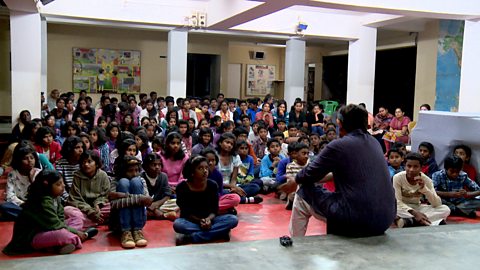
Education - building the India of tomorrow. video
Dua, Amalia and Nayan meet Indian children who have been given the opportunity for a different life through education.
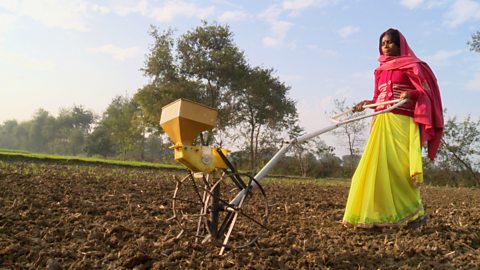
Rural life in India. video
Dua and Nayan explore rural life in India and learn that the majority of India’s population work in farming and agriculture in the countryside.
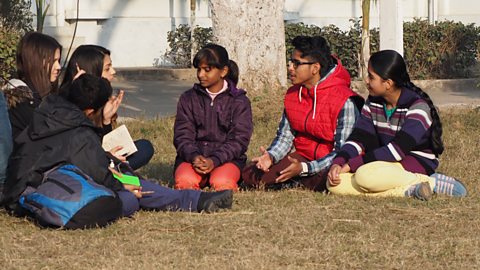
Introducing the physical and human geography of India. video
Dua, Amalia and Nayan begin their discovery of the geography of India, including its surface area. They visit Patna and Bangalore.
Rivers: The Ganges. video
Dua, Amalia and Nayan explore the River Ganges in India and discover its significance to both physical and human geography.

Urbanisation in India. video
Dua, and Amalia learn about the impact of migration to the Indian city of Bangalore (Bengaluru) and its rapid urbanisation.