Exploring the River Ganges in India and it's significance to both physical and human geography.
NARRATOR: Three thirteen-year-olds from the UK are on their way to explore the geography of India. Dua, Amalia and Nayan are on a ten hour flight through the night from London to New Delhi, the capital of India, a country of one and a quarter billion people - twenty times the population of the UK.
Nineteen hours after leaving London, Heathrow, they’ve finally reached their destination. They’ve come half way across the world and a huge adventure awaits them.
NAYAN: It starts in the Himalayas…
DUA: 2525 km long…
NARRATOR: Today Dua, Nayan and Amalia are planning a boat trip on the River Ganges.
AMALIA: Well, how many people does it help?
DUA: Yeah.
AMALIA: How many people live off it?
DUA: Yeah. Can also think about how the local people use it. So what is it most commonly used for?
NARRATOR: The team are in Patna, north-east India. Before starting their investigation they want to find out more about the river, known locally as The Ganga.
DUA: Can we see the whole map of India?
MAP SELLER: India? Yes, why not?
DUA: Thank you.
MAP SELLER: This is Ganga River … It comes from … you can see. Ganga River … it’s a blue line … here now … India’s longest, largest river. Passes through a lot of cities near Lucknow … like Haridwar. And after that it comes to Bihar and passes through Patna. We used to say that if you take a bath in this river … all bad things of yours will get washed out.
DUA: Where does the river end?
MAP SELLER: Huh?
DUA: Where does the river end? The Ganges.
MAP SELLER: It’s in the Bay of Bengal.
NARRATOR: The Ganges begins its two and half thousand kilometre journey in the Himalayas, travelling rapidly down the mountains to the flat plains of India. It’s one of the world’s biggest rivers, seven times longer than Britain’s longest river, The Severn. As the Ganges is joined by other rivers and tributaries it widens. Here in Patna it’s over four kilometres wide.
DUA: That is so big! Like I didn’t expect that. Which one’s the actual river? Because there’s like loads of little…
AMALIA: I think it’s the whole thing. So big. Like it goes all the way down there as well.
NAYAN: [Holding camera] I’m going to do a panorama shot of this.
NARRATOR: Rivers are a crucial part of the economy and life of India. The students are meeting local Ganges expert Dr Ravindra Sinha, whose been studying the river for 35 years.
NAYAN: What does the Ganges mean to you?
DR SINHA: The Ganges to me is everything. It is not only our mother, it is the lifeline of Indian civilisation. When a baby is born, some celebration is there and they need Ganges water. And at the time after death, the body is cremated on the bank of the Ganges. From birth to death, in India people are associated with the Ganges.
NARRATOR: Indians believe the Ganges is sacred and regard its water as holy. But it’s also essential for daily life.
NAYAN: Oi! Look there’s a lady there washing her clothes, I think.
DUA: Like there’s loads of people just getting water.
AMALIA: There’s a fisherman there…
DUA: Look at how much sewage water is coming out into the river Ganges.
NAYAN: And then it’s going into the river and damaging the dolphins.
DUA: And it’s right near the banks and that’s where the most polluted area is. OK so there’s actually people washing themselves. Are they burning dead bodies? They’re actually burning dead bodies here.
NAYAN: Are they?
DUA: Yeah. Do you think it might be cremation? The uses are completely different to what we do with the River Thames like we just use it to like visit it really. There’s more boats and stuff but here people really have like a…
AMALIA: This is like a daily…
DUA: …religious…
AMALIA: …like a daily need kind of thing.
DUA: …kind of attachment to it.
DR SINHA: The Ganga created a vast floodplain which attracted people to settle here because they got very fertile soil to produce food. People are growing food to eat and there is no starvation. People are poor but they still have enough food to eat.
NAYAN: If people … like care for the river and respect it why do they … like … dump their sewage waste and rubbish inside it.
DR SINHA: That’s a paradox, a great paradox, that on the one hand we treat mother Ganges as a deity or as a god or goddess like that. On the other hand we pollute it. It’s a paradox. The source of pollution of Ganga in Patna is mainly the domestic sewage. There is no industry so there’s not much industrial pollution. But yes, from the agricultural field we get some pesticides and fertilisers.
AMALIA: Since you’ve been … like … on this river, have you spotted any changes?
BOAT CAPTAIN: The river keeps changing every year. The water channels are never the same. Today we’re going this way, tomorrow we may have to go a different route. So it keeps changing.
NARRATOR: As the Ganges flows across the plains of northern India, it slows and starts to meander, changing its direction. During the monsoon rainy season, flooding can stretch the river to 15km wide, depositing rich sediments, known as silt, which have been picked up along the way. This makes the land extremely fertile.
AMALIA: Is silting an issue?
FISHERMAN: Here in the Ganges the riverbed’s very fragile. It’s gradually eroding and the silt is constantly moving around. The riverbanks are also wearing away, they’re not permanent and silt continues to build up. When we discover that the water levels are low, we dredge the river so boats can continue to use it.
NAYAN: [Looking at the supports for the bridge] Dua, look at them!
DUA: Oh, my goodness!
AMALIA: It’s literally massive.
NAYAN: Yeah.
AMALIA: And look where it started all the way down there.
NAYAN: You can’t even see where it started.
DUA: Yeah, it’s too far.
NAYAN: Despite the end of it.
Does the bridge and man-made objects affect the river?
DR SINHA: Yes, any interference with the river by human beings has some effect. But at the same time, we need development. We need infrastructure. We need railways and roadways to cross the river. But a bridge is not as dangerous as a barrage or a dam.
NARRATOR: There are more than forty dams and barrages along the Ganges and its tributaries, that help to supply water and electricity to 500 million people. However, these structures affect the river and its wildlife. Dr Sinha, has been working to save an unusual mammal that lives in the Ganges: the blind river dolphin.
DR SINHA: Actually there used to be plenty of dolphins because the river had more water… Clean water, more meanderings, more sandbars and more complexities which the dolphins needs.
So today we’re interfering with the river by constructing dams and barrages which create a physical barrier for the dolphin. They can’t move through that barrage or dam. So habitat degradation and loss of habitat has resulted in the extinction of the dolphin from some areas of the river.
DUA: I saw one! I saw one!
NAYAN: The Ganges affects like the whole of northern India. Without the Ganges, India might have been … like … a really barren landscape and it would have just been a desert. The Ganges almost seems living because, despite all of the rubbish, people still respect it and the Ganges keeps providing for the people.
DUA: The rivers explain so much about India … like … just the size of the river explains how big India is. And just the way India uses the rivers explains how they are as a country.
Video summary
Download/print a transcript of the video.
Three 13-year-old UK students explore the River Ganges in India.
They are in Patna, which is located on the middle course of the river where the Ganges is over 4km wide. The Ganges is one of the world’s biggest rivers, and seven times the size of the river Severn, the UK's longest river. They discover that the source of the Ganges is in the Himalayas and the deltas of the Ganges, as it reaches the Indian Ocean, are in Bangladesh.
They meet a local scientist as they travel along the river, and discuss how the river is deemed sacred to Hindus and a lifeline to local people who use the river to irrigate their crops, to wash and to travel, yet it is heavily polluted. The pollution affects the river dolphin population.
The pupils discover that the course of the river changes as it slows and it deposits sediment, which affects the navigation of boats. This sediment helps provide the farmers with rich, fertile soil when the river floods during the monsoon.
This clip is from the series Exploration India.
Teacher Notes
The exploration of the river Ganges is an opportunity to see how humans depend on rivers but also pollute them.
The Ganges is one of the world’s largest rivers and comparative discharge, length and drainage area could be investigated.
How the river is considered sacred to Hindus, who bathe in its waters which are considered pure, could be studied alongside the demands on the river which mean it is actually heavily polluted.
The plight of the blind river dolphin can be explored in relation to this.
Patna is in the middle course of the river, and deposition of fluvial sediment is occurring here as the river slows.
The implications of the river becoming shallower for navigating boats can be seen.
This clip will be relevant for teaching Geography at KS3 in England and Northern Ireland, 3rd Level in Scotland and Progression Step 4 in Wales.
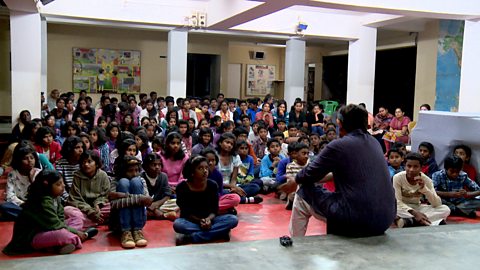
Education - building the India of tomorrow. video
Dua, Amalia and Nayan meet Indian children who have been given the opportunity for a different life through education.
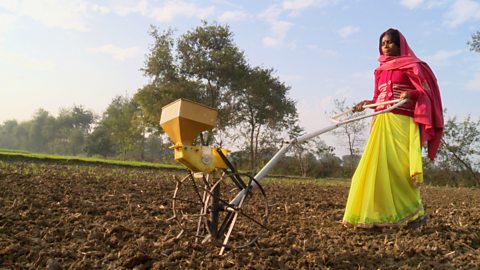
Rural life in India. video
Dua and Nayan explore rural life in India and learn that the majority of India’s population work in farming and agriculture in the countryside.
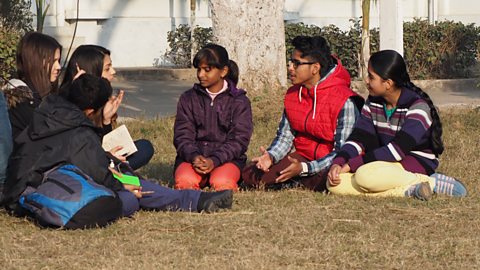
Introducing the physical and human geography of India. video
Dua, Amalia and Nayan begin their discovery of the geography of India, including its surface area. They visit Patna and Bangalore.
Urbanisation in India. video
Dua, and Amalia learn about the impact of migration to the Indian city of Bangalore (Bengaluru) and its rapid urbanisation.
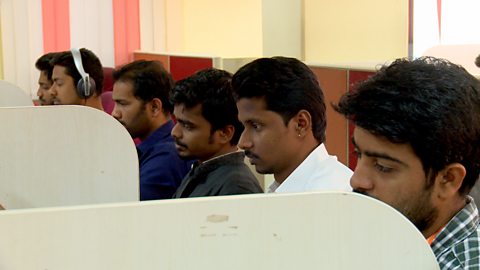
Working life and employment in Indian cities. video
Dua, Amalia and Nayan explore urban life in Bangalore, India - a city that attracts young Indians seeking work and careers.