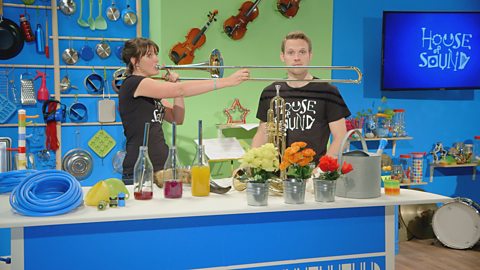
A Short Ride In A Fast Machine by John Adams
GREG FOOT: This piece of music it's called "A Short Ride In A Fast Machine." "Fran what does it make you think of?"
FRAN SCOTT: It makes me think that I'm goingon a short ride in a fast machine.
"Yes that's exactlywhy it's called that!" It was written by someonecalled John Adams.
"Fran why are you making holesin a carrot?"
Because we're going to usethese to discover how woodwind instrumentslike these work.
What's a carrot got to do withwoodwind instruments?
You will see.
"I'm not sure what thiscarrot business is all about but this definitelyisn't a carrot obviously." "It's a clarinet which belongs tothe family of woodwind instruments."
LOW NOTE
Nice! And this is a recorder and it also belongsto the woodwind family.
HIGH-PITCHED NOTE
Lovely but the clarinet winsevery single time. "You know simple woodwindinstruments were first played as far back as 20000 years ago and these Chinese woodwindinstruments are about 1000 years old and as you'll see Fran they are not carrots either."
The clarinet and the recorder makemusical sounds in different ways. When Fran blows into her recorder the air is forced through a narrowpassage called the windway and hits something called the labium. Watch what's happeningin slow motion. The stream of airis flicking back and forth. One moment the air is abovethe labium the next it's below it. This movement which is actuallyhappening really quickly makes the air insidethe recorder vibrate.This is what makessound waves that we can hear. And the Irish whistle that works in a similar way.
HIGH-PITCHED NOTE
Beautiful!
A clarinet is calleda reed instrument. That's because it has got somethingcalled a reed attached to the mouthpiece and they're called reeds because they used to be madefrom plants called reeds. Today a reed isa very thin piece of material that vibrates against the mouthpiecewhen you blow over it. This vibration makes the airinside the clarinet vibrate too. That creates sound wavesand the notes that you hear.
"OK so that's how a clarinetand a recorder make a single sound. "The question is how do we make themplay lots of different notes?"
It all depends on how much airin the instrument is vibrating and we can demonstratehow this works with just some everydaydrinking straws.
Thanks.
"So Greg here's yours." And what you need to do is pinchthe end to make a mouthpiece then you cut the corners off to make it into a point. Now if you do this at home do be careful with the scissors.
Yup.
Have you done it? Now all you've got to do is blow.
THEY PLAY VIBRATING NOTES
"Good good!" "Now cut a little bit off the endof the straw and try it again."
HIGHER AND SHORTER NOTES
Now because we've cut a bit off that means the straw is shorterand so there's less air inside it and because there's less airvibrating the note has gone higher. It has what we call a higher pitch.
"OK yeah." "Now cut a little bit more." And then play it.
HIGHER-PITCHED NOTES
And it's got a higher pitch still! "Now watch this."
NOTES BECOME HIGHER-PITCHED
HE LAUGHS
Love it!
Right so all I have to doto make my clarinet play a higher noteis… cut it in half.
Be funny though.
"Uh no"
It might be but it would alsoruin your clarinet.
OK.
Woodwind instruments havea series of holes along the tube. We can change the amount of airthat's vibrating inside by covering the holes up so if we cover all the holesin a recorder that means there's a lot of air vibratingin the tube because it can't escapethrough the holes and the result is a notewith a low pitch. If I cover up just one hole that means the air can escape and so less air vibrates and thismakes a note with a higher pitch.
"Right I've got it."
Your clarinet has holes in it too but it works a bit different because you use keysto cover them up.
Exactly.
HE PLAYS TUNE
Show-off!
Right you might thinkthat all woodwind instruments are made of wood but they're not. Saxophones are made of metaland recorders can be plastic. In fact you can makewoodwind instruments out of all sorts of things even a carrot.
Ah finally! I was wonderingwhen the carrot would crop up! All you have to doto make a woodwind instrument is make somethingwith a space inside that is full of airthat can vibrate. So to make my musical carrot I've hollowed out its centre… like that… and just made a series of holesin a row. Right. These little holes line upwith the big hole that's down the middle and you might need a grown-upto help you with that bit. Next you take half a pepperand stick it on one end and a mouthpieceand stick it on the other.
This is getting even more bonkers.
And there you haveone complete musical carrot.
MUFFLED NOTE HE LAUGHS
It's really cool! It works though doesn't it?
HeyFran here's something interesting. Around 4 000 years ago if you were a shepherd knocking aboutin Ancient Greece minding your flock you could pass the timeby playing your panpipes.
HE PLAYS SCALE
"Greg I just don't knowwhat to do with you!" But what we can do is we… We can make our own instrument out of a balloonand a cardboard tube. I've called it a balloon clarinet. And to make your ownballoon clarinet you need - a balloon obviously. And you chop offthe big end of the balloon and secure the small end toa little bit of plastic piping. Get a grown-up to help youif you need. And then with this open part here youattach this onto a cardboard tube. And you've got to secure itin place with an elastic band just like this. And then… You can takethat one Greg.
OK.
I'll take this one. And to play it you simply…blow.
LOW-PITCHED NOTES
"It's brilliant isn't it?" And what's happening hereis the balloon is acting like the reed that you sawon Greg's clarinet. And here you can actually seethe vibrations as you play it. Look! They sound a bitlike car horns don't they?
They do which means they'llbe great instruments to join in with A Short Ride In A Fast Machine.
"Oh I see what you've done there.Yeah let's go."
A Short Ride In A Fast Machine by John Adams
THEY TOOT ALONG WITH THE MUSIC
HE TOOTS CRESCENDO
Video summary
In their House of Sound, Greg Foot and Fran Scott explain how woodwind instruments work and how they make all sorts of different sounds.
They find out that lots of woodwind instruments are not even made of wood, and to prove the point Fran makes a woodwind instrument out of a carrot simply by making a few holes in it.
Greg and Fran demonstrate that the pitch of a woodwind note depends on the amount of air that is vibrating inside the instrument.
To prove this, they conduct a fun experiment in which they make simple flutes out of drinking straws and make them play higher notes just by cutting bits off to make them shorter.
Greg uses 3D animation to explain that on a clarinet and a recorder, musicians use their fingers to cover up holes in the instruments to change how much air is inside.
Cover up just one hole and less air can vibrate which makes a high note.
Cover them all up and more air vibrates making a lower note.
Fran demonstrates how anyone can make a balloon clarinet out of a piece of cardboard tube, a balloon and an elastic band.
This clip is from the series House of Sound.
Teacher Notes
The drinking straw demonstration in this clip is a great way of explaining the link between the amount of air in an instrument and its pitch.
By following the instructions in the clip, either as individuals or in groups, pupils could make the ‘balloon clarinet’ which is a surprisingly effective musical instrument.
If children have access to recorders, this is also an ideal opportunity for them to understand how they make a sound and why that sound changes when their fingers cover up the holes.
This clip will be relevant for teaching Science or Music in primary schools at Key Stage Two or Second Level (Scotland).
What is sound? video
In their House of Sound, Fran Scott and Greg Foot explore the science of sound waves through a series of fun experiments.
How drums make sound. video
Fran Scott and Greg Foot explore the science of percussion sound through a series of fun experiments and show you how to make your own drum kit.
How string instruments make sound. video
Fran Scott and Greg Foot explore string instruments and how they work.

How brass instruments make sound. video
Greg Foot and Fran Scott explore how brass instruments make sound.