FRAN SCOTT: I love this piece. In fact I think it was the first bitof classical music that I ever heard.
GREG FOOT: Ah yes Beethoven's Fifth Symphony. It's got the best startto any piece of music ever.
That's brilliant!
Dum-dum-dum-DUM!
But it's also the string instruments.This piece uses them so well. They just bring real feelingto a piece of music. But they play such differentsounds as well.
"You know what Fran?" I think it's about time we hada proper look at the string section.
Let's do it.
OK so this might be a piano but its actually also a string instrument. If we look inside you can see that there are stringsof different lengths and thicknesses. At this end the strings are really thick and as we go along the strings get thinner and thinner.
PIANO NOTE PLAYS
When you press a piano key…a small hammer hits oneof the strings making it vibrate. As it vibrates it movesthe air particles around it which vibrates the ones next to themand the ones next to them.
You've formed a sound wave. When that sound wave reachesyour ear you hear a note.
HE PLAYS OPENING NOTESOF BEETHOVEN'S FIFTH
And the note you hear depends onthe string that's been hit. You can see here the hammer is hitting really thick strings.
LOW NOTES BOOM
And so it makes notesthat have a low pitch.
LOW NOTES BOOM
But if Greg presseskeys at this end…
HIGH NOTES TINKLE
…the hammer hits thin stringsand they make high-pitched notes.
HIGH NOTES TINKLE
So that is a pianoand you play a piano with keys. But what about otherstring instruments?
A guitar works by either pluckingthe strings like this… or strumming them like this.
Lovely. Just like this sitar. The sitar which is popularin Indian classical music has a lot of strings. The exact number variesfrom instrument to instrument and musician to musician. This one has six on topand nine on the bottom and you play ita little bit like this.
SITAR TWANGS
That's good! Good facewhile you're playing as well.
And then there's the cello whichcan be plucked like the guitar…or it can be played by rubbinga bow against the strings like this."
TUNELESS DRONE
Ah that's some beautifulplaying Fran(!)
"But the thing is we can'tactually see what's going on because it's all happening too fast so let's use oursuper slow-mo camera and have a look at thosevibrations in action.
FRAN: The cello is sort ofthe violin's big brother and you can see that the stringis moving from side to side. It's actually vibratingreally really quickly and what it's doing is making the airparticles close to it vibrate too making those sound waves. Different types of stringbehave in different ways. The thickness of a stringis really important. Thin strings vibrate quickly. This means they makea note with a high pitch. And thick strings vibrate more slowly and they make a lower-pitched note just like we saw on the piano. The length of a stringis very important too. This is my mini harp. It's a string instrumentand it goes from long strings right down to short strings just like the piano. Long strings containmore stuff more matter than shorter strings and the morestuff something is made of the longer it takesto speed up and slow down so long strings vibrate moreslowly than short strings. If I choose two strings the samethickness but different lengths so these two here let's havea listen. This is the longer one.
LOWER NOTE
And this is the shorter one.
HIGHER NOTE
The shorter one makes a slightlyhigher-pitched note.
"Ah but also the tighter the stringis the higher the note it makes." So on this violin if I pluck this string then listen to the sound it makes.
LOWER NOTE
But if I turn this pegto tighten the string the pitch should gohigher and higher like this…
NOTE GETS HIGHER
PITCH GETS HIGHER
So the pitch of a note dependson three different things - "the thickness of the string itslength and how tightly it's pulled."
"Thickness length of string and how tight it is?" Got it.
But I do want to show you this. Take this stretchy cord stretch itnice and tight and twang it.
DULL MUTED TWANG
"It doesn't really make muchof a musical instrument does it?" Although it does make a sound it's just not loud enough. Now what we need to do is finda way of making the sound louder.
"Yes we need to amplify it."
"Right are you sitting comfortably?" I'll begin. To make a violin we needsomething called a sound box. It's often the largest partof a string instrument and it's made of a materialthat vibrates easily. The sound box of a violinis made from wood and the key thing isthe box contains air that can vibrate tooand amplify the sound. A small wooden piece called a bridgesits on top of the sound box. Next comes the finger board which is where a violinist's fingerspress down on the strings which go from the sound box over the bridg "and up the finger board where they're connected to the pegs. When you run a bow over a string the string vibrates the bridge vibrates the sound box vibrates the air in the sound box vibrates all of which makes largerand more powerful sound waves that are much easier to hear.
"And remember larger vibrationsmake louder sounds."
Lots of things can beused as sound boxes. We've made this double bassfrom a metal bin a piece of wood and some bungee cord.
"The bin's been carefully cleanedand everything's been emptied out so there's no rubbish left…inside."
Greg I thought you'd thrown him out!
CRASHING
Sorry!
FRAN: Where was I?
SHOUTING FROM DISTANCE: Careful!
We've got our bungee cords which are stretched acrossthe opening of our sound box and I've got this wooden spatulahere which is acting as a bridge and we've got threedifferent strings. They're the same thicknessand the same length but the bottom one isn't very tight the middle one isa little bit tighter and the top oneis even tighter still so each one of themwill make a different note like this…
TWANGS INCREASE IN PITCH
Perfect. Now as we saw on the harp long strings make lower notesthan short strings. We use that idea to playinstruments like the violin and the guitar. We use our fingersto press down on the strings to make them longer or shorter. So let's have a look -
LOWER PITCH
this is long… As it gets shorter…
PITCH INCREASES
This is called stopping the string.
Now as we've seen one ofthe best ways of finding out how string instruments workis just to make your own and this is how to makeyour very own guitar.
Great!
What you need is a cardboard box and you just cut a holein the top of it like this… Then thank you! You getsome elastic bands cut them and thread them through onto one sideof your hole and tie a knot so they keep in placeand finally - nice work! Thread them through tothe other side of the hole and then put some plastic or woodtubes there to act as your bridge and make sure they're nice and tight. Put a cardboard tube on the end tomake your neck and there you have it a completed home-made guitar.
Oh yeah!
You could even makea guitar-shaped template so it looks even more like a guitar.
Now I think we should put ourhome-made guitars to the test with another blastof the Fifth Symphony.
He-he! Roll over Beethoven!
Video summary
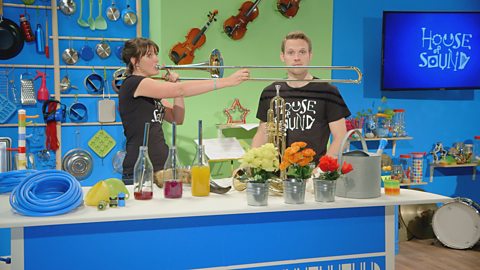
Inspired by Beethoven's 5th Symphony, Fran Scott and Greg Foot set about finding out all about string instruments and how they work and make such different sounds.
They look inside a piano and see long, thick strings that make low notes, and short, thin strings that make high notes.
Using a slow motion camera, they film the strings of a cello vibrating and point out that thick strings vibrate more slowly than thin ones and that this explains the difference in their pitch.
Thick strings give a low pitch, thin strings give a high pitch. The tightness or tension of a string is also important.
The tighter the string, the higher the pitch. The less tight a string, the lower the pitch.
Using 3D animation, Greg explains how the sound a string makes is amplified by an instrument like the violin.
Fran shows us how it is easy to make a guitar out of an old cardboard box and some elastic bands.
This clips is from the series House of Sound.
Teacher Notes
Elastic bands are a great way for children to see how length, thickness and tension of strings are responsible for the notes that are made.
These can then be used to make the guitar described in the clip.
By bringing a violin into the classroom, teachers can talk through how the string vibrates, the bridge vibrates, the sound box vibrates and the air in and around the sound box vibrates, forming sound waves.
Pupils can also learn how the violinist’s fingers are used to ‘stop’ the strings and make them longer or shorter.
This clip will be relevant for teaching Science or Music in primary schools at Key Stage Two or Second Level (Scotland).
What is sound? video
In their House of Sound, Fran Scott and Greg Foot explore the science of sound waves through a series of fun experiments.

How drums make sound. video
Fran Scott and Greg Foot explore the science of percussion sound through a series of fun experiments and show you how to make your own drum kit.

How woodwind instruments make sound. video
Greg Foot and Fran Scott explain how woodwind instruments work and how they make all sorts of different sounds.

How brass instruments make sound. video
Greg Foot and Fran Scott explore how brass instruments make sound.