MUSIC: Mars The Bringer of Warby Gustav Holst
THEY DRUM ALONG WITH MUSIC
GREG FOOT: This music is all aboutthe planet Mars and it was composed by a mancalled Gustav Holst.
FRAN SCOTT: Ah but did you know that Marswas also the Roman god of war?" "Oh that's why it makes me think ofsoldiers marching into battle." Do you know whatit makes me think of? What?
FRAN: That we should actually explain how these drums work. Good idea. Drums have been aroundfor a long long time and they were often used in war. A drum has been foundby archaeologists "in a place called Moravia in Europe" and it turned outto be 8000 years old. Whoa!
But drums are prettysimple instruments. "They're calledpercussion instruments" and percussion just meansone thing hitting another.
Thank you!
"And so to play a drum all you need to do is hit it."
HE PLAYS DRUMS
Thanks.
"That is beautiful Greg."
As well as the drum other percussion instrumentsinclude the triangle.
TINKLING
Thank you.
The tambourine.
TAMBOURINE JINGLES
Thank you.
And the cymbals.
Are you sure? OK. Oh… Yes.
CYMBALS CRASH
That's pretty loud.
"Drums come in all shapes and sizes" but basically each of themis a hollow body "which has a skin over the top" and the skin is stretchedvery very tight. When you bang a drum the skin vibrates. The vibration of the drummakes the air particles inside and around the drum vibrate too and this forms sound waves. The sound waves travel outin all directions and if they reach your ears that means you'll hear the soundof the drum.
"Right so we have got this drumhere and let's imagine that this confetti are the tinyparticles that make up air the air molecules. Right?
And watch what happenswhen I hit the drum.
Thank you.
Whoa! That's good.
"That is awesome that is cool."
So when the skin of the drumvibrates it makes the air molecules the confetti also vibrateand bounce into the air.
I think we're goingto see this much better if we use my super-slow-mo camera.
"OK go."
So there's the hit. It sets the drum skin vibrating it chucks that musical confettiinto the air just like the air moleculesare vibrating above the drum skin. And you can still seethe skin vibrating.
"Looks amazing! It is awesome it's brilliant!"
"So sound waves are invisible" but another way of imagininghow they work is to use this bowl of waterand a tuning fork. Tuning forks are usedby musicians to make sure "that their instruments are playingthe right notes" and they work bysimply…banging them and then they play a certain note.
TUNING FORK VIBRATES
Oh nice!
This one plays the note E. Which means that I can tunethe E string of my guitar.
Go on. Let's do it.
TUNING FORK VIBRATESHE TUNES GUITAR
That's it. Are you there?
Now if I bang this tuning forkagain but this time put it into this bowl of water watch what happens.
NO SOUND
Whoa so let's use our super-slo-mocamera and get a closer look.
"Oh in super-slo-mo you cansee that the tuning fork wobbles." It's those vibrationsthat make the sound waves and it's the same vibrationsthat get the water all excited too.
"And it's quite a good way justto spread water everywhere"
"It is isn't it?" to be honest with you.
Now you may not realise it but you actually haveone of these…inside here. "Yes inside your ear issomething called your eardrum." It's like a drum because thereis a thin piece of skin-like tissue stretched tight across the opening between your outer ear canaland your middle ear. "When the sound waves hit youreardrum they make it vibrate" just like when Fran hitthe skin of her drum earlier. The middle ear and theinner ear convert those vibrations into signals that our brainsinterpret as sounds.
"Now excuse me big drums havea lot of air inside them and when a drum has a lot of airto vibrate it makes a low sound."
LOW-PITCHED NOISE
It has what we'd call a low pitch.
This little drumhas less air inside it and when you have less airto vibrate you get a sound with a high pitch.
HIGH-PITCHED NOISE
Nice!
But you can also change the sounda drum makes in other ways too. So this drum has a skin which youcan make tighter or slacker by turning these handles.
"So at the moment the drum sounds like this."
LOW-PITCHED SOUND
"And if we tighten the skin it sounds like this."
HIGHER AND LOUDER CRASH
"Higher. You can even tightenthe skin as you're playing it as well to change the pitch."
SOUND GETS LOUDER
"The other thing that's interestingis that the harder you hit the skin the larger the vibrationsand the louder the sound.
But the lighter you hit the skin the smaller the vibrations and the quieter the sound. And that is what we call…
BOTH SHOUT: VOLUME!
There are lots of differenttypes of drums and drum sounds. You can play just one drum like…
SHE PLAYS MARCHING DRUM
…like a marching drum.
"Thanks that's enough."
No!
"Thanks that's great cheers thank you."
Or you can…
SHE BANGS DRUM
"Or you can put lots of differentdrums together to make a drum kit and that is exactly whatwe're going to do right now in - "a one two three four."
Yes! Done! Look at that. Now what we've got here is downhere we've got a cardboard box which is like our bass drumwhich we can hit like that. "This is my favourite bit brilliant." It's cool.
We've got a beautiful cymbalright here.
Now these these are the drumsand this one this one's got a little bit of Greg's spare changeon it so that's our snare drum. Nice sound.
"And to finish off we have our big bin drum."
Now actually there'sone more thing we need an old oil can that've scrubbed clean."Now I think we are ready to rock."
RHYTHMIC THUMPING
The largest drum ever made isa South Korean CheonGo drum. It's five and a half metres wide… It's five and a half metres wide six metres tall…thank you!And weighs 7000 kilograms. That is heavier thanan African elephant.
ELEPHANT TRUMPETS
However if you want to make drumsthat are simple and easy to make fun to play and cost hardly anything then we are going to show you how. What you need is a plastic cup elastic band a balloonand some scissors. Now be careful with the scissors. And what you do isyou take the balloon and you simply just snip offthe neck of the balloon like that. Then you just needto place it over your cup and it's really importantto stretch it completely with no lumps and bumps in. Then you take the elastic bandand tighten it up.
Sure.
Can you help me with this Greg?
One. Two.
Can you just put it over?
And there you go.That is your drum made.
"Greg can you just pass methat kitchen mallet? Thank you."
Works well. And you just hit it. You can make other types ofpercussion instruments as well by adding rice or I've got somepopcorn here that hasn't been popped yet. You can just put thatinside the bottom of our cup and…
RATTLING NOISE
"Ah it makes maracas!I like that." "That's pretty cool isn't it?"
Pretty cool but I've got to say I think my home-made drum kitwins this one.
"Take it away Mr Holst." Let's go to Mars.
"MUSIC: Mars The Bringer Of Warby Gustav Holst"
LOUD DRUMMING
Video summary
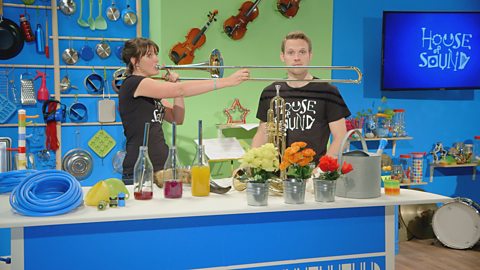
In their House of Sound, Fran Scott and Greg Foot investigate how drums work.
Drums have been around for thousands of years and throughout history have often been involved in warfare -something they are reminded of as they play along to Mars from Holst’s The Planets suite.
Using confetti placed on a drum they use a slow motion camera to reveal how the confetti behaves like air molecules when the drum is struck.
The skin of the drum vibrates and makes the confetti dance.
As the air molecules vibrate against each other, sound waves are formed and the sound of the drums can be heard.
Fran explains that the pitch of a drum depends on how tight its skin is. If the skin is tight the drum makes a high note, if it is slack it makes a low note.
Greg points out the amount of air inside a drum also influences its pitch. The more air in a drum, the lower the note. The less air in a drum, the higher the note.
Volume depends on the size of the vibrations that are made.
Hit a drum hard and this makes big vibrations and a loud sound.
Hit a drum softly and the vibrations are smaller and the sound not as loud.
Together they make a drum kit out of things that can be found around the house, and Fran shows us how to make fun drums out of a plastic bowl and half a balloon.
This clip is from the series House of Sound.
Teacher Notes
Using everyday objects like pans and tins, pupils can experiment with pitch, discovering for themselves how big objects make lower sounds than small objects.
They can make their own simple drums and percussion instruments by following the instructions given in the clip.
Working in teams they could also assemble drum kits, understanding how different sounds are made by the instruments and how they all work together.
This clip will be relevant for teaching Science or Music in primary schools at Key Stage Two or Second Level (Scotland).
What is sound? video
In their House of Sound, Fran Scott and Greg Foot explore the science of sound waves through a series of fun experiments.
How woodwind instruments make sound. video
Greg Foot and Fran Scott explain how woodwind instruments work and how they make all sorts of different sounds.

How string instruments make sound. video
Fran Scott and Greg Foot explore string instruments and how they work.

How brass instruments make sound. video
Greg Foot and Fran Scott explore how brass instruments make sound.