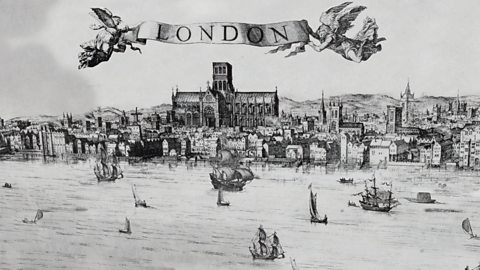
DR IAN MORTIMER:Imagine everything that's ever happened. The whole of history.
NEIL ARMSTRONG:'One small step for man.'
DR IAN MORTIMER:Imagine you could go to any place, any time, and see what the people then saw, understand what they thought, and appreciate what they felt. So much of what we know now goes directly back to England's golden age, the reign of Queen Elizabeth the First. 'Who wouldn't want to travel back in time and see it first-hand.'
DR IAN MORTIMER:'Elizabethan England is dominated by the rich and powerful. But this is a world enjoyed by a privileged few. For most people, life is very different. In the countryside, many people are poor and they face great hardship.'
DR IAN MORTIMER:'You've arrived in England in 1558.'
DR IAN MORTIMER:'Elizabeth has just been crowned Queen. It's very unlikely you'll land in a castle or a rich man's house. You're much more likely to find yourself somewhere like this. An open heath, in this case Hothfield, in Kent. About a quarter of England is like this, wild moors, heaths, hills and wasteland.'
DR IAN MORTIMER:'Today we might describe Hothfield as quiet and scenic. To the Elizabethans, however, it is anything but.' The heaths, woods and moorlands are dangerous places. There are no roads across them, only trackways and muddy paths. Elizabethan people see them as horrific, anything but beautiful.
DR IAN MORTIMER:'Given that this is what the locals think of such places, I suggest you find shelter, and quickly.'
DR IAN MORTIMER:'Dotted around the countryside you'll find small thatched cottages, some already hundreds of years old. And when you first spot one, don't have any ideas that life in the countryside is pleasant. The family you'll meet here is very poor indeed. It's not unusual to find as many as seven or eight people living in a house like this.'
DR IAN MORTIMER:Imagine you've come to stay with one of your ancestors in the 1560s, and you're going to stay here. Well the thing that will strike you most is that it is dark. Very dark. You can't just turn on a light in a house like this. In fact, it's very unlikely you'll see colours indoors at all. It's just too dark.
DR IAN MORTIMER:You'll go to sleep in darkness and you'll wake in darkness. 'Inside, you'll find it's very basic. Just one room with an earth floor. In the middle you'll see a fire, permanently lit. But what will really hit you is the thick smoke filling the whole room. To prevent you suffocating, they've made an opening in the roof.'
DR IAN MORTIMER:'And the windows are no more than just holes in the wall.' Because the windows are unglazed, covered only by a shutter, they let in the cold. So they're small, to retain as much heat as possible. Even in the summer months, very little light is going to enter your home. 'Candles, you might think, are the obvious answer.'
DR IAN MORTIMER:'Today, we just take them for granted. But in Elizabethan times, candles are expensive, and a poor family simply can't afford lots of light. This family's only possessions are a few pots, some spoons and ladles, a basket and a bench. You'll find yourself sleeping on the floor,'
DR IAN MORTIMER:'or if you're lucky, on one of their thin straw mattresses.' In this world of darkness, you won't just see differently, you'll listen differently too. You pay attention to the things you hear. The small sounds of the house. The crackling of the fire. The sighing of a child in the cradle. The raindrops on the roof.
DR IAN MORTIMER:'It's also important to understand that Elizabethan society is strictly divided according to the class into which you are born. It's explained in this book from 1577, A Description of England, by a clergyman called William Harrison. Harrison describes the ordinary sort of people that you'll meet on the road or in a village alehouse.'
2000:06:13:07 00:06:21:00DR IAN MORTIMER:'Most country men fall into one of three categories, a yeoman might own or rent his farm, and employs workers.'
DR IAN MORTIMER:'A husbandman rents the land that he works on.'
DR IAN MORTIMER:'Labourers simply work on other people's farms.'
DR IAN MORTIMER:'A dark, smoke-filled house is one reason why these people spent the whole day out of doors. As an unknown poor person looking for work in the countryside, your options are extremely limited. Your best bet is to go from farm to farm offering your services as a labourer.'
DR IAN MORTIMER:'If you ask around among the local yeomen and husbandmen, you might find someone who will employ you on a casual basis, and allow you to sleep in a barn. But be prepared for a hard slog.' The working day starts at dawn and continues until sunset. And if you're employed as a labourer, what's your reward for this hard day's toil?
DR IAN MORTIMER:Just a groat.
DR IAN MORTIMER:'You may be disappointed to see that your first day's pay is a thin coin roughly the same size as a modern 20p piece. Made of pure silver,'
DR IAN MORTIMER:'the groat has been part of the English currency since Mediaeval times.'
DR IAN MORTIMER:'You'll also hear it referred to as fourpence.'
DR IAN MORTIMER:'What does this sum really mean? There's no easy way of comparing the value of Elizabethan money to the money we use today.' When a labourer earns fourpence a day,
DR IAN MORTIMER:a chicken costs fourpence a day, and a lemon threepence.
DR IAN MORTIMER:If chickens were as valuable to us in the 21st Century as they are to people in the 16th,
DR IAN MORTIMER:they would cost about £100 each, and a single lemon would cost £75.
DR IAN MORTIMER:'So lemon chicken is off the menu. But what can you buy on wages of fourpence a day? A loaf of bread and a small amount of butter and cheese every day. Four small pieces of meat and three pieces of fish per week. And some ale to drink. Ale, because water's polluted.' It all adds up to about 6,000 calories per day,
DR IAN MORTIMER:which is enough for a working man and his wife,
DR IAN MORTIMER:but it leaves nothing for firewood, nothing for rent, nothing for clothing, and nothing for the children. Unless you grow vegetables in your garden and make your own clothes and forego some of that food for rent, you won't be able to raise a family. 'Lots of ordinary things like getting married and having children'
DR IAN MORTIMER:'may not be possible if you can't afford enough food. Life for the poor in the Elizabethan countryside is a real struggle to survive.'
Video summary
Through a journey back in time, we discover that for many Elizabethans living in the countryside life could be very harsh.
Ian Mortimer visits a reconstructed Elizabethan thatched cottage to experience the living conditions for himself.
Inside it is very basic and its inhabitants would have had few possessions.
Society was strictly divided by class, and these people were among the poorest.
They would have earned a meagre living by labouring on nearby farms.
Without growing some of their own food and making their own clothes, life would have been a real struggle for survival.
This short film is from the BBC series, Time Traveller's Guide to Elizabethan England.
Teacher Notes
This short film could be used as a starting point for pupils to do further research into what life was like in Elizabethan rural England.
This short film is suitable for teaching history at Key Stage 3 in England, Wales and Northern Ireland and at Level 3 in Scotland.
To what extent was life changing in Elizabethan England? video
Ian Mortimer takes a journey back in time to find out how life was changing in Elizabethan England.
What was life like in the court of Elizabeth I? video
Historian Ian Mortimer takes a journey back in time to find out what life was really like in the court of Elizabeth I.
What was life like for the poor in the towns of Elizabethan England? video
Historian Dr Ian Mortimer takes a journey back in time to find out what life was really like for the poor in the towns and cities of Elizabethan England.
Who were the rich in Elizabethan England? video
Ian Mortimer takes a journey back in time to find out who were the rich in Elizabethan England.
Why was London the centre of the Elizabethan world? video
Historian Ian Mortimer takes a journey back in time to find out why London was the centre of the Elizabethan world.