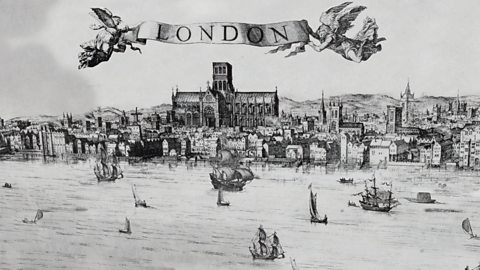
You may have heard that Elizabethans don't travel. That's a myth. You'll pass a large number of people on the roads, most heading into towns and cities. On arrival in any town, you'll be drawn instantly to the hustle and bustle of the market. A town can double in size on market day with all its many visitors.
Every town has at least one market open at least one day a week. This is where you'll need to come to buy eggs, butter, cheese, meat, and fish. This is also where you'll come to buy stuff. You'll certainly recognize some of what's on sale, but you'll need to know what things are called. Another word for calf-length boots is a pair of buskins. Biggins are close-fitting caps. Knee-length trousers or breeches are known as slops.
People spend many hours at the market, so various fast foods are available. Cooked meats, pasties, and pies are all on offer. So are tasty treats. They're pricey, so you might stretch only to some herbs or an onion to make a soup. You'll notice women with baskets wandering around. They're selling oysters, seafood, and herbs. Also, look out for a man carrying a flame from door to door. Most people find it too difficult to light their fires using only a tinderbox and some kindling, so they pay for somebody to light them instead.
As the day ends and the noisy activity of the market dies down, the town seems a little less friendly and a little less safe. In fact, after dark it's terrifying. Where there is poverty, there is often crime. Half the entire Elizabethan population is under the age of 22. For comparison, the middle mark in modern times is 39. People have so much less life experience and, being younger, they're more aggressive and hot-headed. They're also armed. Most young men carry a dagger and many will wear a sword.
Desperate times call for desperate measures and there is no doubt that the poor are desperate. If you are tempted by a life of crime, just bear in mind that the penalty for any felony is death. And that includes the theft of just 13 pence-worth of goods. Helping yourself to a fine shirt off a washing line or some silver spoons from a rich man's house can lead you straight to the gallows. There are, in total, five different ways in which you can be executed. The first is straightforward hanging on a gallows. The second is the traitor's death of hanging, drawing, and quartering. Third, there's beheading. Fourth, burning at the stake. And fifth, peine forte et dure. That last one means hard and strong punishment. You are laid on the ground and a sharp rock is placed under your spine. Heavy weights are then added, one by one, to a board on your body. It could well take 12 hours for you to be crushed to death.
If you're found guilty of witchcraft in England, it is likely you'll be hanged, unlike in Catholic countries, where witches are burnt at the stake. This journey as a poor person through Elizabethan England has shown you many peculiar things, but witchcraft is probably the strangest of them all. Today science has taught us that witches don't really exist and that evil spells and lucky charms don't actually work. But in the 16th century, if you deny that witches exist, people will think you are insane.
While the poor in Elizabethan England have a particularly hard time, there's one cause of suffering that's a threat to everyone - the weather. And we're not talking here about a few spots of rain. One bad summer and the crops fail. Food becomes scarce and prices rise. Whole families suffer from malnutrition. If the harvest fails for two years in succession, they starve to death. If it fails for three years in a row, as it does in the years 1594-1597, thousands die. Failed harvests mean that many people in the countryside have no work and without a job they can't afford to stay in their homes.
In the 16th century, it's against the law to look after a homeless person not from your neighborhood. You can be fined £1 for taking in a perfectly innocent homeless couple. As a consequence, lots of people end up walking for miles up and down the country for work or food, constantly being moved on. There are even cases of people migrating to Kent on foot from as far as Lancashire and Yorkshire.
In 1597, three years into the worst famine seen in living memory, England is about to make some major changes to the law. Across the country, there was a feeling that something has to be done to help the poor. In October, Elizabeth's government passes an act for the relief of the poor. For the first time, people are taxed locally and the money is given to parish overseers to provide for the very poorest people. This is a major change and has to count as one of the turning points in English social history. From now on, helping the poor isn't just left to individual acts of charity. It's a duty that everyone shares. The new law establishes the system of caring for the poor for the next 200 years.
As a poor person, life may seem much better under the new laws, but lurking in the shadows there's another ever-present threat, especially for the poor. Death is the thing that all fear and due to the high levels of disease in society, it features very prominently in daily life. Most children lose one parent by the time they grow up. And most parents lose half their children. In Stratford in the 1560s, there are, on average, 63 children baptized every year and there are 43 buried. There are just so many diseases you can catch. The one you'll certainly hear most about from people in the street is the plague. The 1578 Plague Orders decree that if plague is found in a house, it is to be boarded up and guarded until everyone inside is either dead or has survived for six weeks.
It has been known for some people feeling the symptoms to dig their own graves and to lie down in them waiting for death. So what can you do to avoid what seems like certain death? Some medical manuals have strange recipes. For example, live swallow chicks ground up in a pestle and mortar. But the more serious ailments require the attention of a physician and then you might get a surprise because the medicines he prescribes won't just depend on your illness. They'll also depend on how wealthy you are. Expensive medicines with the best ingredients are given to the rich. The poor receive a cheap alternative.
Life in the towns and cities of Elizabethan England is tough. There is great poverty and many people struggle to feed and house their families. While the Poor Laws go some way to improving this, there are still many hardships to overcome. The punishments for even the smallest crimes are harsh and disease is rife.
Video summary
On his travels Ian Mortimer explores various aspects of town and city life in the sixteenth century, including the markets, which drew so many people in from the surrounding countryside.
He also looks at how the Elizabethans tackled the problems of crime and disease, which were such a prominent feature of life for the urban poor.
Although life could be tough, he discovers that the introduction of the Elizabethan poor laws did go some way to alleviating the worst times.
This short film is from the BBC series, Time Traveller's Guide to Elizabethan England.
Teacher Notes
Your pupils could compare crime and punishment in Elizabethan England to the present day.
This short film could be used to help pupils understand some of the reasons why disease spread so quickly in towns and cities, and what they did to try to stop the plague from taking hold.
This short film is suitable for teaching history at Key Stage 3 in England, Wales and Northern Ireland and at Level 3 in Scotland.
To what extent was life changing in Elizabethan England? video
Ian Mortimer takes a journey back in time to find out how life was changing in Elizabethan England.
What was life like in the court of Elizabeth I? video
Historian Ian Mortimer takes a journey back in time to find out what life was really like in the court of Elizabeth I.
What was life like for the rural poor in Elizabethan England? video
Ian Mortimer takes a journey back in time to find out what life was really like for the rural poor in Elizabethan England.
Who were the rich in Elizabethan England? video
Ian Mortimer takes a journey back in time to find out who were the rich in Elizabethan England.
Why was London the centre of the Elizabethan world? video
Historian Ian Mortimer takes a journey back in time to find out why London was the centre of the Elizabethan world.