DR IAN MORTIMER:'Elizabethan London is unlike any other city or town in England. It has a much bigger population, covers a larger area, and is much richer.'
DR IAN MORTIMER:'As you near the city, you'll pass a bizarre collection of people. Royal messengers, sheep drovers, physicians hurrying to bedsides, and foreign travellers in new-fangled carriages. All streaming in and out of the city.' There are numerous must-see attractions on any wealthy tourist's itinerary. 'Firstly, the Tower of London.'
DR IAN MORTIMER:'Here you can hire a tour guide. You'll see Henry VIII's armour, the Royal Mint, a collection of exotic animals, and the dungeons, where Catholics and others are tortured.' But tourism doesn't come cheap.
DR IAN MORTIMER:If you want to do the full Tower experience in Elizabeth's reign, it will cost you the equivalent of 12 week's wages for the average labourer.
DR IAN MORTIMER:But the one thing you simply have to see is London Bridge. It's what every visitor to the city talks about. 'It's more than just a simple bridge. It's a magnificent ancient structure of 20 arches. It's 800ft long, 60ft high, and 28ft wide. It towers above the river. The bridge is covered in buildings,'
DR IAN MORTIMER:'from wealthy merchant's houses to shops, and even public toilets. It also has impressive gates, and fortifications designed to protect the city.' In 1599, the Swiss tourist, Thomas Platter, remarks that, "London is not in England, but England is in London." An observation about crowding in
DR IAN MORTIMER:echoed by almost every foreign visitor to the city. 'London's not just the most crowded place, it's also the centre of Government, international trade, the law and, of course, culture.' It's also a place of wonder and horror, of great wealth, and abject poverty. 'Over the 45 years of Elizabeth's reign,'
DR IAN MORTIMER:the city's population increases from 70,000 to an astonishing 200,000,
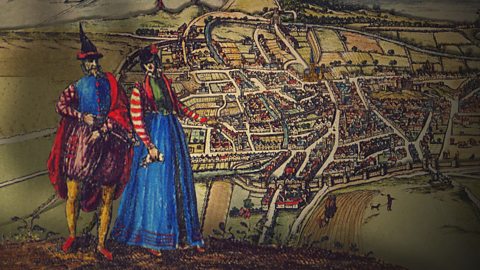
DR IAN MORTIMER:as multitudes flock to the capital to seek their fortune. 'Queen Elizabeth doesn't like London expanding so close to her land and palaces, and so she declares that no new building can take place outside the city walls.' In London, space is at a premium. This plan shows you how closely packed together all the houses are,
DR IAN MORTIMER:and gives you a sense of how cramped life is. It also shows you all the latrines. Actually, this bit of London isn't too badly served for such facilities, due to the proximity of the River Fleete. Even so, you might have to cross your legs, as it shows just 10 loos for the 30 properties on the map.
DR IAN MORTIMER:Let alone all the hundreds of other houses nearby. 'For those who come to live in the city, life is crowded, cramped, unhygienic and little more than a struggle. Tensions are increased by having to live so close to your neighbours. The lack of space means houses are rising fast, sometimes up to seven storeys high.'
DR IAN MORTIMER:'All supported by nothing but timber beams. The rapid growth of London also means that sanitation suffers. Without flushing toilets, or effective drains, the smell of Elizabethan London is going to take some getting used to.' Strange though it may seem, to most Londoners, the smell of sewage is the smell of progress,
DR IAN MORTIMER:because it's also the smell of lots of people. Although the sanitation might leave a little to be desired, the city is where you can better yourself, and improve your lot. London attracts everyone hoping to make a fortune, or a name for themselves. 'When visiting London, the River Thames will be your constant companion.'
DR IAN MORTIMER:It's the lifeblood of the city, and for many wealthier Londoners, it is by far the best way to get about. This is one of the reasons there are so many boats on the river. From the practical barges, carrying everything from dung to wine, and the Queen's glass-sided barge, to thousands of wherrys, as water-borne taxis are known.
DR IAN MORTIMER:'These river taxis operate in all weathers. It'll cost you a penny to cross from the city to the many entertainments of Southwark on the south bank of the river. The River Thames also provides the city with its port, and it's this that makes London such a centre of international trade,'
DR IAN MORTIMER:'new ideas and opportunities to make money. London's middle classes are only too pleased to spend their new-found wealth. And it's London's bustling port that satisfies the demand for novelties,' as well as basic commodities. Luxury items, such as sugar, exotic spices, carpetsDR IAN MORTIMER:are imported from Europe, the Far East and the New World. If it's the finer things in life you're after, then London is definitely the place to be. 'The constant movement of people and cargos in and out of the city, along with the filthy and overcrowded streets, makes London the perfect breeding ground for the most terrifying thing'
DR IAN MORTIMER:'you'll encounter in Elizabethan England. 'The plague.' When planning your visit, you really must avoid 1563. In that one year alone, over 17,000 Londoners die of bubonic plague.
DR IAN MORTIMER:But let's say you do visit during an epidemic, are there any precautions you can take to avoid catching this dreaded disease? 'You could never predict where it would strike. 'Outbreaks occur all over the country at different times. But bear in mind that it is carried by rat fleas and they don't travel very fast.'
DR IAN MORTIMER:'If you hear that the plague is in town, leave immediately.' Poor areas are more severely affected than rich ones, so avoid slums. Plague can also be spread through infected garments, so don't borrow or wear someone else's clothing. And finally, bear in mind that plague can be spread in the breath.
DR IAN MORTIMER:Don't get overfamiliar with strangers, and keep the kissing to a minimum. So what should you do if you feel painful buboes in your groin and armpits? And find yourself suffering from a rapid pulse, fever and headache? Medicine won't help you. There are supposed cures for plague, but none of them will do the slightest bit of good.
DR IAN MORTIMER:A physician won't even come near you. I'm afraid, in such circumstances, the outlook is bleak. There is nothing you can do. 'If you're unlucky enough to catch plague, the laws enacted in 1578 mean you're subject to strict control measures. You can't buy your way out of this one.'
DR IAN MORTIMER:'You'll be boarded up inside your house for a minimum of six weeks. You, your family and servants, sick and healthy, all in it together. No matter how rich, ambitious, or knowledgeable you are, nothing can save you from the plague.' As well as horrific events like plague,
DR IAN MORTIMER:Elizabethan England also sees several positive changes that make a real difference to the lives of the middling sort of people. 'On the south bank of the Thames at Southwark, you'll see a revolution unfolding before your eyes. To many, it's the high point of Elizabeth's England. The theatre.'
DR IAN MORTIMER:'If you visit the Globe theatre in 1599,' you might just be lucky enough to see the work of the man who has come to be regarded as the foremost Elizabethan of them all. William Shakespeare. 'Here at the Globe, Shakespeare's plays provide rich entertainment for the crowds. One in three of all adult Londoners watches a play every month.'
DR IAN MORTIMER:'You'll certainly want to join these middle-class theatre-goers. When you arrive, you'll be one of a 2,000-strong audience. Waiting with excitement for the entertainment to begin. Be on guard against pickpockets who are everywhere in the bustling audience. You wouldn't want to lose some of your hard-earned fortune.'
PICKPOCKET VICTIM:'Oi, you!'
DR IAN MORTIMER:'The Globe is just one of the many things you've seen that put London at the centre of Elizabethan England. The historian John Stow describes it as, "the fairest, largest, and best inhabited city in the world." Elizabeth's reign sees dramatic changes across the whole country. But the changes seen in London make it the foremost city on Earth.'
Video summary
Ian Mortimer travels around the capital and visits the sights that were the most significant, including the Tower of London, the River Thames, London Bridge, and the Globe Theatre.
In the hustle and bustle of city streets, he uncovers a world of extreme contrasts; great wealth and poverty, magnificent buildings, theatres, slums and disease.
He finds that as today, London was a centre of international trade, a place of new ideas and opportunities to make money.
The Elizabethans were prepared to put up with the overcrowding, filth and unbearable smells to be part of this great city.
This short film is from the BBC series, Time Traveller's Guide to Elizabethan England.
Teacher Notes
Pupils could take on the role of Elizabethan tour guides and produce a tourist itinerary for sixteenth century London.
They could also suggest the improvements needed to make sixteenth century London a healthier place to live in for both rich and poor.
This short film is suitable for teaching history at Key Stage 3 in England, Wales and Northern Ireland and at Level 3 in Scotland.
To what extent was life changing in Elizabethan England? video
Ian Mortimer takes a journey back in time to find out how life was changing in Elizabethan England.
What was life like in the court of Elizabeth I? video
Historian Ian Mortimer takes a journey back in time to find out what life was really like in the court of Elizabeth I.
What was life like for the rural poor in Elizabethan England? video
Ian Mortimer takes a journey back in time to find out what life was really like for the rural poor in Elizabethan England.

What was life like for the poor in the towns of Elizabethan England? video
Historian Dr Ian Mortimer takes a journey back in time to find out what life was really like for the poor in the towns and cities of Elizabethan England.
Who were the rich in Elizabethan England? video
Ian Mortimer takes a journey back in time to find out who were the rich in Elizabethan England.