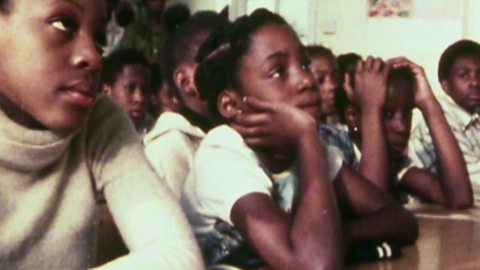
I'm Kenyah Sandy, I play Kingsley Smith, a child sent to an educationally subnormal school, in Steve McQueen's series of films, Small Axe. In the 1970s, hundreds of children were taken out of mainstream schools and sent to educationally subnormal schools known as ESN Schools.
Is it easy for you to define ESN, educationally subnormal, for us? They were defined as youngsters who could not benefit from the education provided within the ordinary school. This frightening label, the ESN school, they tell you, okay, it means educationally subnormal, which doesn't mean anything to you at all. You may start now.
At the time, all London school children were made to take an IQ test which lots of black children failed. Whether a child goes to normal school or an ESN school is determined by these IQ tests, by these other measurement devices, which are in many cases incredibly biased and certainly against children coming from a completely different culture.
What was this test you mentioned? The IQ test is an intelligence test designed, well, designed to test the general intelligence of any age group across the population. Now I'm afraid Kingsley, uh, Kingsley scored well below average. My son sometimes doesn't get things right the first time. Can't he take the test again? It doesn't work like that now. It's, uh- it's a one-off exam, but adjudicated independently so we know it's fair.
Many of them were Windrush children who came over to the UK from the West Indies with their families for a better life between 1948 to 1971. The test asked questions that might be easy for a child born in Britain into a middle-class family but were very hard for children who had recently arrived in Britain. For example, how does Big Ben indicate the time? It's in Kingsley's best interests that he be transferred to another school. Fortunately, we can do this straight away. Who decided this? Can I speak to them? I am the messenger of good news here, Mrs. Smith. I shouldn't have to remind you of that.
Parents were told their children were being sent to a special school. That it was somewhere their needs would be met and they would thrive. But there was nothing special about the schools. There are 3000 West Indian schoolchildren in these schools for the educationally backward, compared with only 500 from other immigrant groups, a proportion which has led some West Indian parents to accuse the authorities of deliberately channelling their children into the special schools.
There were reports of children between the ages of four to 16 being put together in the same class, and pupils without learning difficulties were put in classes with children with severe learning difficulties. We are a special school and I would imagine that a lot of people think that the kids fit nicely into a category and they are more or less the same, but they're not. The pupils were often belittled and were taught lessons that were far below their learning ability.
I walked and walked. And what did I see? I saw mother and mother saw me. Come home she said, come home with me. John said, I like big trains, I like little trains. Right everyone, that's lunch. It made many of them feel stupid, robbed them of their futures and reinforced stereotypes that black children were problem children. In our overwhelmingly white country, blacks still lose out. And some West Indian parents blame the teachers. Penton is a very, very nice lad. But unfortunately, with some things he tends to be going downhill.
The parents weren't told about the realities of these schools, so the authorities initially got away with it. Part of the work of the select committee is to look into the anxiety which has been caused by the very high proportion of immigrant children who appear to be at what we call ESN schools. But as the pupils began to struggle with the basics of reading and writing, some parents and action groups started confronting teachers and the ESM schools.
For a long time, black parents have felt that state education in Britain is failing their children. They know they've got a problem and they're convinced they must tackle it themselves. Parents and other Afro-Caribbean people feel very dissatisfied. They believe that the school system militates against black children and against working-class children. They campaigned to close these schools down for good. We have trusted the people who tell us that they are the professionals. We have put our heart, our soul and our trust in their hands, and then they have let us down.
In response to such criticisms, some education authorities have stopped using IQ tests on immigrant children until these children have made an adjustment to our culture. We would like to see an entire review, a re-examination of the situation to save some of these children from almost the final end.
The black community came together to set up supplementary schools on a Saturday run by black teachers and parents to fight against the racism and inequality their children were experiencing in the education system. The lessons compensated for all the subjects they were missing out on including reading, writing and maths. Lessons are just beginning at the Black Arrow Supplementary School in Wolverhampton, where head teacher Mel Shivan and a team of volunteers quite literally supplement the education of black children.
This supplement to school is one of several score that have recently sprung up in immigrant communities across Britain, all of them running on a voluntary system of self-help, taught by teachers who give their time for nothing and who still believe in the basic three Rs. The children were also taught about black history and West Indian culture to connect with their identity. It was the beginning of a much bigger movement to close the ESN schools.
What do you all know about our ancestors? That we were slaves. That is what they want us to know. Did they teach you anything else? What about the Nubians, the Masai, the kingdom of Kush? So you know nothing about the people or the richness of the cultures. Although the schools were eventually closed, they had a lasting effect on today's black community. Studies have shown black boys are much more likely to get expelled from school than any other ethnic group.
Video summary
Kenyah Sandy, who plays Kingsley Smith in Steve McQueen's Small Axe, tells the story of how hundreds of children were taken out of mainstream schools and sent to Educationally Subnormal Schools (ESN schools) in the 1970s.
At the time, all London school children were made to take an IQ test which lots of black children failed. Many of the them were Windrush children, who came over to the UK from the West Indies with their families.
The IQ test asked questions that were very hard for children who had recently arrived in Britain, and were biased against those coming from a different culture.
Parents were told their children were being sent to a special school, where their needs would be met and they would thrive. But in reality, children between the ages of four and 16 could be put together in the same class, and pupils without learning difficulties could be put in classes with pupils with severe learning difficulties.
As children began to struggle with the basics of reading and writing, parents and action groups began to confront teachers and campaigned to close these schools for good.
The black community came together to set up supplementary Saturday schools, run by black teachers and parents to fight against the racism and inequality their children were experiencing. The lessons compensated for all the subjects they were missing out on, including reading, writing and maths.
The children were also taught about black history and West Indian culture.
Although the ESN schools were eventually closed, they had a lasting effect on today's black community.
Teacher Notes
This short film is suitable for teaching KS3 and KS4 students. However, it raises issues of racism and therefore might be more suitable for older KS3 students. Teacher review is recommended prior to showing your class. It can be used alongside the other Small Axe BBC Teach films or independently.
It could fit as part of a KS3 history curriculum when looking at ‘social, cultural and technological change in post-war British society.’ For example, it could be integrated into an enquiry or scheme of work looking at migration to Britain or black British history.
At KS4, the film could be used to illustrate the experiences and treatment of migrants to Britain after World War Two as part of the AQA ‘Empire, Migration and the People’ course, the OCR ‘Migrants to Britain’ course or the forthcoming Edexcel Migration course.
It could also be used in a lesson looking at how education has changed over time or to spark discussion about educational inequality.
Before watching the film:
Prior to this lesson you may want to introduce students to other relevant preceding events in post-war black British history to provide context. For example:
- the arrival of the Empire Windrush in 1948
- the 1948 British Nationality Act, which conferred equal citizenship status to people in Britain and her colonies
- the changing nature of migration (at first it was mostly young, single adults but over time more families and children moved to Britain from the Commonwealth)
- the discriminatory bussing of black and Asian students in the 1960s and 1970s in an attempt to disperse them
During watching the film:
You may want to pause the video at certain points to check for understanding. Alternatively, you could wait until the end and pose questions such as:
- Why were children sent to ‘Educationally Subnormal Schools’?
- In what ways were these schools ‘nothing special’?
- How were the West Indian community discriminated against by the education system?
- How did the black community respond to being let down by the education system?
- What was taught in supplementary schools?
- What happened to Educationally Subnormal Schools?
- Why do you think director Steve McQueen might have chosen to make ‘Education’ as part of his Small Axe collection of films?
Following on:
You could ask students to summarise the key points of the video and Kingsley’s story. This could be done in various different ways, through storyboarding or bullet points. At KS4 the film may serve as a case study in a lesson about West Indian migration to post-war Britain.
ESN teacher and activist, Bernard Coard features briefly in the film. He wrote the seminal book ‘How the West Indian Child is made Educationally Sub-Normal in the British School System’ in 1971. One option is to use the film as part of a lesson looking at why Bernard Coard wrote the book and what impact it had, with a focus on parental activism.
A range of relevant primary source material exists. The George Padmore Institute has a selection of sources available on its website, such as letters about ‘How the West Indian Child is made Educationally Sub-Normal in the British School System’ and campaign leaflets. It also has information about the broader Black Education Movement and specific campaigns within it, for example the Haringey Anti-banding campaign, partly sparked by the leak of ‘The Doulton Report.’
The Black Cultural Archives holds a variety of sources, a small number of which are available online, including poetry and a child writing about her experience of schooling in London. Windrush: The Irresistible Rise of Multi-Racial Britain by Mike & Trevor Phillips contains many oral history excerpts in chapters about children’s experience of schooling and parental activism.
The recent Windrush Scandal has primarily affected children who arrived in Britain in this period. You may wish to draw attention to this and use the film as an opportunity to explore what the Windrush Scandal is, what caused it and how the government has responded.
The Mangrove Nine. video
Rochenda Sandall, who plays one of The Mangrove Nine in Steve McQueen's Small Axe, tells the true story of this significant event in British history.
Blues Parties. video
Micheal Ward, who plays Franklin in Steve McQueen's Small Axe, explores the eruption of Blues parties in London between the 1960s and 1980s.
Alex Wheatle and the Brixton Uprising. video
In his own words, this is the story of Alex Wheatle MBE, who grew up in a children's home and later became an award-winning writer of books for children and young adults.
Leroy Logan and the Metropolitan Police. video
In his own words Leroy Logan MBE, one of the few black police officers in the Met when he joined in 1983, narrates and shares his experiences of prejudice in the police force as portrayed in Steve McQueen's Small Axe.
Subnormal - A British Scandal. video
This short film for secondary schools examines how black children in the 1960s and 1970s were disproportionately sent to schools for the so-called ‘educationally subnormal’.