Charlie has a cold, and calls his friend Jens who lives in Berlin to practise speaking German.
Jens is at an adventure playground with Lena and Annika, but says he is bored.
The girls try to get him interested in football, climbing, cycling and hide and seek, but Jens says he doesn’t like any of them.
Charlie asks what is wrong, and Jens explains he is fed up because he has to do homework all weekend.
Lena and Annika start to build a fire with the playground leader, and Jens joins in.
Charlie has to go, because his mum wants him to do his homework.
This short film focuses on German vocabulary for leisure activities and likes, dislikes and hates.
It is from the BBC series, Virtually There: Germany.
In this series of short fun films, a British boy practices German by talking to a group of children in Berlin via a tablet. Virtually There: Germany revises basic German vocabulary in a series of real-life settings, and using memorable songs.
Teacher Notes
Use to introduce or revise the names of activities and express opinions in German.
A good listening activity might be to call out the names of hobbies and ask pupils to mime them.
Practise structures to express opinion, for example, 'Ich mag Fußballspielen', 'Ich hasse Fußballspielen'.
Support grammar by looking at German word order when making a negative sentence, for example, 'Ich mag nicht Fußballspielen'.
In groups, pupils could be asked to make a "human sentence:"
Give each pupil one word on an A4 sheet of paper.
Pupils display the words to the class and stand in the correct order.
Pupils can also practice forming the negative in pairs.
One pupil gives a positive statement, for example, "Ich mag Radfahren."
Their partner replies in negative "Ich mag nicht Radfahren."
The class can practice sentences using "verbal pingpong."
For example:
The teacher could say to the class, "Ich liebe Klettern."
Pupils could return with, "Ich hasse Klettern."
Highlight the use of capital letters for nouns, for example: Radfahren."
Support pronunciation by highlighting [I:] ie phoneme in 'Fußballspielen' and [ai] ei phoneme in 'langweilig'
Also focus on [c] ch sound in 'nicht'.
Pupils could be asked what their favourite outdoor hobbies are in German.
Curriculum Notes
This short film could be used for teaching German at KS2 or at a beginner level in England, Wales and Northern Ireland and 1st and 2nd Level or beginner level in Scotland.
More from Virtually There: Germany
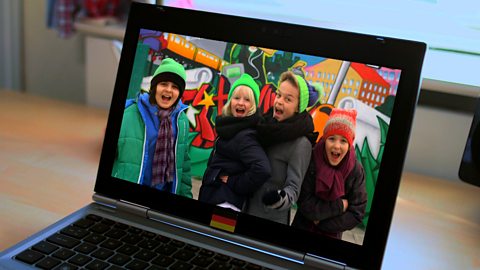
Making new friends in Berlin. video
Charlie’s learning German at school, and practising online with some children in Berlin. They introduce themselves and show him around some of the city’s most famous sites.
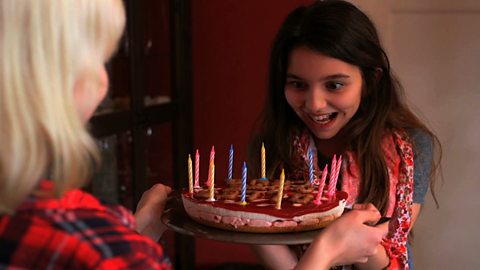
A birthday surprise in Berlin. video
Charlie’s German friends plan a birthday surprise for Lena, making her a cake with 12 candles and singing her a birthday song.
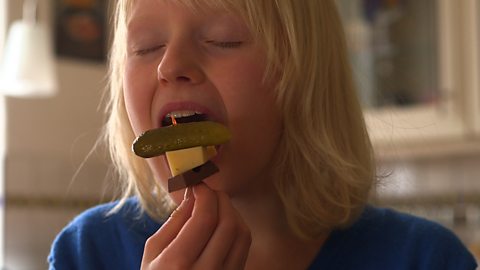
A German food adventure. video
Charlie talks to his friend who is buying a snack at a sausage stall in Berlin, and to his other German friends who are making unusual kebabs with everything they can find in the fridge.
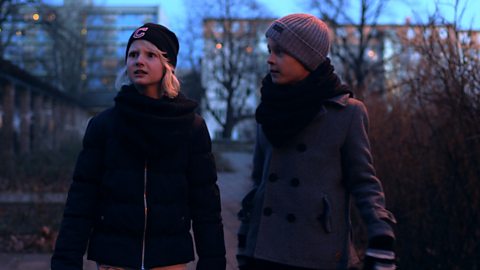
Getting directions in Berlin. video
Charlie’s German friends get lost on the way to their concert. They are given directions, and Charlie helps them get there just in time.
A song to learn the days of the week in German. video
A lighthearted and catchy song in English and German to practise the days of the week.

Der die das song. video
A fun song that explains the three genders of nouns in German whilst revising parts of the body.
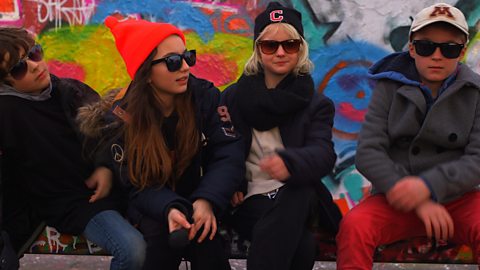
Painting and colours in German. video
Charlie links up online with his friends in Berlin who are painting a portrait of one of their friends in the style of Franz Marc, the expressionist. Things don’t go to plan!
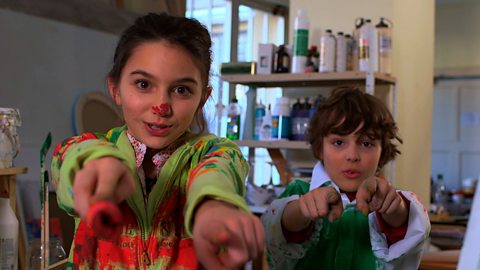
Shopping at the flea market. video
Charlie’s German friend Lena can’t decide what to wear for a party. She takes him to a local flea market where they haggle with a stallholder to buy a colourful wig.

A song about playing games. video
A lively song for learning German in which children sing about Karneval and playing games.