We all live with computers…but getting the most out of them… getting them to do what you need…can be kind of difficult.
But if you can understand how they process things, a computer can be the most useful housemate you’ll ever have.
Ada:
“Give me an A"
“Give me an L”
Voice over:
If you want a computer to do something, you have to tell it exactly what to do.
Ada:
“Give me an G”
“Give me an O”
Voice over:
They only understand lists of clear instructions. Called Algorithms.
Ada:
“Give me an M!”
“Give me an S”
Voice over:
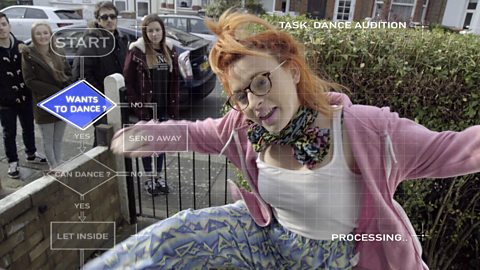
Algorithm – looks like a scary word. But it’s just a series of steps. We use algorithms all the time. When making a journey. Or making music. Or learning a dance.
Ada:
Come on dance with me!
Voice over:
A dance is an algorithm… First you work out all the different actions you might need. An algorithm needs to have a start, an end and a set of clear instructions in between. One way of writing an algorithm is as a flowchart. Flowcharts use symbols to represent how the system works and help the programmer come up with the right set of instructions. And remember - Computers are only as good as the instructions you give them.
Ada:
Ah, I see what the problem is.
Voice over:
If they’re not in the right order then the pattern of steps will be wrong. And things might not go well.
When you write an algorithm you have to try and think of everything that might happen.
You might need to add something called a 'Decision'.
Now we have a dance algorithm with a start, a clear set of instructions and some decisions, we’re in business.
Algorithms - Sets of clear instructions that achieve tasks.
Video summary
A teenage programmer creates an algorithm to teach her computer a dance routine.
An algorithm is a clear sequence of instructions with a start, a finish, and usually some decisions in the middle.
They can be expressed in a flow chart.
The computer only makes mistakes if there are mistakes in the instructions.
These clips are from the series How to Think Like a Computer.
Teacher Notes
Units of measurement can be discussed and linked to Mathematics, both for measuring the rice (cups) and also for filling the mop bucket (litres).
Students can flowchart these algorithms or write them in pseudocode and then peer assess/evaluate them for efficiency.
Discuss the contributions of women in IT such as Ada Lovelace as the main character is called Ada.
Discuss testing the algorithm during development and also after development.
Discuss the reason for efficiency in an Algorithm.
This clip will be relevant for teaching Computer Science at KS3 and KS4 in England, Wales and Northern Ireland and National 4 and 5 in Scotland.
What is decomposition? video
A teenage programmer discovers how decomposition works through trial and error.
Pattern Recognition. video
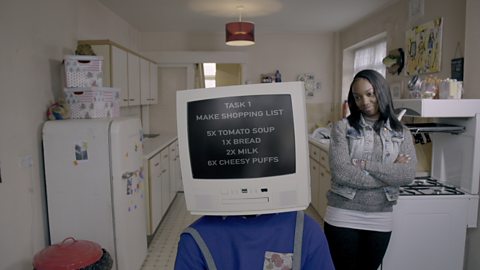
A teenage programmer is giving her computer instructions on making a sandwich.
What is abstraction? video
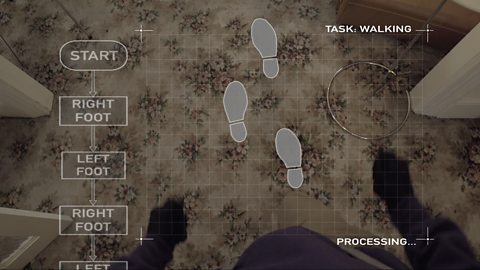
A teenage programmer finds out how to use abstraction in programming.