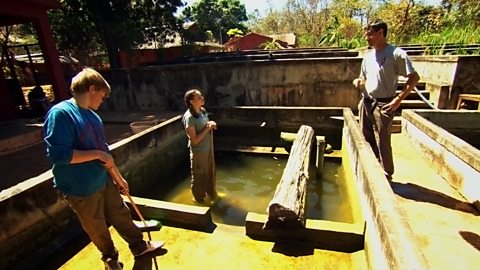
Eight UK teenagers investigate the causes of deforestation threatening the habitat of the lemur and discover there are no simple solutions.
The video
KS3 Geography. Africa - Conservation in Madagascar.
How deforestation is threatening animal habitats
STEVE BACKSHALL: This is Madagascar. It’s a vast island in the Indian Ocean off the east coast of Africa. And it’s home to some of the most unique and rare creatures on the planet. Incredibly 80% of the wildlife here exists nowhere else on earth. But it’s a paradise under threat.
I’ve sent eight ordinary kids from the UK to discover for themselves how the people and animals can both survive here together. This was never going to be easy.
CHILD NARRATOR: Lemurs can only be found in Madagascar. And on our mission one of the things we did was to track down some in the wild…with guides to help us find them in the jungle.
GUIDE: Be careful on the bridge - it’s a bit wobbly.
CHILD NARRATOR: And sometimes it took hours just to find any sign of them.
CHILD: I’m really excited about seeing any kind of lemur.
CHILD NARRATOR: But in the end we were not disappointed.
CHILD: [WITH LEMUR ON SHOULDERS] It’s like a parrot!
CHILD NARRATOR: One lemur we were really happy to see was the bamboo lemur.
GUIDE: So just up there - that’s one of our animals - the greater bamboo lemur.
CHILDREN: That’s pretty special! / Very privileged.
CHILD NARRATOR: But with rainforests in Madagascar being destroyed these animals have become one of the most critically endangered primates in the world. Seeing these guys up close made us want to find out what exactly was harming them.
CHILD: Why are lemurs so rare?
GUIDE: The habitat they live in is being encroached by human population. People are chopping this down for agricultural use, because human population ever expanding. If the bamboo goes, they go.
CHILD: Yeah.
GUIDE: So it’s pretty… It’s pretty dire the things that are going on with lemurs in Madagascar.
CHILD NARRATOR: Knowing that only 500 of these bamboo lemurs are left in the entire world made us think it’s reaching crisis point.
CHILD: It’s kind of a battle between the lemurs and the humans and right now we don’t really know who’s going to win it.
CHILD NARRATOR: Surely the lemurs have to win. We should protect them at all costs.
CHILD: [WATCHING A LEMUR] Come here. You see the head?
CHILD NARRATOR: What do you think?
[QUESTION MARK]
CHILD NARRATOR: On our mission we got to hang out with lots of local people. We saw that life for them is very different to ours back home. We met up with Fabrice, who wanted to show us why chopping down and using trees is really important.
CHILD: Fabrice, what’s your house made of?
FABRICE (TRANSLATED): Ravenala tree.
CHILD: Do you know how many ravenala trees it takes to build this room?
FABRICE (TRANSLATED): About 300.
CHILD: Wow!
CHILD NARRATOR: But housing isn’t the only reason why trees are being cut down. We found out that they also have to be cleared to grow rice. Rice is grown in flooded fields called ‘paddies’. It is the main food source for the 20 million people living in Madagascar.
[IN PADDY FIELD]
CHILD: How long does it take him to grow all of the rice?
GUIDE (TRANSLATED): Four months.
CHILD: How much rice do you get from a field this size?
GUIDE (TRANSLATED): He said his rice field starts from those mango trees to here… But only like 250kg of rice.
CHILD NARRATOR: And that’s only just enough rice to feed his family. It’s not enough to sell to make any money. [WORKING IN THE FIELD] We decided to have a go ourselves.
CHILD: Imagine how that boy has to do it every single day for like an hour on his own.
CHILD: We have to do so much for like not even that much food, and it’s like more effort than what you get in return.
CHILD NARRATOR: Meeting people that have to use the land around them so they can eat and survive made us think that they have to cut down the trees.
CHILD: The problem is you can either save the rainforest and the lemurs or save the people. You have to make the right balance, cos they need all the trees. They need to cut it down and things so that they can grow their own food so that they can survive. But in doing so that endangers the forest and the lemurs.
CHILD NARRATOR: The people need to chop the forest so they can live. What do you think?
Video summary
Download/print a transcript of the video.
The teenagers consider some of the causes of deforestation in Madagascar - in particular the need for wood to build houses and for fields to plant rice.
Madagascar has an extraordinary diversity of animal species - 80% of which are found nowhere else in the world. But the deforestation is causing the destruction of the habitat of the lemur. The UK teenagers must consider how best the balance the needs of humans with those of local wildlife.
This clip was originally from the series Deadly Dilemmas.
Teacher Notes
Download/print a copy of the Teacher Notes for this video.
Teacher Notes prepared in partnership with the Geographical Association.
Before watching the video
- Locate Madagascar using maps of the world and Africa.
- Discuss what biomes we would expect to see in Madagascar, based on its location.
- Introduce key terms such as:
Deforestation: the cutting down and removal of trees by humans.
Habitat: the natural home or environment of a living organism.
Biodiversity: the range of species living in one area.
Conservation: the practice of protecting Earth's natural resources for the benefit of current and future generations. - Create a list of the impacts of deforestation and categorise this into social, economic and environmental impacts, for example:
Social: people may be displaced from the land to make way for farmland.
Economic: Money can be made from the sale of land or trees.
Environmental: The loss of animal habitats.
While watching
You may wish to stop at relevant points during this short film to pose questions and check understanding, or wait until the end. Useful questions might include:
- Which species are becoming critically endangered?
- Why are the rainforests being cut down?
- How many bamboo lemurs are left in the wild? (film update, there are now 1,500 in Madagascar due to successful conservation programmes).
- Why is deforestation important to some people?
- Why are the paddy fields important?
- Why is the balance between the environment and the needs of people difficult?
- What do you think should be done?
After watching
- This clip could be used to start a discussion for and against deforestation. The class could be divided into pairs and asked to formulate an argument for and against deforestation. Questions that could be posed to the class include: 'How far do you think the human population should go to protect the lemurs?' / 'What will happen to the local people if they are prevented from farming?'
- Students could be asked in two opposing lines representing both sides of the argument (conscience alley). Select one pupil to walk through the middle while both sides say/shout/whisper their argument.
- Discuss who the child listened to and why.
- Summarise different sides of the argument: clarify the strengths and weaknesses of different positions and choose individuals to signal personal opinion clearly.
- As a further activity, pupils could write an argument in role either as a local farmer or conservationist.
- They could produce a poster campaign about a particular flagship species or write a letter arguing for more farm land.
Curriculum links
This clip will be relevant for teaching Geography at KS3 in England and Northern Ireland, 3rd/4th Level in Scotland and Progression Step 4 in Wales.
Where next?
- Research the Aspinall Foundation and the work they do in Madagascar. How did they increase the numbers of the Greater Bamboo Lemur when it was nearly extinct?
- The news articles on the website could be used as in-class reading and the conservation sites could be mapped, this also provides an opportunity to look at the variety of rainforest ecosystems in Madagascar.
Links
Benefits and challenges of conservation:
https://www.bbc.co.uk/bitesize/guides/zsbn7p3/revision/6
Endangered species and hunting:
https://www.bbc.co.uk/bitesize/guides/zsbn7p3/revision/5
Managing ecosystems:
https://www.bbc.co.uk/bitesize/guides/z2tstv4/revision/6
Deforestation:
https://www.bbc.co.uk/bitesize/articles/zpv3r2p
More from Africa - Conservation in Madagascar:
Balancing tourism and conservation in Madagascar. video
The teenagers consider the impact of tourism in Madagascar. They explore the link between the economy and conservation.
How fishing on a coral reef in Madagascar causes habitat loss. video
The teenagers consider a local conservation dilemma: families who fish on a coral reef even though the activity is destroying the habitat.
When the need for food threatens endangered species. video
The teenagers consider what can be done to protect bats, which are often hunted as a source of meat although endangered.
Protecting endangered species in Madagascar. video
The teenagers consider two contrasting wildlife conservation projects, both working to protect endangered species.