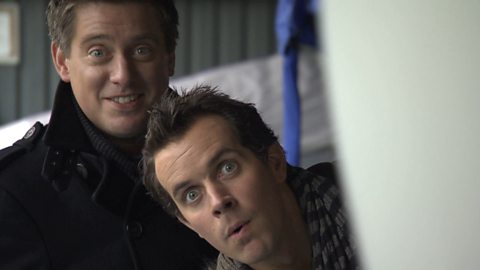
Today we're going to introduce you to an amazing man who came up with a genius solution…
TOILET FLUSHES
…to a very whiffy problem. I'd leave it for a minute if I were you.
Yeah. Thanks to him, whatever was in there has now gone and we don't have to worry about where it is.
Just leave it to today's genius, who invented London's first giant sewer system.
Ladies and gentlemen, we give you Sir Joseph Bazalgette.
HE GASPS
Do you mind? I'm rather busy!
Have you ever wondered what happens when you flush the loo? All the waste that goes down your toilet ends up underground in the sewer where it's safely carried away. But more than 150 years ago in London, there was nowhere for raw sewage to go. So it was dumped straight in the River Thames. And in the hot summer of 1858, the smell became unbearable. It was called The Great Stink.
We're recreating the River Thames in Victorian London. This represents the poo produced by two and a half million Londoners.
Look! That's splatted on my trousers!
Let's recreate the moment to see what the river would've looked like back in the day.
See if it flows.
There you go. Oh, someone had a bad night there, somewhere in East London.
THEY LAUGH
But it was no laughing matter. People were getting sick and dying. At first, they blamed the smell. But disease was actually being spread by harmful bacteria leaking from the river into people's drinking water.
To find out more about the bacteria in poo, we've come to the University of Reading. We want to examine our own stool to see the bacteria inside. Well, not ours, someone lent us one.
I think we should give a name to our donator.
Do you? What would you like to call it?
Er, Steve.
Steve? All right. I'll just pick up Steve's sample. Steve's not been very well.
DICK LAUGHS
So just take a small amount.
Some bacteria in poo is harmful, so we're wearing protective gear. Examining your own stools at home is not recommended. Right, let's see how much bacteria Steve's sample has on it.
All these little shapes that you see here are bacteria.
Ah, OK.
Human waste contains billions of bacteria. That's why we wash our hands after going to the loo. But in Victorian times, people were washing in and drinking dirty water contaminated by sewage. The Great Stink was the final straw.
Enter Joseph Bazalgette, London's chief engineer, with a background in building railways. Parliament gave him the job of solving London's sewage nightmare, and what he came up with was a genius piece of engineering. Bazalgette's genius idea was to build a system of big sewerage pipes to catch London's waste before it flowed into the river, and London's drinking water. The sewage was then carried eastwards and pumped out to sea. No more stink. Genius!
Right now we're here at London's glittering Leicester Square. We're not going to be going to a premiere. Oh, no.
No, no. We're going underground into the sewer.
Not many people get to go inside Bazalgette's sewers, so this is a real treat.
DICK LAUGHS
OK. I can't even describe the smell in here.
A little bit soft under foot, isn't it?
Bazalgette's genius sewer system took over ten years to finish. It used 318 million bricks and involved 82 miles of new underground sewers linking to more than 1,000 miles of street sewers.
Is this Bazalgette's exact design?
Yeah.
Why did he make it so big?
It's what you call forward planning. It's what you call… Well, he was a genius.
Bazalgette predicted the population would grow, so he designed his sewer tunnels big enough to cope.
And breathe! Phew!
London air has never smelt so good.
Glad you liked my tunnels, boys. Now go and get washed!
Video summary
Dick and Dom describe the life and work of Joseph Bazalgette.
He lived in a time before sewers, in which toilet waste was disposed of into the nearest river. This caused the 'Great Stink’ in London in 1858, and many people became sick and died.
Dick and Dom visit a laboratory and look at a stool sample under the microscope to see the bacteria present.
They then visit the first sewer that Bazalgette designed. It took 10 years and 318 million bricks to build.
The key scientific points are made in a fun and student-friendly way.
This short film is from the CBBC series, Absolute Genius with Dick & Dom.
In this entertaining series Dick and Dom learn about the geniuses whose ideas, creations and discoveries have shaped our world.
Teacher Notes
This short film could be used as an introduction to Joseph Bazalgette and his achievement - the creation of the London sewerage system.
You could show this in your classroom and then invite pupils to make a timeline of 'human waste disposal' - allocating historical periods to the children, e.g. Ancient Egypt, Roman Empire, Middle Ages, Victorian England.
You could help your pupils to explore what happened to human waste.
This could also be used when learning about microorganisms as found in human waste and how good hygiene helps preventing the spreading of diseases.
Add to the fun by conducting an experiment with your pupils:
-Smear their hands with (easily wipeable) paint or chalk, pretending they haven't washed their hands after going to the toilet.
-Let them get on with their normal activities for 10 minutes and then have a look at where they can find traces or the paint.
-Invite them to evaluate the experiment.
This short film is suitable for teaching science at Key Stage 2 in England, Wales and Northern Ireland, and Second Level in Scotland.
Discovering the work of Archimedes. video
Dick and Dom describe the major scientific achievements of 'Absolute Genius', Archimedes, who is best known for his work on floating and sinking.
Discovering the work of Delia Derbyshire. video
Dick and Dom describe the major scientific achievements of 'Absolute Genius', Delia Derbyshire, including creating electronic music.
Discovering the work of Elsie Widdowson. video
Dick and Dom describe the scientific achievements of 'Absolute Genius', Elsie Widdowson, who was the first to discover the nutrional values of many foods.
Discovering the work of Isambard Kingdom Brunel. video
Dick and Dom describe the achievements of 'Absolute Genuis', Isambard Kingdom Brunel, who designed famous bridges.
Discovering the work of James Watt. video
Dick and Dom describe the major scientific achievements of 'Absolute Genius', James Watt, who made steam engines much more efficient.
Discovering the work of Leonardo da Vinci. video
Dick and Dom describe the scientific achievements of 'Absolute Genius', Leonardo da Vinci, who is famous for his painting of the Mona Lisa.
Discovering the work of Michael Faraday. video
Dick and Dom describe the major scientific achievements of Michael Faraday, who is most remembered for his work on electrical energy.
Discovering the work of Sir Isaac Newton. video
Dick and Dom describe the scientific achievements of Isaac Newton, who is best known for discovering gravity.
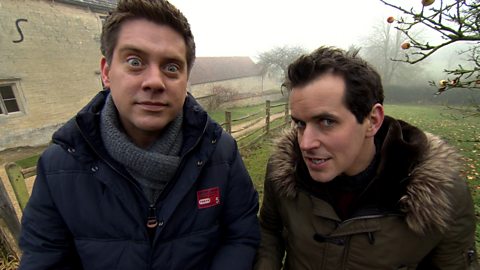
Discovering the work of Wernher von Braun. video
Dick and Dom look at the scientific achievements of Wernher von Braun, who was described by NASA as “the greatest rocket scientist in history”.