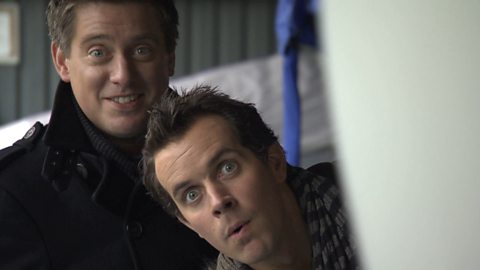
Today we're going to introduce you to a truly great man and a great Briton. One of the best engineers this world has ever seen. Yeah. He could build and design pretty much anything. Bridges, tunnels. Ships, railways. Ladies and gentlemen, we give you… Isambard Kingdom Brunel. Good day!
Isambard was born in 1806 in Portsmouth, England. His dad, Mark, was a very good engineer and taught his son everything he knew about the job. In the 1820s, Isambard and his dad were working together on the banks of the River Thames in London. They were attempting what no engineer had previously achieved. Their incredibly ambitious plan was to dig the world's first-ever tunnel under a river. And here, in the streets of Rotherhithe, East London, is where it all started.
Now, what a lot of people don't know is that Brunel and his dad had a very unique way of digging a tunnel. But it was a lot cleverer than using a bucket and spade. Until then, engineers, if they wanted to dig a tunnel, would just dig a big trench and then stick a roof on top. But, of course, you couldn't do that for a tunnel under the Thames, because if you did, the river would flood in and everyone would get wet. Very wet. So they needed to dig down right underneath the river bed. But in order to do this, they had to burrow a really massively long hole.
The Brunels took their inspiration from a creature that's very good at burrowing. And I'm not talking about a rabbit. No. Believe it or not, it was a worm. Meet top marine biology dude, The Blowfish. He's brought along something called a shipworm. I'm not surprised the Brunels found some inspiration from this guy. The shipworm lines his burrow with calcium. As Dom will now demonstrate. This is your calcium cocoon. No, it's a sheet. It's a sheet of calcium. Let the tunnelling begin! Go! That's it! Go on, son, dig that earth! Go on! He's doing well. This is stupid! This means nothing, it's achieving nothing, no-one's learning from this! Stop this!
Dom may struggle to dig like a shipworm, but the tunnelling technique of that creature is very similar to what the Brunels used for their Thames tunnel. It's time to go underground. So is this the first tunnel that went underneath a river, ever? Yes, the first in the world. And when it was finally finished in 1843, there was great excitement! They even had dinner in the tunnel and invited all their friends. The idea of walking under a river the size of the Thames is like walking on the moon. Right. Well, that really was absolute genius. But Brunel didn't stop with the Thames Tunnel.
Brunel loved building bridges. And here in Bristol is his most famous one of all. The Clifton Suspension Bridge. When it was designed, it was the highest and longest suspension bridge in the world. End to end, it stretches 214 metres! Nearly 12,000 cars cross it every day. The weirdest part for me is that we're on this bridge and it is moving slightly in the wind. When the cars go across, as well. Is that normal for a bridge this high? Of course it is. It is a suspension bridge. It hangs. And this is where I can show you where it moves. Wow. And it's meant to do that? That's right. And that's the brilliance of Brunel. This whole bridge was designed to be flexible, to move and to adapt to changing weather conditions. Sheer genius. Very kind of you to say so, boys.
Video summary
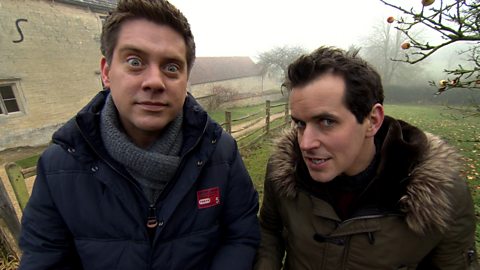
Dick and Dom describe the life and scientific works of Isambard Kingdom Brunel.
He was born in 1806 in Portsmouth, England. In 1820, he worked with his father to build a tunnel under the Thames between Rotherhithe and Wapping.
Dick and Dom visit one of the most famous bridges that Brunel designed, the Clifton Suspension Bridge in Bristol.
It was the highest and longest bridge in the world at its time.
The key scientific points are made in a fun and student-friendly way.
This short film is from the CBBC series, Absolute Genius with Dick & Dom.
In this entertaining series Dick and Dom learn about the geniuses whose ideas, creations and discoveries have shaped our world.
Teacher Notes
This short film could be used to promote a discussion on how famous scientists found the inspiration for their work.
Pupils could be challenged to research and present information on the inspiration for other important discoveries.
This could include Jenner, Pasteur and many others.
This short film is suitable for teaching science at Key Stage 2 in England, Wales and Northern Ireland, and Second Level in Scotland.
Discovering the work of Archimedes. video
Dick and Dom describe the major scientific achievements of 'Absolute Genius', Archimedes, who is best known for his work on floating and sinking.
Discovering the work of Delia Derbyshire. video
Dick and Dom describe the major scientific achievements of 'Absolute Genius', Delia Derbyshire, including creating electronic music.
Discovering the work of Elsie Widdowson. video
Dick and Dom describe the scientific achievements of 'Absolute Genius', Elsie Widdowson, who was the first to discover the nutrional values of many foods.
Discovering the work of James Watt. video
Dick and Dom describe the major scientific achievements of 'Absolute Genius', James Watt, who made steam engines much more efficient.
Discovering the work of Joseph Bazalgette. video
Dick and Dom describe the major scientific achievements of Joseph Bazalgette, who designed one of the first ever sewers.
Discovering the work of Leonardo da Vinci. video
Dick and Dom describe the scientific achievements of 'Absolute Genius', Leonardo da Vinci, who is famous for his painting of the Mona Lisa.
Discovering the work of Michael Faraday. video
Dick and Dom describe the major scientific achievements of Michael Faraday, who is most remembered for his work on electrical energy.
Discovering the work of Sir Isaac Newton. video
Dick and Dom describe the scientific achievements of Isaac Newton, who is best known for discovering gravity.
Discovering the work of Wernher von Braun. video
Dick and Dom look at the scientific achievements of Wernher von Braun, who was described by NASA as “the greatest rocket scientist in history”.