World War One was the first war where civilians were attacked from the air……
….by aeroplanes and airships known as Zeppelins.
German Zeppelins first appeared over Britain in January 1915….
More than one thousand four hundred people were killed…
….and lots of damage to buildings and homes.
Stanley Joseph Grimes. I’m 10.
I’ve seen loads of Zeppelins. They often pass over here on their way to bomb London. I don’t like ‘em. They’re huge, grey balloons which drop bombs and kill people. Sometimes children.
It was about 2 in the morning . My Dad woke me up and told me to get dressed and come downstairs.
There were lots of people in the field behind our house staring up at the sky. We could see a Zeppelin lit up by the searchlights moving through the clouds. Then we heard the engines of an aeroplane.
For a while nothing happened. Then we saw a glow which slowly seemed to spread. Then suddenly the whole sky was lit up by a huge ball of fire. People started shouting and cheering cos the Zeppelin was in flames and coming down.
It crashed near Cuffley about six miles from here and next morning we went to see the wreckage. The Zeppelin had broken into thousands of pieces. People were picking up bits of metal to keep as souvenirs. That’s how I got this.
Later we heard the full story. A pilot called Lieutenant Leefe-Robinson had flown up there in the dark and he’d fired three drums of machine guns bullets at it.
The first one to be shot down and I saw it happen. Shows these Zeppelins can be beaten. I still don’t like ‘em but I don’t have nightmares any more.
Video summary
This short film is for teachers and review is recommended before use in class.
Newsreel, photographs and a school child’s commentary give an account of the Zeppelin raids on Britain which began in January 1915.
This was the first time civilian populations had been attacked from the air.
Around 1,400 British people were killed in the Zeppelin raids, which also caused widespread damage.
In a dramatic monologue, Stanley Joseph Grimes, aged 10, tells us about the Zeppelins he saw on their way to bomb London.
He recalls seeing the wreckage of a Zeppelin that was shot down at Cuffley near Potters Bar, in 1916.
This was the first Zeppelin to be brought down on British soil.
Zeppelins would never again enjoy a reputation for being ‘invincible’.
This clip is from the series WW1 A to Z.
Teacher Notes
Pupils could locate Cuffley on a map of the UK.
They could search online using the search term ‘Cuffley Zeppelin’ to find out more about the airship Stanley Grimes describes.
Newsreel items, first-hand accounts, letters and newspaper reports are all freely available for study.
Pupils could write a short story ‘Night of the Zeppelin’ describing the events of 3rd September 1916.
Why do they think the story of the Cuffley Zeppelin was so widely reported by the British press?
This short film is suitable for teaching history at Key Stage 2 / Second Level or above.
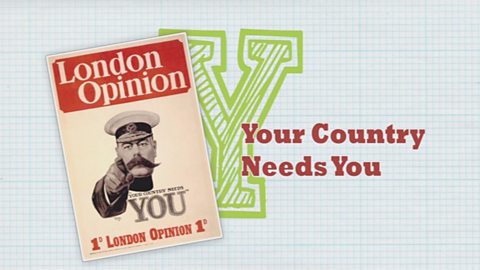
Y is for Your Country Needs You. video
A selection of British newspaper headlines from WW1 suggest the impact propaganda had in Britain.
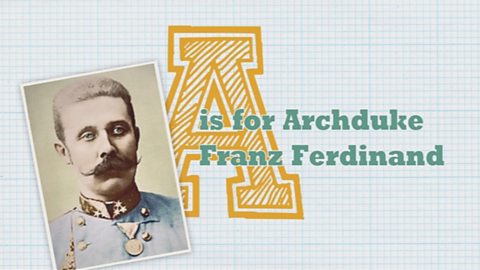
A is for Archduke Franz Ferdinand. video
Pictures and commentary explain the beginning of World War One in 1914, sparked by the assassination of Austria-Hungary’s Archduke Franz Ferdinand.
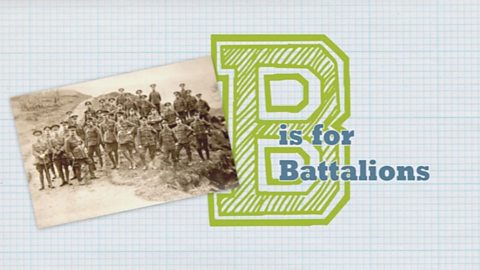
B is for Battalions. video
Newsreel and dramatic footage illustrate how the British army recruited groups of friends and neighbours to fight together.