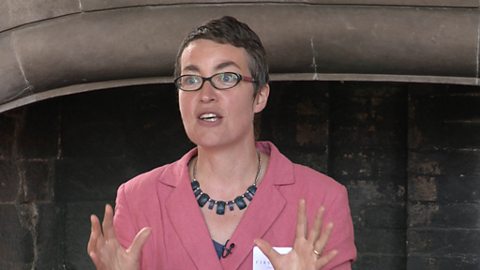
KATE CLANCHY:One of the things that happens when you are a writer and you, kind of,
KATE CLANCHY:say to yourself that you’re a writer is that you get more faith in your own process you think that after I've tackled this rubbish idea a few times.
KATE CLANCHY:And after I've applied all my best tricks to it, it will get better. There isn't any point in rattling around with the idea that you might be a writer one day, might something happen to you you've actually gotta start writing.
KATE CLANCHY:What I wanted to write about is we've all been today in this amazing castle.
KATE CLANCHY:Quite a strong place it's a place with a strong personality it's something that's worth writing about.
KATE CLANCHY:We're going to be writing a poem. And for me the basic unit of what a poem is, is an image. It's when you use a picture.
KATE CLANCHY:Out of your senses, out of your concrete information about the world to bring your idea of something alive.
KATE CLANCHY:And the other base unit of a poem is comparison, analogy, when you say something is something else or is like something else.
KATE CLANCHY:So were going to be thinking about all the things that this castle is like.
KATE CLANCHY:If this castle was an animal… What kind of animal would it be?
KATE CLANCHY:And try and be really specific.
KATE CLANCHY:If this castle was a kind of food, what sort of food would it be? If it was a pudding, what kind of a putting?
KATE CLANCHY:If it was a joint of meat what sort of meat are we talking about? I want it very specific I want the adjectives in there. I want the colour, I want the smell. If this castle was a time of day, what time of day is it, is it a late night place?
KATE CLANCHY:Is it… The middle of the night? Is it noon, is it late afternoon? Is it stormy? Is it a tranquil afternoon? Is this castle spring? Is it mid-summer? Late autumn, is it in its winter?
FANTASY MUSIC
CAROLINE BIRD:It is the dusk just before the sunset about 6 P.M. And the wedding cake looks like a rusty old bus.
CAROLINE BIRD:Honey badgers roam the gravel driveways amongst the Ford cars. With the leather smell and Rolls Royce's parked at karma's sloths.
CAROLINE BIRD:The turkey has been thoroughly stuffed. The curry is thick with raisins. And if you listen hard, the castle is breathing like a dragon.
CAROLINE BIRD:And whispering, "Off with his head" and, "Save me I'm gonna collapse". Nothing is real and the English breakfast tea tastes cold but sunny.
CAROLINE BIRD:A silver plates crammed high with mussels chips and lamb chops, is carried past by an old deaf butler. His hearing aid isn't arriving until Tuesday.
CAROLINE BIRD:Everything is covered in dust, but the dust is clean.
CAROLINE BIRD:Clean as the Silverback of a gorilla. Clean as the slice through the meat of a wild boar when it's bleeding with red wine sauce.
CAROLINE BIRD:Darlings, let's sit here together and smell the cigars. Cause nobody outside can reach us. And we can stay until the sun goes down. Wearing old cardigans, eating cherry trifle.
APPLAUSE
Video summary
The Great Hall of Oxfordshire's Broughton Castle is the setting for this poetry workshop.
Writer and teacher Kate Clanchy asks a group of teenagers to write down poetic images inspired by this extraordinary and ancient building.
Kate asks questions to help the process, for example: If the castle was a creature, what creature would it be?
What season is this castle? Is it winter or summer? What time of day is this castle? Night? Dawn?
The resulting images written by the young people are then assembled into a remarkable poem performed by Caroline Bird.
Teacher Notes
Can be used to show students one way into writing creatively about place.
Students should collectively decide on a striking local place or building, on which to base their ideas.
They can gather different pictures of this place to use in class. Students use comparison (analogy) to complete a series of writing exercises.
Students write down their ideas of the chosen building as an animal or creature, a food, a pudding, a type of meat, a time of day, a season etc.
Ask students to remember to add detail, with adjectives and descriptions of colour and smell.
Students could get into groups and pool their ideas to produce a poem, using comparing to bring the chosen setting into a new way of being.
This clip is relevant for teaching English Literature at KS3 in England, Wales and Northern Ireland, and 3rd and 4th Level in Scotland.
Rebecca Abrams - writing tips. video
Rebecca Abrams gives top tips for young fiction writers on different subjects.
Poetry workshop - The 2 sides of me. video
Caroline Bird invites thirty teenagers to imagine the two sides of their personalities and write poems about the differences.
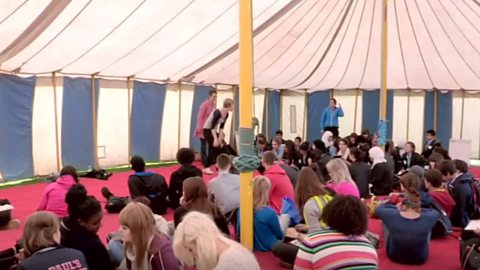
Poetry workshop - Finding inspiration. video
Writer and teacher Kate Clanchy asks a group of teenagers to write down poetic images inspired by their surroundings.