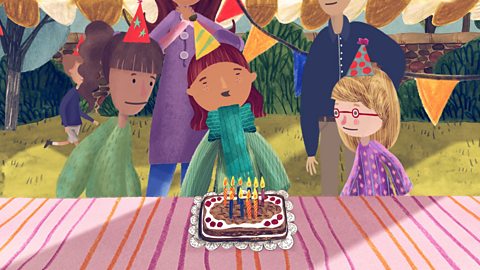
MELISSA: I grew up in a big family, so… and I’m the middle child.
It was just my mum and we didn’t have a dad around but you know, there was loads of us and I could always talk to my sister or my brother.
Yeah, I just felt really free as a child and quite happy.
I was told that I was HIV positive when I was eleven…
I remember my mum, the doctor and my older sister being there and they just sat me down and all I could remember feeling was like: “My life is over, I’m going to die!” and then he said I had to take medication from that point on every day, for the rest of my life.
We all have an immune system that keeps us healthy and alive and it fights all colds and HIV is like an attacker of the immune system. It comes in it, it tries to battle with the things that are trying to make you healthy and able. It’s like a battle between the good and the bad and HIV is the bad.
If you take your medication, you’re helping your immune system, you’re fighting the bad army which is HIV.
And AIDS is the result of not taking your medication and managing your HIV.
There are different ways of getting HIV, which is what the doctor also explained to me. Say like breastfeeding, like from the mother to the child. I assumed that I got it from my mum.
I knew that I couldn’t tell people about HIV because my mum wasn’t able to tell me.
I heard stories from like my sister, that someone had been bullied because they had HIV, so inside I always felt like I was keeping a secret and I sometimes felt like I was wearing a mask and I kind of played a character sometimes.
I’d Just put on this face and I’d be brave and happy and smiley but inside I felt like I was sort of feeling small sometimes because… it was like a weight that I was carrying around all the time.
I just wanted to be normal.
While I was taking my medication and… I’d never eat breakfast because I’d just end up throwing up.
I didn’t like that feeling of feeling sick and I just stop really. I’d just say: “Yes, I’ve taken it.”
And then one day I was sitting down in class and I couldn’t get up! I was saying to my friend (crying) “My legs are really hurting me!” and she tried to help me out.
I had to just go to the hospital and then… they said that it was arthritis in my leg and that they had to operate on my knees.
Because I wasn’t taking my medication, my immune system was like, breaking down. I was just getting weaker but I didn’t feel it until that happened.
I felt like, if I told my friends, firstly they wouldn’t know, they wouldn’t understand. They’d be really confused, like how I was! Also, they wouldn’t want to be my friend anymore.
You know, I went to a place where I could meet other people that were also like myself, HIV positive and that made me feel so much more comfortable in my skin because I knew that I wasn’t alone.
It kind of gave me confidence.
So when I moved into Secondary school I then told… two of my friends.
They didn’t believe me because I just tell too many jokes!
So they were just like “Are you serious?” and I said “Yeah." And then I had my medication with me and I showed them. And they were like “Wow! This is real! Okay, but you’re still you! You’re still, you know…”
So that made me feel a lot more confident and happy about what I was dealing with.
Video summary
A powerful and beautifully animated documentary that uses the first-person testimony from Melissa, a child living with HIV.
Melissa explains what HIV is, how she was diagnosed, the medication she takes and the physical effect of the virus.
She talks about her fear of telling people, and the stigma that made her feel early on that her condition must be kept secret.
This animation will be particularly useful for teachers when covering topics like self confidence, emotional well-being and respecting differences.
Teacher review prior to use in class is recommended. Contains some scenes which younger viewers may find upsetting.
This clip is from the series: I Can't Go To School Today
Teacher Notes
Key Stage 2:
You could ask your pupils how having HIV might impact their lives; what challenges might you be confronted with, how can other people around you make things easier?
Key Stage 3 / 4:
You could encourage students to discuss whether they have ever felt lacking in self-confidence and how they overcame that feeling.
This short film will be relevant for teaching KS2, KS3 and KS4 in England, Wales and Northern Ireland and at 2nd, 3rd and 4th Level in Scotland.
Summer's Story - Living with epilepsy. video
Summer explains the different forms of epilepsy that she suffers from; absent seizures and tonic clonic seizures.
Naomi's Story - Living with leukaemia. video
Naomi is a nine-year-old girl who has recently been cured of leukaemia. Naomi explains her diagnosis, her treatment (including chemotherapy and radiation therapy), and her recovery.
Jasper's Story - Living with cystic fibrosis. video
Jasper, a boy who lives with cystic fibrosis, explains what his condition is, the treatment he receives and the emotional challenges he faces.
Izzy and Ben's Story - Living with anaphylactic allergies. video
Two children, Izzie and Ben, both suffer with anaphylactic allergies. Izzy describes what anaphylaxis is and together they describe the different ways it influences their daily lives.