NAOMI: My name is Naomi. I live with my brother, my mum, my dad and my cat.
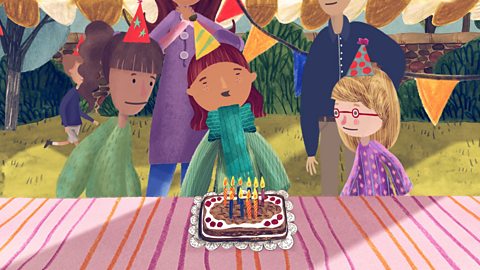
I was the only girl the boys would actually invite to their birthday parties. I think they thought I was really cool because I started playing football with them and I was the only girl that actually did that.
I did join the football team in year six and I started taking football lessons but that was… that was like the term I felt ill.
I was doing some homework that I hadn’t finished yet…
And I came downstairs and said “My throat really hurt!” to dad and he just… he took me to the doctors and the doctor looked at me and he just said to dad “Something is not right…” and mum came over and I just remember being packed into an ambulance.
We went up to the children’s ward and… they brought up a kind of X-Ray machine, they took and X-ray of my chest and they could see this huge tumour in my chest that was making it harder to breathe and I was rushed into Intensive care and by then I probably knew that was something up because Intensive Care Unit was for children.
You see so many terrible things that have happened to them and I was probably the most intensive because I was put into my own special room.
I remember just thinking “I’m like a cyborg.” because I have so many wires sticking in to me.
They thought I had some kind of cancer and it turned out I had Acute lymphoblastic leukaemia. It’s a type of blood cancer.
Erm, and my dad didn’t try to say like “prepare yourself” or anything, he wasn’t trying to seem smaller than it was. he just said “You’ve got cancer."
I didn’t really said anything, I just took it all in.
I think that’s the best way to have it because I know it feels like a slap in the face, but as obviously a slap in the face would get better.
I spent about two weeks in that room and afterwards I was moved up to the children’s ward.
We had a quite nice view of London and you could see all the skyscrapers and at night there were some fireworks which was really cool.
I started chemotherapy. it’s kind of like a medicine that eats cancer basically but they haven’t managed to make it just target the cancer so it can harm some of the body.
I was on the drip stand, so you could walk anywhere you want but you’d had to take the drip stand with you.
I used to get really grumpy too.
That’s what chemotherapy does and I remember it made me sick.
My hair was down to my waist and it started falling out when I was in the children’s ward so I had it as a bob and it was short at the back, long at the front and I really liked it that way but then my hair started falling out really soon.
So my dad just shaved it off.
Erm, at first it was kind of nice… to get away from school but it got really boring.
And also I got really tired of hospital because there were these bleeping machines. They would “Bleep” and “Bleep” and “Bleep” whenever something, chemo, fluids, steroids stop. It’d go “Bleep, bleep!”. Even in the middle of the night! “Bleep, bleep” and it was so frustrating!
And then I went onto full body radiation, where they tried to wipe out all my bone marrow.
So I remember coming back and I found the cat, he sat next to me and I remember just sitting on the chair for two hours. My friend Jenny came round and we had a chat and it was really nice to be home.
It was six months and we celebrated it.
It’s completely gone!
I am fighting my brother again and he’s definitely not being as careful with me as he was.
I’m just really happy because everything is going back to normal. I’ve got my hair again and it’s being really good.
Video summary
A powerful and eye-opening animation using the first-person testimony of Naomi, a 10-year old girl with acute lymphoblastic leukaemia.
Naomi is now in remission; she talks about her diagnosis, chemotherapy, radiation therapy and recovery.
We also hear about her life before and after the diagnosis, discussing the emotional impact of cancer and the sudden changes that it inflicts on everyday life.
The intimate and direct impact of using Naomi’s real first-person testimony encourages pupils to empathise with her situation, and to understand how some children’s lives are very different from their own.
Naomi talks about school, family, friends and explains the confusion and chaos caused by cancer.
Teacher review prior to use in class is recommended. Contains some scenes which younger viewers may find upsetting.
This clip is from the series: I Can't Go To School Today.
Teacher Notes
Key Stage 2:
You could use this short film to start a discussion with your pupils about what anaphylaxis is and how it can affect someone that suffers from it.
Key Stage 3 / Key Stage 4:
You could ask your pupils to suggest how they can be more accepting of each other's differences.
Discuss these suggestions as a class and ask how they could apply them to other situations as well.
This short film will be relevant for teaching KS2, KS3 and KS4 in England, Wales and Northern Ireland and at 2nd, 3rd and 4th Level in Scotland.
Summer's Story - Living with epilepsy. video
Summer explains the different forms of epilepsy that she suffers from; absent seizures and tonic clonic seizures.
Melissa's Story - Living with HIV. video
Melissa, a child living with HIV, explains what it is, how she was diagnosed, the medication she takes and the physical effect of the virus.
Jasper's Story - Living with cystic fibrosis. video
Jasper, a boy who lives with cystic fibrosis, explains what his condition is, the treatment he receives and the emotional challenges he faces.
Izzy and Ben's Story - Living with anaphylactic allergies. video
Two children, Izzie and Ben, both suffer with anaphylactic allergies. Izzy describes what anaphylaxis is and together they describe the different ways it influences their daily lives.