Music was very important during the War.
Keep the Homefires Burning was written in 1914.
It was written by Ivor Novello and Lena Guilbert Ford.
It became one of the most popular war songs.
Ivor Novello. Aged 45. Composer, actor, musician and songwriter.
I was just 21 when I wrote this; an unknown songwriter. The war had just started and I was trying to write a song that would cheer people up. Give them some hope.
I had this tune in my head (he hums a line) but I needed some words. All I had was ‘Keep the Home Fires Burning’. That was it. After that I was stuck. Then I remembered Lena Guilbert Ford. She was an American living in London. Lena was always writing words for songs. Perhaps she could come up with something.
She came to my house. She liked my tune and agreed to go home and write some words. Two hours later the phone rang. Lena had written the rest of the chorus.
‘There’s a silver lining / Through each dark cloud shining / Turn the dark clouds inside out / Till the boys come home. ‘
As soon as I heard Lena’s words I knew that song would catch on. We called it ‘Till the Boy’s come Home’. And catch on it did… as if by magic.
Within days of it being first performed in London in 1914, it was as if o everyone knew it! But the funny thing was people were calling it “Homefires” so we changed the title and……
‘Keep the Homefires Burning’ became one of the most famous songs of that terrible war. I became famous too but poor Lena was killed in a Zeppelin raid in 1918 and people soon forgot her. That’s unfair because without her words my tune would have been nothing.
They say there’ll be another war now. Perhaps we’ll have to sing it again.
Video summary
This short film is for teachers and review is recommended before use in class.
Newsreel and commentary about the role of patriotic songs in World War One.
School children practise singing the 1914 number ‘Keep the Home Fires Burning’, with music by Ivor Novello and lyrics by Lena Guilbert Ford.
A dramatic monologue set in the late 1930s introduces Ivor Novello, who tells us how his famous song came to be written.
Britain is on the brink of another war and Novello wonders if his song will be sung once again.
This clip is from the series WW1 A to Z.
Teacher Notes
Pupils could find out more about other patriotic songs of the war years, from books and websites.
The children could compile a wartime songbook, grouping the songs in sections, according to their subject or purpose.
The children might have a section of recruitment or home-coming songs, for instance.
They could practise singing a selection of songs and vote for their top ten favourites.
This short film is suitable for teaching history at Key Stage 2 / Second Level or above.
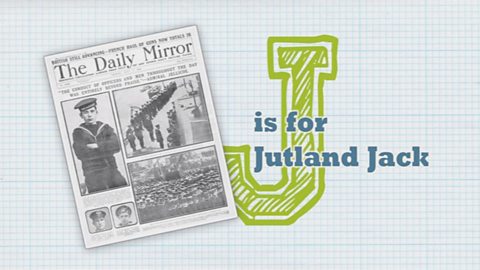
J is for Jutland Jack. video
Newsreel and commentary about the role of patriotic songs in World War One, plus a dramatic monologue about the songwriter Ivor Novello.
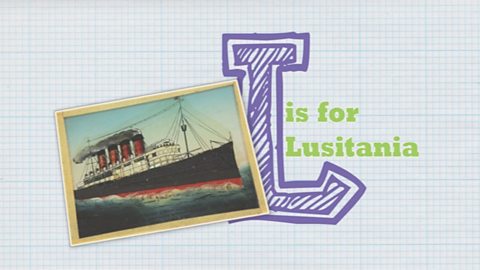
L is for Lusitania. video
Newsreel and a dramatised monologue about the Lusitania, a passenger ship that was sunk by a German U-Boat off the coast of Ireland.
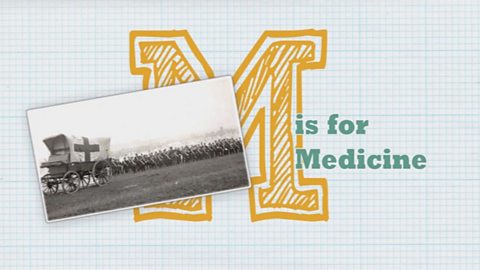
M is for Medicine. video
Newsreel and a dramatised monologue about the advances in medicine made during World War One.