Overview of Planet Planners on Roblox
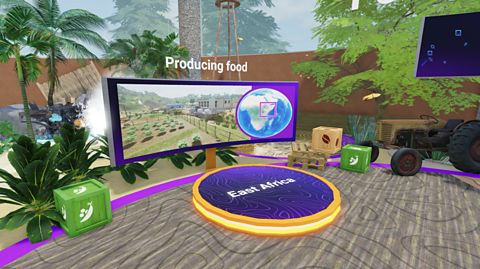
Planet Planners on Roblox is an engaging way for students to learn about some of the world's most pressing challenges – from preparing for natural disasters to managing large cities.
A decision-making exercise game with geographical thinking at its core, it also builds key skills such as teamwork, time management, resilience, problem-solving and decision-making.
It is accessed via Roblox – an immersive platform for 3D experiences. To learn more about Roblox and how it can be used in education, visit Get started with Roblox Education.
For more detailed information about the game, visit How to teach using Planet Planners on Roblox.
Scenario description
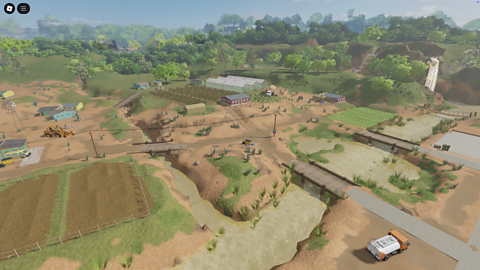
In this scenario, players take on the role of decision-makers in a rural farming community where they must weigh up environmental sustainability, food security and economic development.
They must analyse data and respond to environmental and agricultural issues, as well as make decisions about water pollution, crops and infrastructure.
Players are encouraged to think critically and evaluate trade-offs between increased profits and the protection of natural resources.
Approximate location: East Africa
Teacher notes
Download/print the teacher notes for this scenario (PDF).
Teacher notes prepared in partnership with the Geographical Association.
Learning objectives
- To identify the challenges of food distribution in low-income countries (LICs), including issues related to infrastructure and transportation.
- To make decisions about strategies to address and combat food insecurity in LICs.
- To examine the political, economic and human costs associated with food insecurity in LICs.
Key decisions
- How should we respond to water pollution?
- What economic activities should we prioritise: food for local people or growing products for export?
- Which crops are best suited to specific rainfall and soil conditions?
- Should we use chemical or natural fertilisers?
- How do we balance the need for farmland with the protection of wildlife?
Key geographical terminology
Agriculture: Using the land to produce food – eg growing crops or rearing animals.
Export: To sell goods to other countries and send them out of the country to them. The goods are known as exports.
Fertiliser: Nutrients added to the land to make crops grow better.
Pollution: Something in the environment that shouldn’t naturally be there – eg chemical spills in rivers and lakes.
Think, work and apply like a geographer
Encourage students to explore the links between gameplay and real-world job roles, such as:
- agricultural scientist
- farmer
- hydrologist
- environmental consultant
- conservation officer
Questions to explore
- What are the causes and effects of water pollution in farming communities?
- How can farming practices affect local ecosystems and water sources?
- What factors influence crop choices?
- What are the advantages and disadvantages of chemical and natural fertiliser use in low-income countries?
- How do decisions about land use affect biodiversity and food security?
- How do infrastructure investments improve rural livelihoods?
- Who benefits from export-focused agriculture vs. local food production?
- What are the effects of deforestation?
Emotional and ethical considerations
Ethical decision-making: Is it fair to prioritise exports if local people go hungry? Should we protect endangered species at the expense of farming expansion? Should big companies or small farmers benefit more from shared community resources?
Resources
Teacher notes
Download/print a copy of the teacher notes for this scenario (PDF).

Student worksheet
Download/print a copy of the student worksheet (PDF).
Explore more
Support classroom learning with BBC Bitesize resources.
Note: Some video content may only be available in the UK.
Food resources
There is enough food to feed everyone, but it is not evenly spread. Food insecurity is a major issue in some countries.
Sustainable food resources
Sustainable food production could help feed the world’s growing population.
Africa. 6: Achieving sustainability. video
Exploring sustainable developments in Africa and moves towards a greener economy.
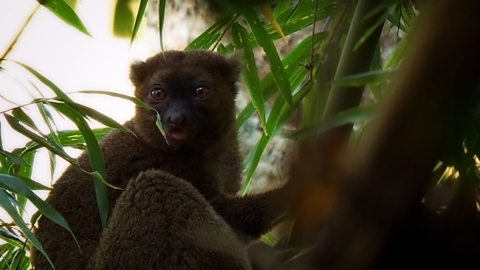
How deforestation in Madagascar is threatening animal habitats. video
The teenagers investigate how deforestation in Madagascar threatens the lemur's habitat, but happens in response to local needs.
UN Sustainable Development Goal 2: No hunger
Around the world, hunger and limited access to food is still a major problem for millions of people.
How to become a farmer: Aimee's story
Aimee is a farmer on the Shetland Islands.