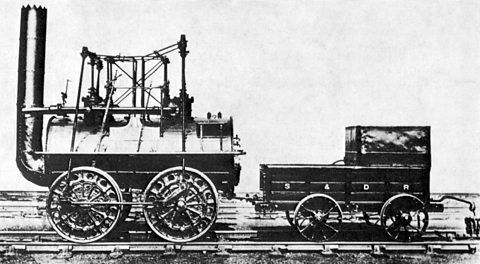
This collection of teaching resources is suitable for use with both primary and secondary schools, and can be used to mark the 200th anniversary of the Stockton and Darlington Railway on 27 September 2025.
What was so important about the Stockton and Darlington Railway?
In 1821, the inventor and engineer George Stephenson was commissioned to build a new railway to transport coal more efficently from collieries near Bishop Auckland to the port at Stockton-on-Tees, in the north-east of England.
The Stockton and Darlington Railway opened on 27 September 1825 and was the first public railway to carry fee-paying passengers using steam locomotives.
It is widely considered to be the first 'modern railway', bringing together many elements that transformed the transport industry – both in Britain and around the world.
in this short video, historian Dan Snow tells the story of the Stockton and Darlington Railway, which opened on 27th September 1825.
By the early 1800s, parts of industrial Britain had developed an ingenious way of moving coal around. Known as a wagon way, it involved a horse pulling a cart along railway lines. It was groundbreaking for its time, but this was the Industrial Revolution, and times were changing fast.
Nowhere was this more obvious than at one huge coalfield in County Durham. It had massive moneymaking potential, but wagon ways were not enough to unlock it. The only thing that could was a railway. Step forward George Stephenson, a local engineer, and his colleague, Nicholas Wood. It was agreed that they would build this railway—the first of its kind.
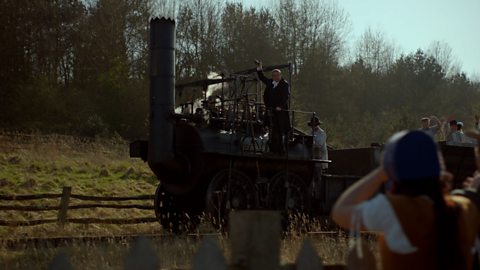
The Stockton and Darlington Railway opened on the 27th September 1825, watched by crowds of thousands of astonished onlookers. This was something totally new. Unlike anything that had come before, the rails were made of iron instead of wood, and the power came not from horses but from locomotive engines driven by steam. It was a success! People on board could now travel faster than a man could run.
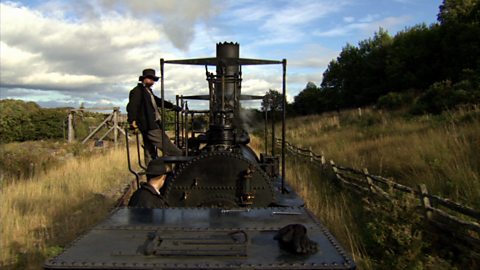
The trains were built to take coal from Darlington to the port of Stockton on the River Tees, but this railway provoked a reaction that no one was expecting. Even though I have travelled on faster trains, riding on this replica still gives you a sense of just how magical it must have been for those first passengers at the dawn of the railway age. It was that magic that made it a success.
While some critics, including writers and artists, were warning against the arrival of machines, the people fell in love with them. It seems amazing now, but no one had really expected the excitement it would cause. Tens of thousands of people wanted to travel between Stockton and Darlington, whereas a fraction of that had gone by stagecoach.
The Stockton and Darlington became world famous, and people travelled from across Europe just to see it. This has been seen as a huge turning point in the history of railways. In a way it was, but not because of all the minor incremental improvements Stephenson made to the locomotive and the rails. It was because, partly driven by this huge demand from people, from passengers, it made money. It was profitable.
Of course, the line wasn't without its problems. The engine broke down all the time, so horses still had to be used. There were accidents, and it was far too busy. But, make no mistake, this was a massive event. For a while, the eyes of the world were on Stockton and Darlington, and the line was more popular than anyone could ever imagine.
Put simply, it proved that railways were the future.
Primary resources
Down at the station. video
A traditional nursery rhyme with lyrics suitable for teaching 3-5-year-olds.
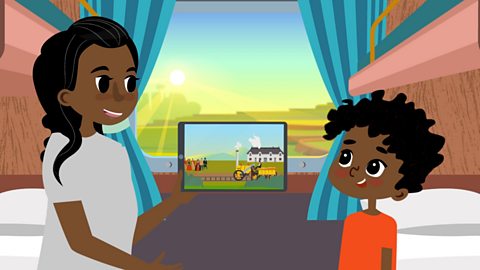
Travel and transport: Tremendous trains. video
In this short animation Rian and Maya travel across India, finding out about the history of train travel. Suitable for teaching 5-7-year-olds.
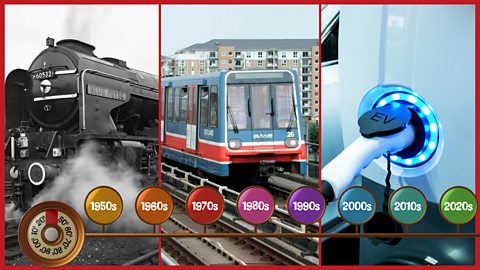
Changes within living memory - Transport. video
Explore changes in transport within living memory with this short film aimed at 5-7-year-olds.
School Radio: Victorian railways. audio
This collection of audio resources explores the invention of the train and the expansion of the Victorian rail network. Suitable for teaching 7-11-year-olds.
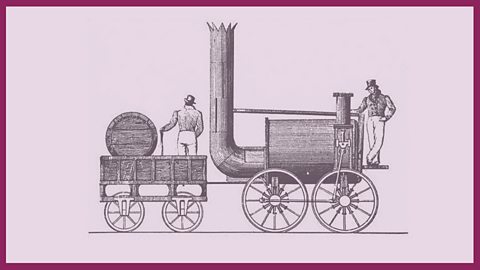
How have our railways changed? collection
Learn about how the railways have changed since the Victorian era with this lesson for children aged 7 to 11 from the Railway Museum and BBC Bitesize.
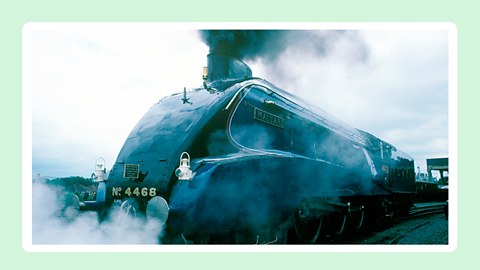
Secondary resources
Locomotion: Dan Snow's History of Railways. collection
Dan Snow examines the development of the railways from their beginnings as track-ways for coal carts in the early 18th century to the pivotal technology for modern Britain. Suitable for teaching 11-16-year-olds.
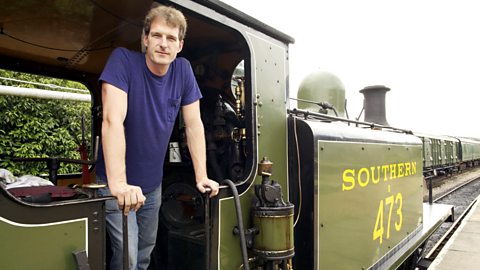
The invention of the railway. video
A short film looking at the major scientific invention of the railway by George Stephenson. Suitable for teaching 14-16-year-olds.
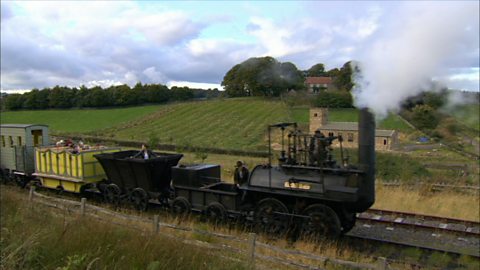
The Industrial Revolution. video
Andrew Marr tells the story of Britain’s industrial revolution including the impact of the railways. Suitable for teaching 11-14-year-olds.
Transport — canals and railways. revision-guide
A revision guide for 14-16-year-old pupils on how railways brought changes to industry, society and politics.
The impact of the railways during the Industrial Revolution. revision-guide
A revision guide for 3rd level (11-15) Scottish History that looks at how the arrival of the railways revolutionised life in Britain.