|
 |
 | | | You are in: Motorsport: Formula One |
|
| |  Friday, 13 September, 2002, 08:32 GMT 09:32 UK Friday, 13 September, 2002, 08:32 GMT 09:32 UKWhy F1 teams dominate then fade  F1's top teams take success in turns
There is not a trace of complacency as Ferrari arrive in Monza hoping to celebrate Michael Schumacher's third consecutive Formula One title with a home win. The reason is simple - Ferrari's bosses know all too well that Formula One history shows that a single team very rarely dominates for more than two or three years. McLaren enjoyed a run of four world titles in the late 1980s and early 1990s, but since then the drivers' championship has been won by four different teams, each of whom held on for just two years until Ferrari's current run. Why does this happen? Why is each team dominant for a short period and then overtaken by an arch-rival? To explain, BBC Sport Online investigates the ebb and flow of F1 fortunes over the last 20 years. How we rate the teams Think of each team's overall performance being made up of four elements: engine, chassis, drivers and tyres. The most successful team might not necessarily have the best engine or the best chassis, but their overall package will be the best. If you were to award points out of 10 for each element, the 2002 line-up might look like this: Ferrari Total: 38/40 Williams Total: 31/40 McLaren Total: 29/40 So although Williams' BMW engine is better than Ferrari's, their chassis is not in the same class, their Michelin tyres are not as good as Ferrari's Bridgestones and Juan Pablo Montoya is outperformed by Michael Schumacher. But here is the rub. The balance of power is so delicate that if just one element falls away, the entire team can be fatally weakened. McLaren's Mika Hakkinen won back-to-back titles in 1998 and 1999, with Ferrari the closest pursuers. So what happened to turn that on its head by 2000? In 1998, the contest looked something like this: McLaren Total: 37/40 Ferrari Total: 34/40 By 2000, Ferrari had kept up their rate of improvement, but McLaren - and particularly their engine supplier Mercedes - had not matched their rivals' rate of development. Hakkinen was still a good driver; Adrian Newey's chassis was still a beauty; all F1 teams were using Bridgestone tyres. But the drop in development rate had allowed Ferrari to catch up. And since then, Mercedes have really gone off the boil, leaving McLaren further and further behind. The interplay of all these separate parts is complex - but pretty much every change in the F1 hierarchy since the mid-1980s can be explained in the same simplified manner. The ebb and the flow
In 1987, McLaren had a 7/10 chassis, a 6/10 Tag-Porsche engine, Alain Prost at the 9/10 mark and the same Goodyear tyres as everyone else.
Both Prost and Piquet scored three wins to Mansell's six, but Piquet's consistency made him champion. And Williams were the constructors' champions. By 1988, the McLaren chassis had improved to 10/10. They now had the 10/10 Honda engine and Ayrton Senna and Prost at 10/10. Williams, by contrast, maintained their chassis at 8/10, had Mansell and Ricardo Patrese at 7/10 but had to cope with the calamitous Judd engine - for which we award no more than 4/10. The result? 15 Grand Prix wins out of 16 for McLaren, with Senna taking the drivers' title from Prost - and no wins at all for Williams. 1993 to 1994: Benetton take over from Williams By 1992, the Newey-designed Williams chassis and the Renault engine plus Nigel Mansell had them back on top.
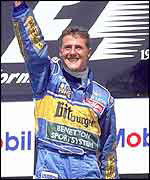
Benetton's demise from 1996 onwards can be put down in large part to the departure of Schumacher at the end of 1995, and the subsequent decision of designers Ross Brawn and Rory Byrne to join him at Ferrari. The future How long will Ferrari's dominance last? The contracts of technical director Brawn, chief designer Byrne and sporting director Jean Todt all expire with Schumacher's at the end of 2004. While those four men remain at Maranello, there's a pretty solid chance that the team will stay at the top of pile. But beyond that? It would be a brave man who was prepared to bet on it. | |
See also:  21 Jul 02 | Formula One 01 Sep 02 | Formula One 18 Aug 02 | Formula One 28 Jul 02 | Formula One 21 Jul 02 | Formula One Internet links: The BBC is not responsible for the content of external internet sites Top Formula One stories now: Links to more Formula One stories are at the foot of the page. | |||||||||||||||||||||||||||||||||||||||||||||||||||||||||||||||||||||||||||||||||||||||||||||||||||||||||||||||||||||||||||||||||||||||||||||||||||||||||||||||||||||||||||||||||
| | | | | | |||||||||||||||||||||||||||||||||||||||||||||||||||||||||||||||||||||||||||||||||||||||||||||||||||||||||||||||||||||||||||||||||||||||||||||||||||||||||||||||||||||||||||||||||
 | |
|  E-mail this story to a friend E-mail this story to a friend |
| |
| Links to more Formula One stories |
| | | ||
 | ||||
 | | Back to top
| ||
| ------------------------------------------------------------ BBC News >> | BBC Weather >> -------------------------------------------------------------------------------- © MMIII | News Sources | Privacy |