Why has it gone so wrong for Aston Martin?
- Published
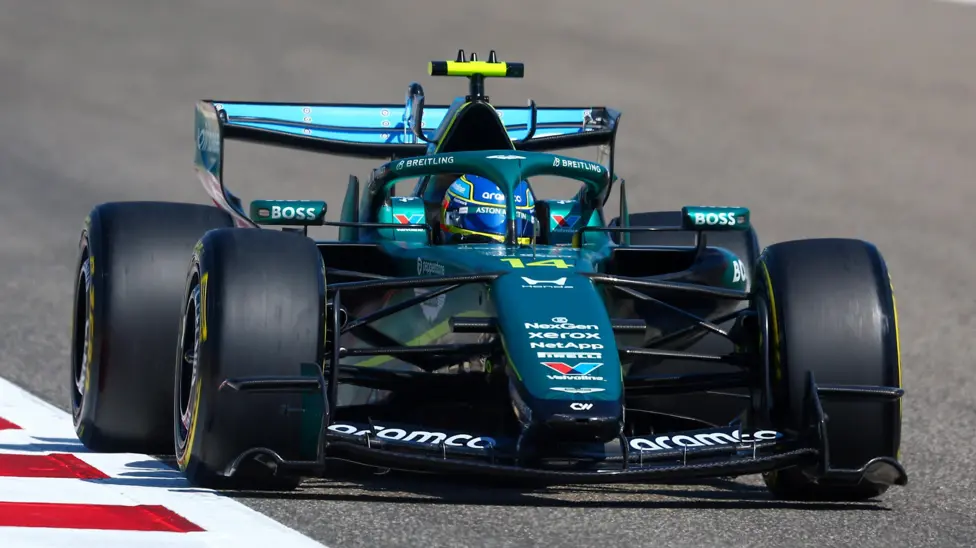
When Aston Martin's new Formula 1 car first appeared in testing at the end of January, it drew admiring glances up and down the pit lane.
In its all-black temporary colour, the car not only looked menacing, but also noticeably different from all its rivals. It included the sort of innovations that have become famous from design legend Adrian Newey, installed as managing technical partner at Aston Martin since March last year.
But reality bit hard as soon as the car started to run. It was already late, and it managed just four laps on its first day in Barcelona before conking out at the entrance to the pit lane.
Aston Martin's fortunes have barely improved since.
The car was the slowest in the field by the end of pre-season testing last week, and had done the fewest miles.
Team owner Lawrence Stroll looked like the bottom had fallen out of his world as he stalked the paddock in Bahrain, his face betraying a combination of anger and despair.
The few times the car was out on track amid myriad reliability problems, it looked a handful for the drivers.
Publicly, Aston Martin and Honda were saying little. Privately, no-one was trying to hide the reality. They were in trouble, they knew it, and whatever was wrong - and it was a lot - would take time to fix.
Promise, undelivered

Lawrence Stroll's son Lance is Fernando Alonso's team-mate at Aston Martin
It all looked so promising
No Formula 1 team looked towards the 2026 season with greater expectations than Aston Martin.
On paper, Stroll had put together a dream combination, one that seemed guaranteed to produce success.
The signing of Newey in September 2024 seemed to be the final piece of the jigsaw the Canadian billionaire was creating to turn his team into championship contenders.
In the previous years, Stroll had already inked a deal to become the factory engine partner of Honda, who won four consecutive drivers' titles with Red Bull and Max Verstappen from 2021-24, and two constructors' championships.
He had funded a sparkling new factory, including a state-of-the-art wind tunnel and driver-in-the-loop simulator.
He had put together an enviable sponsorship portfolio of boundless resources, including the full financial might of the state of Saudi Arabia, through its national oil company.
And in the cockpit was another legend, Fernando Alonso. Ageing, certainly, now he is in his mid-40s, but still without question a major force behind the wheel.
Newey's new car is a dud - so far

Adrian Newey joined Aston Martin as managing technical partner and has also taken on the role of team principal in 2026
The past few years have not been easy for Aston Martin. A major step forward at the start of 2023, when Alonso first joined the team, led to six podiums in the first eight races and what could have been a win in Monaco, lost only to a wrong tyre choice during a late shower of rain.
But in the second half of that season the team slipped back, as they failed to keep up with the development rate of their rivals. The same happened in 2024, from a lower starting point, and in 2025 they were simply uncompetitive, slipping to seventh in the championship from fifth the previous two years.
Newey's arrival was supposed to herald the start of the turnaround, especially as historically he has aced regulation changes, producing design philosophies that were followed by rivals - in 1998 with McLaren, and again in 2009 and 2022 with Red Bull.
The biggest rule change in F1 history for 2026 gave him the chance to do it again, this time for Aston Martin.
But the first car produced under his leadership has fallen far short of expectations, and a glance at the context makes this less of a surprise than it appears on the surface.
In F1, success comes from stability, and that is the last thing Aston Martin have had in the past few years. There has been major leadership churn, and right at the top, too.
This has included new recruits, such as chief technical officer Enrico Cardile, who finally arrived in July after a year on gardening leave from Ferrari.
But also casualties. The most recent was Andy Cowell, the architect of the success of the Mercedes engine in the hybrid era. He was installed as chief executive officer only in October 2024, but just over a year later, after a clash with Newey, was demoted to a different role.
Cowell is now spending much of his time in Japan, trying to help Honda sort itself out.
Andrew Benson Q&A: Send us your questions
- Published13 August
Aston Martin were already playing down expectations when they had their official team launch in early February, emphasising the project would need time to become successful.
Newey has explained that his starting in March left them some months behind other teams in terms of development.
The new 2026 aerodynamic regulations were finally officially published on 2 January 2025, two months before Newey officially started work at Aston Martin.
In reality, teams have been working on their 2026 cars for much longer than that. The basics of the cars' layouts in the rules had been known for some time, and the teams had all been in working groups refining the detail with governing body the FIA, so knew where they were going.
The word is that when Newey arrived in March 2025, he effectively ordered a redesign of the car on the basis of his ideas. So the current car is several months, at least, behind all its rivals in terms of development. With that sort of deficit, even he cannot work miracles.
Newey has described the Aston Martin as "one of the more extreme interpretations" of this year's new rules.
Right now, in its under-developed form, there is no question it is uncompetitive - slow and unpredictable. It may yet turn out that it can be developed into a good car, but until Honda sorts itself out, it will be hard to tell.
Why is the Honda engine lacking?
Honda's plight has brought back painful memories of a decade ago.
When it returned to F1 in 2015 with McLaren, it was underprepared, and spent three difficult seasons with engines that were underpowered and unreliable. The similarities with now are unmistakable.
Why it is so unprepared this time is less understandable.
Honda officially pulled out of F1 at the end of 2021, when Max Verstappen took a Red Bull powered by their engine to his first world title.
It announced its return to F1 with Aston Martin in May 2023.
The argument given to explain now being so far behind is that Honda's F1 engine project was essentially disbanded and the engineers involved reallocated to other areas of the company in the 15 months between the two dates.
However, it's not like Honda went away. Both Red Bull teams continued to use its engines until the end of last year.
Although there was a development freeze, the engine was still being upgraded each year because F1's regulations allowed modifications for reliability reasons. Every manufacturer in F1 uses this loophole to produce performance upgrades in the name of improved reliability.
If Honda had not been doing this, it would have fallen behind progressively from 2022 to 2025, which it did not.
On top of that, Honda representatives were involved in meetings about the new engine rules all the way through - hence their U-turn on involvement in early 2023.
Still, the argument is that without a fully dedicated F1 engine department, Honda lacked a team designing and building a new engine to the revised rules for this year, and had to build one up again more or less from scratch.
But so did Red Bull. In 2020, when they announced their decision to build their own engine factory, they had nothing. The original plan was to go into partnership with Porsche, but that deal foundered by late summer 2022.
Considering Red Bull had to build a powertrains factory from literally nothing in this period, and recruit an entirely new staff, their timeline is not that dissimilar from Honda's.
So why is Honda so far away from where it wants to be? No answer to that has been provided.
The Alonso factor

Fernando Alonso made his F1 debut in 2001 and won the world title in 2005 and 2006
A new car and engine partnership with Honda that struggles for reliability and performance and has Alonso as one of the drivers. If that sounds familiar, it's because it is.
In 2015, Alonso joined McLaren from Ferrari wooed by the promise of Honda's potential. That potential was eventually realised - but not until 2020-21, by which time Honda and McLaren had long since split and Honda had joined forces with Red Bull.
Alonso's career, meanwhile, became a kind of living purgatory. One of the greatest drivers the sport has ever known reduced to fighting for scraps, making up his own targets for motivation, rather than what he should have been gunning for - wins and titles in F1.
He last won a race in May 2013, and he is now 44. But his performances have continued on a high level, and the respect he has from his peers on the grid is higher than ever. For his talent, and his ability to keep up his motivation in the face of everything.
The Newey-Honda-Aston Martin combination on paper promised Alonso something positive, a last hope of a return to success with which to bring his storied career to a close. Either this year, when his current contract runs out, or perhaps after one more, if glory seemed tangible.
Instead, he has found himself transported back in time 10 years.
Alonso has waited an entire career to work with Newey, the excellence of whose cars - and some terrible luck - have denied the Spaniard at least two further world titles that he should have won.
Alonso won't doubt Newey can sort this out. Who would? But after his experiences with Honda last time, can he really convince himself it can turn this around in the limited time he surely still has available?
In public, Alonso is staying hopeful, just as he did with McLaren and Honda, bar one or two public slips when it all got too much.
"Everything can be fixed, for sure," he says. "Short and medium term. I don't think there is anything that is impossible to fix.
"We will try to fix everything we can before Australia and after that we try to fix as many things as possible in the first couple of races. Because [otherwise] it's too late in the championship. But no, I'm optimistic. I think there is a solution in place."
Alonso's partner Melissa Jimenez is expecting their first child in late March.
The emergence of the unfolding catastrophe that is Aston Martin-Honda is so recent he has not yet been asked about his thoughts on his future. But he will already be considering what to do.
Does he roll the dice one last time, try to summon the energy and commitment to go again after what will doubtless be a very trying year? Or call it quits?
Related topics
- Published20 February
- Published20 February