Why Frank at Tottenham was a gamble that ended in bitter failure
- Published

Thomas Frank's appointment as Tottenham head coach was a gamble by both parties. It was a gamble that failed - ending in a storm of toxicity.
Frank left behind the stability and structure that underpinned his superb work at Brentfordfor the chaos of Spurs.
In place of the bedrock of Brentford owner Matthew Benham and director of football Phil Giles, Frank stepped into a high-stakes environment where even winning the Europa League - Spurs' first trophy in 17 years - did not spare predecessor Ange Postecoglou the sack.
Spurs, in turn, were employing a head coach who had operated away from the sort of harsh spotlight and high expectations that awaited him in his new job. It was an ill-starred alliance, and Frank quickly found himself out of his depth.
This has been a joyless, miserable spell characterised by constant hostility aimed in Frank's direction by the vast majority of Spurs supporters, who decided very quickly he was not the man for them or the job he was required to do.
Frank's dismissal will be a bitter disappointment for the popular, personable Dane, who earned his big opportunity at Spurs by taking Brentford into the Premier League and keeping them there for four seasons.
So where did it go wrong?
Frank's Spurs lacked identity
Frank dismissal needed as Spurs in danger of relegation - Shearer
Frank took over a side that finished 17th in the Premier League last season, having lost 22 games in the process.
They won the Europa League, but the true measure of a side is league position - and by that metric, Frank inherited a mediocre squad.
The notion this could be fully corrected - or even significantly transformed - in a matter of months is from the realms of fantasy.
Spurs not only needed a change in team, but a change in culture. This must be factored into Frank's downfall.
The club has struggled to find anyone to match the popularity of Mauricio Pochettino, who was sacked six months after Spurs' defeat by Liverpool in the 2019 Champions League final.
Frank's dismissal means he joins a list that includes proven winners Jose Mourinho and Antonio Conte, along with Nuno Espirito Santo and Postecoglou, who brought back long-awaited silverware last season.
The Dane ultimately could not get to grips with this most testing of tasks. It consumed him, ending with him looking a broken, beleaguered figure.
Frank failed to produce a side with any sort of clear identity, dragged down by muddled thinking and, when it mattered, a safety-first approach.
When the history of Frank's time at Spurs is written, defeats at home by Chelsea and at Arsenal in the north London derby will assume something close to notoriety.
In statistical terms, they were two of the most impotent attacking displays by any Premier League team this season. Spurs generated 0.1 xG at home in their 1-0 loss to Chelsea, then just 0.07 xG in the 4-1 reverse at Arsenal.
It was Frank's timid approach - almost as much as the loss - that drew such fierce criticism after the game at Arsenal - a five-man defence effectively a damage-limitation exercise that allowed the Gunners to win with ease.
The fact Eberechi Eze - a player Spurs wanted but allowed Arsenal to steal in and beat them to a £60m deal - scored a magnificent hat-trick only added to the pain and embarrassment.
While the defeat at Arsenal will have hurt Spurs fans more, it was the loss to Chelsea that was arguably more worrying, especially as it was at home.
Only a combination of wastefulness from the visitors and the heroics of goalkeeper Guglielmo Vicario prevented it from being a hammering.
It was the beginning of a painful journey to the end.
When Frank was at Brentford, he had a reputation for clarity of thought, strategy and communication - a personality who could detect problems and solve them.
Those qualities were lost as Spurs hit the buffers after winning his first two Premier League games in charge.
Either Frank was not clear enough or the Spurs players did not buy into his approach.
If regular observers were asked to identify any obvious style or strategy, they would struggle to answer. This was a mishmash of ideas with no clear identification marks.
Frank started with two wins: at home against Burnley, then at Manchester City. But, as with Postecoglou, a bright start soon subsided.
At Brentford, Frank's plan was to play long, play quick, and pressurise opponents in open play and set-pieces. There was quality too, with forwards such as Ivan Toney, Bryan Mbeumo and Yoane Wissa.
Frank never established any obvious identity at Spurs, with fans quickly turning against what they saw as at best a pragmatic approach, and at worst a negative one.
Fans, and on many occasions players, either failed to understand Frank's strategy or believe in it, with the head coach himself sometimes looking shocked at the manner of Spurs' unravelling.
One of Frank's first acts was to name Cristian Romero as captain in succession to Son Heung-Min. It was an ill-judged decision to hand the armband to the Argentine World Cup winner. Too often he has been a liability on the field - at times a red card waiting to happen - and off the pitch with loose-lipped statements.
The former was proven in red cards against Liverpool and at Manchester United, the latter in two outbursts against the club's hierarchy - the first effectively accusing them of lying in a later edited Instagram post then, saying the lack of available players was "disgraceful".
It did Frank more harm than good.
Failed Eze deal and injuries hit Frank's plans
For all the failings on the pitch, Frank did not enjoy the best of fortunes when it came to players available to him.
Injuries denied him the chance to use some of his most influential performers. And there also was the departure of the iconic Son.
Another major blow came when the club let the potential signing of Eze drag on so long that Arsenal seized the opportunity to hijack his move from Crystal Palace.
Spurs also thought they had a £60m deal to sign Nottingham Forest's gifted midfielder Morgan Gibbs-White, with a medical tentatively pencilled in. But Forest owner Evangelos Marinakis begged to differ, and the saga ended with the player signing a new deal.
In Eze and Gibbs-White, Spurs could have acquired match-winners who might have proved priceless to Frank.
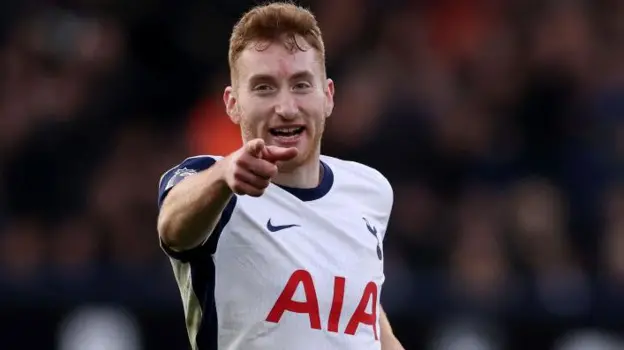
Dejan Kulusevski's long-term knee injury robbed Frank of a crucial attacking weapon
Dejan Kulusevski - one of Spurs' most dangerous game-changers - never played a minute under Frank because of surgery on a patella injury sustained last season.
England midfielder James Maddison had been in and out under Postecoglou, but his hopes of making an impact under Frank disappeared when he tore his anterior cruciate ligament in a pre-season friendly against Newcastle in June.
Dominic Solanke - the side's £60m spearhead - was also missing for months after an operation on an ankle injury, while Mohammed Kudus - a £55m signing from West Ham - and Richarlison also suffered long-term injuries.
While Frank was unable to find solutions, there is no question those absences were damaging.
Frank failed to connect with fans
Former chairman Daniel Levy was a permanent lightning rod for the anger of Spurs fans. When he departed in September, it was welcomed by the majority but left Frank more in the firing line - and with a shield removed.
Frank was - justifiably - a hugely popular figure at Brentford, not just for his success on the field but the close connection he forged with supporters.
The sight of him leading his players on a post-game lap of honour became familiar - and he would acknowledge faces he recognised in the crowd.
It was ironic, then, that one of the most toxic moments of Frank's brief reign came at the Gtech on New Year's Day, when he was greeted with loud jeers from the visiting Spurs fans at the end of a mind-numbing goalless draw.
It was not so easy to forge close bonds in a vast, state-of-the-art arena housing more than 61,000 supporters. They have to be forged by results - results which did not come, winning just two of 13 home league games.
Frank's post-match lap of honour became a point of contention and controversy when defenders Djed Spence and Micky van de Ven brushed past him and refused to take part after the defeat at home by Chelsea, though they later apologised.
Even if they were angry with fans, the manner in which they brusquely dismissed Frank's wishes sent out poor signals, raising doubts about his level of control.
For all Spence's contrition, the manager again faced awkward questions about his defender's reaction to being substituted during the dismal 3-0 loss at Nottingham Forest.
It has been a miserable, joyless reign. Too often games ended in discontent - a disconnect noted by the club.
Frank certainly never felt the need to publicly criticise his own supporters at Brentford - a move that rarely ends well - but after a defeat by Fulham he declared the booing of goalkeeper Vicario "unacceptable" and not the actions of "true Spurs supporters".
To do so - even to only a section of the crowd - was a high-risk strategy. He never got the wins to heal that fracture.
Frank's reign also proved to be unwittingly accident prone, as when he was caught on camera unwittingly drinking out of an Arsenal cup before the defeat at Bournemouth in January.
A small matter not of Frank's doing, but led to him being lampooned by Gunners' fans, with memes depicting the Spurs boss relaxing in Arsenal pyjamas while sitting on a red-and-white club duvet.
Frank's honesty, upbeat demeanour and results meant he was idolised at Brentford. It was the polar opposite at Spurs.
Time and patience - precious commodities at Brentford - were in short supply. Not just from the post-Levy powerbrokers, but from fans who simply never warmed to Frank, and who were unconvinced by his pedigree and methods.
There was no doubt many Spurs supporters felt Frank was not up to the job from the start - his solid grounding at a smaller club in Brentford not, in their eyes, the background required to wrestle with the unwieldy beast in north London.
Frank needed to make an instant impact to dispel the doubts. He was unable to do so.


