Milan-Cortina 2026 closes with ceremony in Verona
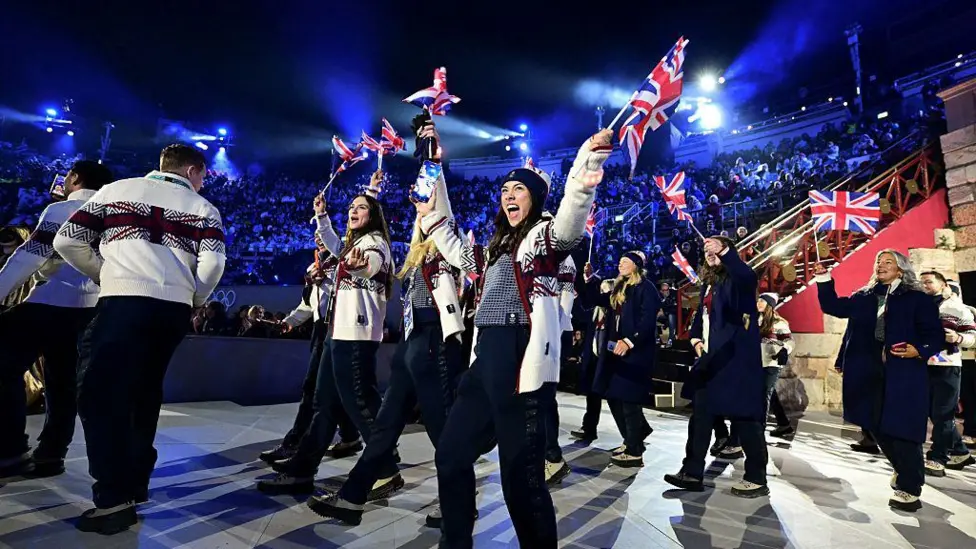
British athletes paraded at the closing ceremony in Verona following the most successful Winter Games ever for Team GB
- Published
The Milan-Cortina 2026 Winter Olympics have officially ended following the closing ceremony in northern Italy.
It took place at Verona Olympic Arena, despite none of the sporting events happening in the city, which is 75 miles from Milan.
After beginning with a tribute to classic Italian opera, flagbearers representing the 92 competing nations entered the stadium through large props from Aida and accompanied by a tribute to Italian film music.
The 'Drop of Fire' – the Olympic flame carried in a small glass vessel – was brought into the ancient arena to light up the rings before the parade of athletes.
While athletes are supposed to come in all mixed together, here they were still largely in national groups.
The final medals from Milan-Cortina 2026 were awarded in the women's and men's 50km mass start cross-country skiing events, before a tribute to the Games volunteers.
The ceremony finished with performances from popular Italian musicians Major Lazer and singer-songwriter Achille Lauro.
In her speech to close the Games, International Olympic Committee (IOC) president Kirsty Coventry said: "You have been incredible – every one of you. Brave. Fearless. Full of heart and passion. You left it all on the snow and ice.
"Two unforgettable weeks, living every moment to the fullest. You gave everything – and you shared it with all of us.
"This is the true Olympic spirit: competing, embracing, lifting each other up, whatever the result. You showed us what excellence, respect, and friendship look like in a world that sometimes forgets these values.
"You showed us that the Olympic Games are a place for everyone. A place where sport brings us together."
It ended a Games which saw 116 medal events, and historic sporting success for several of the competing nations – including Great Britain.
Team GB won five medals, including three golds, to finish 15th in the table. Britain has never previously won more than one gold at a Games before.
Matt Weston, the male flagbearer, won two golds in skeleton – the men's event and the team competition with Tabby Stoeker.
The female GB flagbearer was Charlotte Bankes, who won gold in the team snowboard cross with Huw Nightingale; it was the first Olympic event on snow won by British athletes.
Team GB also won silver in the men's curling, while Zoe Atkin claimed bronze in women's ski halfpipe on the final day.
Brazil's Lucas Pinheiro Braathen took the men's giant slalom title to register a first Winter Olympic gold won by a South American nation.
Tears of joy and the agony of defeat - relive the best moments of the 2026 Winter Olympics
Why 2026 marks a Winter Olympic turning point for Team GB
- Published22 February
Weird and wonderful stories from the Winter Olympics
- Published22 February
USA win men's Olympic ice hockey gold for first time in 46 years
- Published22 February
Dazzling closing ceremony wraps up 2026 Winter Olympics
Georgia earned their first Winter Olympic medal with silver in pairs figure skating, while Spain collected their first gold medal for 54 years in the men's ski mountaineering. Benin, Guinea-Bissau and United Arab Emirates competed in their first Winter Games.
For hosts Italy, Milan-Cortina marked their best Winter Games with 10 golds among 30 medals to put them fourth in the table.
Norway topped the medals table for the fourth successive Games. They collected 18 medals, including six for Johannes Hoesflot Klaebo, the king of cross-country skiing.
Had Klaebo, who set a record for the most golds won by an individual athlete at a single Games, competed as a nation on his own, he would have been ninth in the medal table. Fittingly, his sixth gold - in the men's 50km cross-country skiing - was presented at the closing ceremony as the final medal awarded at the Games.
The oldest individual medallist was Elana Meyers Taylor of the United States, who broke the Games record by winning monobob gold, aged 41.
Skiing great Lindsey Vonn saw her Olympic career end with a broken leg.
The Games also had controversial moments.
Ukraine's Vladyslav Heraskevych wished to compete in the men's skeleton while wearing a remembrance helmet featuring artwork depicting athletes killed during the Russian invasion of his country.
But the IOC said this contravened Games rules and, after Heraskevych refused to back down, disqualified him from competing.
There was also a silver medal, in men's ski mountaineering, for Russian athlete Nikita Filippov. He competed as an Individual Neutral Athlete (AIN) because Russia were banned from the Games because of their aggression in Ukraine.
Filippov, along with other AIN competitors, was allowed to take part in the closing ceremony having been banned from the opening event.
Men's curling gold medallists Canada had their campaign dogged by allegations of cheating.
The ceremony included the handover of the Olympic flag to the delegation representing the French Alps, which will host the next Winter Games in 2030.
The presidents of the two French regions to host the Games, Renaud Muselier and Fabrice Pannekoucke, enthusiastically accepted the flag from Coventry.
There was a performance of the sixth verse of La Marseillaise, the French national anthem, as it was deemed to be more universal and less patriotic. The arrangement changed throughout into a more contemporary style with an electronic base.
As well as a video showcasing the Alps, there was also a performance by 25 musicians and 24 athletes – the first time Olympians have featured in the artistic elements of the closing ceremony.
- Image source, Getty Images
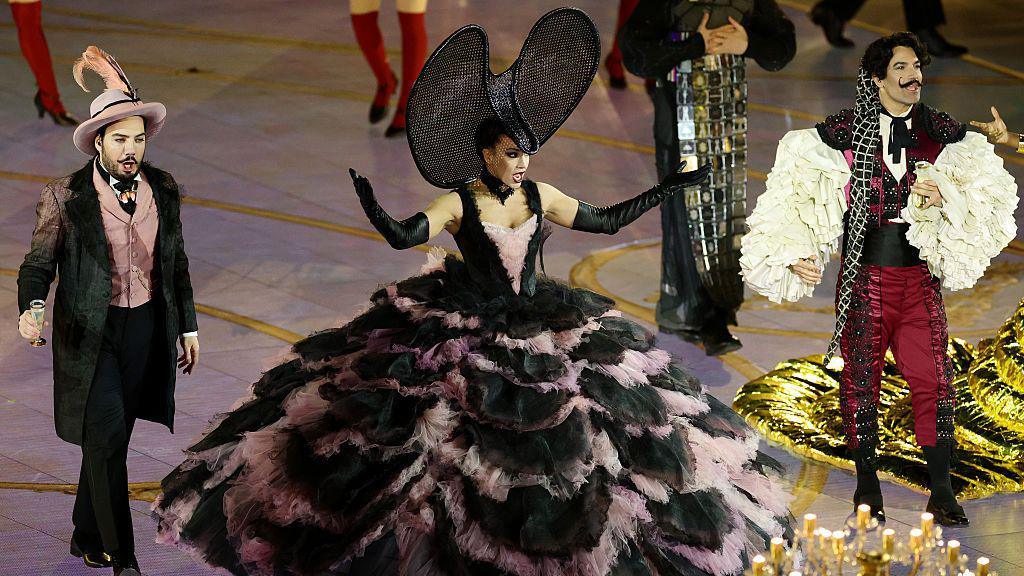
Image caption, The ceremony began with a spectacular tribute to Italian opera


1 of 6
Winter Olympics 2026
6-22 February
Milan-Cortina
Relive the 2026 Winter Olympics on BBC iPlayer (UK only)
