'Shocking' or correct? Why Ukrainian skeleton slider was banned
Tearful Coventry on 'emotional morning' of talks with Ukrainian skeleton racer
- Published
The biggest controversy of the Milan-Cortina 2026 Winter Olympics came to a head on Thursday morning, as Ukraine's Vladyslav Heraskevych was banned from competing.
Heraskevych, who was his country's flagbearer at the opening ceremony, wished to compete in the men's skeleton while wearing a special remebrance helmet featuring artwork depicting Ukrainian athletes killed during the Russian invasion.
But the International Olympic Committee (IOC) said this contravened the Olympic charter – the rules and bylaws for the organisation of the Games – and informed him on Tuesday that he would not be allowed to compete in the helmet.
After two days of discussions in which Heraskevych refused to back down, it was confirmed on Thursday morning that he had been disqualified.
What has been the reaction?
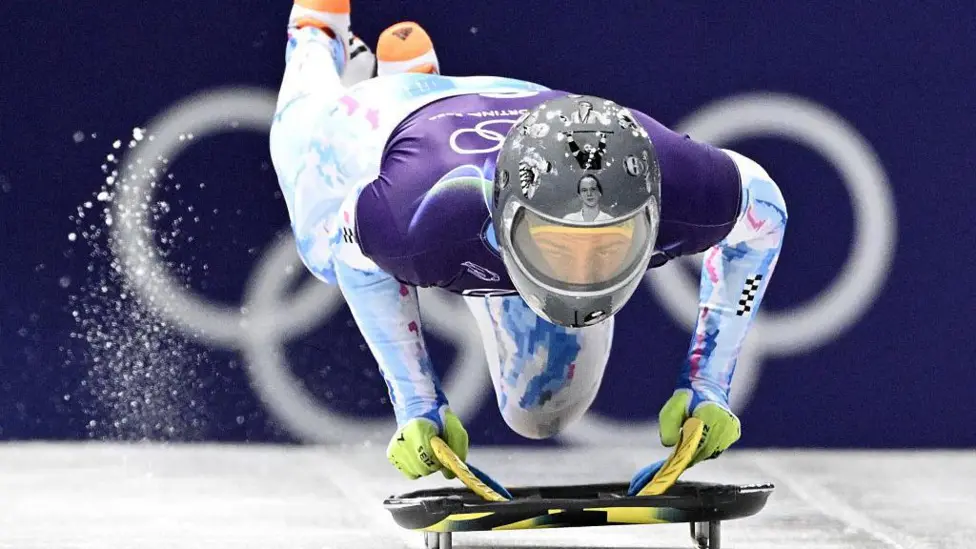
Ukraine's Vladyslav Heraskevych wore the helmet during his practice runs in Cortina
The decision to disqualify Heraskevych has drawn shock and condemnation from many former and current Olympic athletes.
Lizzy Yarnold, Team GB's two-time Olympic skeleton gold medallist, told BBC Sport: "I think it is actually quite shocking. Within the sliding community there is shock and confusion.
"This [wearing the helmet] was a reaction to something which was an act of memorial and incredibly emotionally important to him.
"I think the IOC owe him an apology and this was the wrong decision."
Two-time Olympic bobsledder John Jackson was equally unimpressed with the IOC.
Jackson, who also served as a Royal Marines commando, told the BBC: "His approach to that is about remembering those who have fallen.
"For me, being military and now a veteran, remembrance is really important to all veterans. We have all lost friends and colleagues in conflict, and we all know someone who isn't here and paid the ultimate sacrifice.
"I support him in what he was trying to achieve. It is really important to remember those who have given their life for something that ultimately doesn't need to happen."
Heraskevych meanwhile told the BBC that being banned only left him feeling "emptiness."
"Yesterday and before yesterday I was training good. I could be among the medallists for this event, but suddenly because of some interpretation of the rules that I do not agree with, I am not able to compete," he said.
"Expression guidelines - what do you consider as expression? Many others here in this arena have helmets with different colours and I believe that is also a kind of expression.
"Some others had national symbols, that is also expression. For some reason, their helmets weren't checked and they were allowed to compete but I am not.
"I believe they [those who have fallen] deserve to be here because of their sacrifice. I want to honour them and their families."
Heraskevych's international team mates showed their support throughout Thursday's competition in Italy.
Alpine skier Dmytro Shepiuk displayed a note reading "Ukrainian heroes with us" after competing, while luger Olena Smaha also voiced support for Heraskevych wearing a glove reading: "Remembrance is not a violation."
Ukraine president Volodymyr Zelensky accused the IOC of "playing into the hands of the Russian aggressor" after Heraskevych's disqualification
"Sport shouldn't mean amnesia, and the Olympic movement should help stop wars, not play into the hands of aggressors," he wrote on X, external.
"Unfortunately, the decision of the International Olympic Committee to disqualify Ukrainian skeleton racer Vladyslav Heraskevych says otherwise."
Why IOC has banned Ukraine's Heraskevych
What do the IOC rules say?
Heraskevych wore the helmet in all his training runs before the competition began and carried it through media mixed zones and in multiple interviews.
But IOC rules dictated that he would not be allowed to wear it during official competition.
They cited rule 40.2 of the Olympic Charter, external, which states: "All competitors, team officials or other team personnel in the Olympic Games shall enjoy freedom of expression in keeping with the Olympic values and the fundamental principles of Olympism, and in accordance with the guidelines determined by the IOC Executive Board."
These are the athlete expression guidelines, external, determined in 2023 and which have been codified into Olympic rules.
This states that: "The focus at the Olympic Games must remain on athletes' performances, sport and the harmony that the games seek to advance.
"It is a fundamental principle that sport at the Olympic Games is neutral and must be separate from political, religious and any other type of interference. Specifically, the focus on the field of play during competitions and official ceremonies must be on celebrating athletes' performances."
They say athletes can express their views during Olympic Games when speaking to the media, on social media, and on the field of play at the start of competition or during their introduction.
However, they forbid these expressions during medal ceremonies, during competition and in the Olympic village.
If these rules are broken, participants "may be subject to the IOC's disciplinary proceedings."
The IOC said these changes have been agreed after consultation with 4,500 athletes – stating that the focus on the field of play must be on the sport.
It was initially erroneously claimed by the IOC that it was rule 50 - which states that "no kind of demonstration or political, religious or racial propaganda is permitted in any Olympic sites" - that resulted in the disqualification.
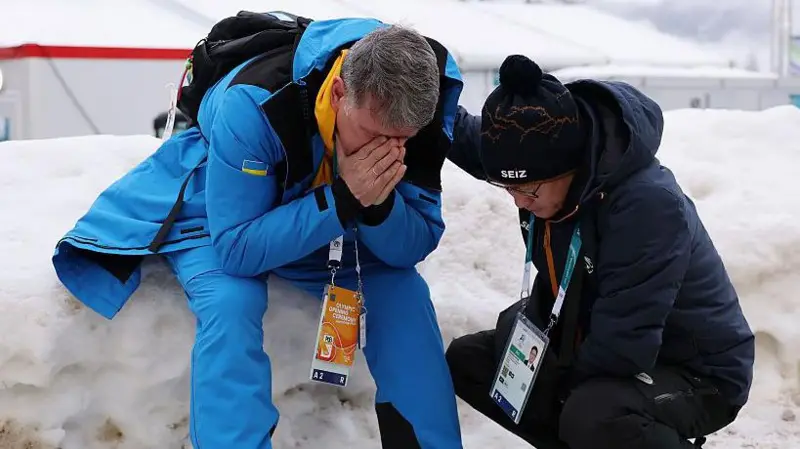
Heraskevych's father Mykhailo was consoled by members of other federations after the decision was made
What is the IOC's reponse
IOC president Kirsty Coventry visited Heraskevych and his father in Cortina at 7.30am on the morning of competition, to make a last-gasp plea for him to not wear the helmet.
She said they had a lengthy, respectful meeting – but ultimately no compromise could be reached.
"No-one is disagreeing with the messaging. The messaging is a powerful message of remembrance, it's a message of memory, and no-one is disagreeing with that," Coventry told the media.
"What I proposed to him this morning and to his dad - because he also said when he goes down it's blurry, you can't really see it - so I said: 'Could we find a solution where we pay homage to his message, to his helmet before he races, then as soon as he's finished racing going into the mixed zone where you can see the pictures?'
"Sadly, we've not been able to come to that solution. I really wanted to see him race today. It's been an emotional morning."
Coventry was seen to be in tears after leaving the meeting. A former Olympian herself, she won two gold medals in swimming for Zimbabwe.
The IOC have also reinstated Heraskevych's accreditation, allowing him to stay around the Games and in the Olympic village for the remainder of the competition.
In a tense media conference on Thursday morning, IOC spokesperson Mark Adams defended their decision to ban Heraskevych.
Adams said that if they allowed athletes to wear kit commemorating those killed in war, it would open the Games to exploitation.
"There are according to the Red Cross, 130 conflicts going on at any one time," he said. "We can't have them all in competition with each other at the Games.
"The field of play could become a field of expression, you could see it would lead to chaos. We cannot have athletes have pressure put on them by political masters to make expressions during competition.
"We do our best to create a level playing field, I make no apologies for that."
Adams also denied that the IOC had been pressured by the Russian Olympic Committee or government to ban Heraskevych.
Heraskevych meanwhile has made an urgent appeal against the decision to the Court of Arbitration for Sport (CAS).
CAS can hold ad-hoc committees during the Games, meaning his appeal will be heard immediately - although BBC Sport understands there is currently no timeframe for a decision.
Ukrainian team take a knee to show solidarity with banned athlete
Winter Olympics 2026
6-22 February
Milan-Cortina
Watch two live streams and highlights on BBC iPlayer (UK only), updates on BBC Radio 5 Live and live text commentary and video highlights on the BBC Sport website and app.
