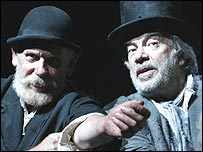
To read and listen to an interview with Frome's James Laurenson who starred in the play, click on this link: It was so quiet, you could hear tummies rumbling, hearing aids pinging, and legs crossing and uncrossing. There are long moments in Samuel Beckett's Waiting for Godot when nothing happens. As someone once said: "Nothing happens, nobody comes, nobody goes. It's awful." 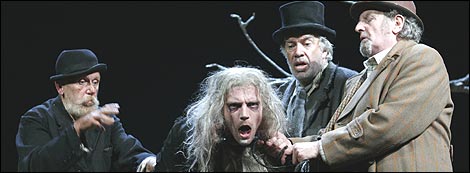 | | The cast of Waiting for Godot on stage |
Strictly speaking, the tragic-comedy is not without form or even plot. It begins and ends with a certain symmetry, allowing the audience to understand the basic premise: life is beyond our control, we take part without knowing why or where life will take us - we are all waiting for Godot. Classic drama...If the play is a metaphor for life's absurdities, then Beckett takes his time in revealing the simplicity of the idea. It starts and ends with two down-and-out men waiting for Godot - of whom we learn little. The main action is the conversations they have with each other, and also with two bizarre characters they encounter during their vigil by a rock and a tree. 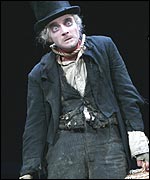 | | Richard Dormer as Lucky |
Sir Peter Hall must know the text back to front, and upside down, as he has been directing the controversial play since 1955 when he made his name with it at The Arts Theatre in London. The critics were split: some thought it nonsense, while others felt it redefined theatre for a modern world. It now sits comfortably in the canon of contemporary drama as a classic piece of work, even if it's viewed by many theatre-goers as a difficult relative who is coming to stay for the weekend. It's part of our world but not necessarily cherished like a favourite aunt. It has not, however, become a period piece like Look Back in Anger. ... but what's it all about?The two tramps, Estragon (Alan Dobie) and Vladimir (James Laurenson) have all the best lines and moments. The duo were immensely watchable as a kind of absurd, comic double-act. They rage against each other and criticise each other, but also help and care for each other in what at first appears to be a post nuclear-war landscape. In fact it's simply their space, where there's been little attempt to make it look realistic. Milking every line, these two say everything you have ever thought about life - if you are prepared to listen to them for two hours. Witty and poetic, their language is the core of the play's success and they were perfect for the parts. 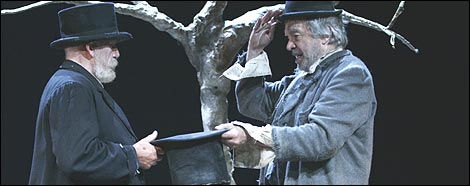 | | Dobie as Estragon and Laurenson as Vladimir |
Also impressive was Lucky (Richard Dormer) who is a kind of slave to Pozzo (Terence Rigby). He imposed his salivating soul upon us all with a powerful piece of physical theatre. When he spoke, it was all the more extraordinary as he launched into a poetic rant about life - this drew a round of applause for a play with few recognisable dramatic highlights or set pieces. Terence Rigby's portrayal as Lucky's master Pozzo had perhaps too much bluster, making it difficult to catch all his dialogue at times. He perfectly illustrated the unspeakable ruling classes he symbolised though, and their total reliance and attachment to their workers. You don't come away from this thinking what a fantastic play. However, you do depart discussing what the play was all about - a reaction that Beckett was after in making us all wait in vain for Godot. |