Why Guyana?
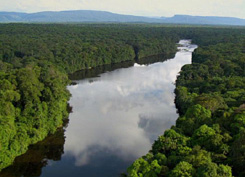
The answer lies in a homemade video tape posted to the BBC Natural History Unit back in 2005. Made by a tracker who lives in a remote corner of Guyana, it showed footage of a huge anaconda lying curled asleep on a riverbank. Snakes of this size are rarely found and it must have survived many years – an important sign of no hunting. Even more amazingly he had film of a jaguar, lapping the stream water and nonchalantly looking at the camera. It opened the possibility that the animals in this rainforest could be truly naive of humans. In the 21st century, that is very rare indeed. In most rainforests around the world, large animals are rare and those that survive have usually learnt to be wary of man. These creatures, at the top of the food chain, usually need large areas of forest to survive and the twin pressures of hunting and the chopping up of rainforest into ever smaller pieces means these apex species find it increasingly hard to survive. Fifty years of beautiful wildlife films have given the impression that rainforests are always teeming with life. That's certainly true of insects and smaller animals, but unfortunately it's very often not the case for larger mammals and birds. At its worst there is a phenomenon that conservationists call 'empty forests' – the trees are still there but the large animals have all gone. The homemade video fired me and my team's imagination. We had just finished making Expedition Borneo and were eager for another rainforest challenge. Everyone has heard of the Amazon, Borneo or the Congo, but if this forgotten forest was as pristine as it appeared, we wanted to put it well and truly on to the map. Back to top Under pressure
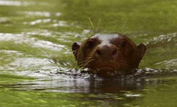
The results exceeded all our hopes. We found giant otters and jaguar, animals that have been persecuted for their pelts through much of South America. We filmed beautiful scarlet macaws, that can be traded for hundred of dollars in the illegal pet trade. In just a month we found and filmed six of the eight monkey species of Guyana – and they were so relaxed they were even coming around camp, clearly not bothered by our presence. But Guyana is a country under pressure. It's the second poorest country in South America, depending heavily on the export of sugar and in recent years these prices have fallen. The government is looking at the vast forests as a source of revenue. Selective logging has started in the north of the country. Now the timber concessions are spreading further and further south. Our basecamp was in a patch of forest that was put up for sale a few years ago as a logging concession. Conservation International, an NGO based in Washington but working globally, did a deal with the government where they paid the same return as a timber company, but instead kept the area for nature. We came back to Britain in October 2007 with hundreds of hours of raw footage and began the long process of turning it into finished films. A month later I was in the local newsagents one morning and was amazed to see on the front page of a national newspaper a full page picture of Guyana's jungle together with the headline 'Take over our rainforest.' It said that the Guyanan president, Bharrat Jagdeo, had offered to place the entire standing forest under the control of a British-led international body in return for a bilateral deal with the UK that would secure development aid and the technical assistance needed to make the change to a green economy. Back to top Keeping the rainforests standing
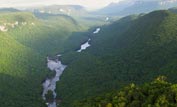
Rainforests aren't just vital to the world as a storehouse of half the world's species of animals and plants (if that wasn't reason enough to save them). They're also vital in the fight against climate change. Deforestation accounts for 18% of global CO2 emissions. The Stern Review on the Economics of Climate Change came up with the startling statistic that in the next four years, more C02 will be given off from deforestation than all the aeroplane flights from the Wright Brothers up to the year 2025. Keeping the rainforests standing is vital in the fight against climate change. According to the Stern Review, it's not only vital – it is also very cost effective. At the time of writing this article, the UK Government has not made any public reply to the proposal. I'm told that talks are going on behind the scenes. There's a further twist to this story. In January 2008, whilst we were in the thick of editing, it was announced that a US timber company had bought the rights to explore one million acres of rainforest adjacent to the conservation concession where we were based. They will be looking for commercial timbers with an aim to build a road and start selective logging of the forest. In programme three of Lost Land of the Jaguar, George McGavin and Gordon Buchanan travel there and find some amazing animals. It's early days yet and much will depend on how the company proceeds. Selective logging can have different impacts depending on how it is carried out. In past experience, the building of roads into remote rainforest areas can have a severe impact on wildlife. Guyana is at a crossroads. It has an extraordinary rainforest that I believe is of global importance for both wildlife and preventing climate change. One thing is certain. Keeping those rainforests intact will involve the global community. Back to top |