UK rock's greatest hits
There's no need to go to the end of the Earth to find fantastic geology, says Dr Iain Stewart, we have some of the best on the planet sitting right on our doorstep. Everything from three billion year old basement to loose debris from the last Ice Age can be found beneath our feet here in the UK. If you know where to look. OK, so you may not be able to see erupting volcanoes or feel the full force of restless seismic fault lines, but Britain and Ireland have seen more than their fair share of geological action. The clues to this restless and turbulent past are still there in the rocks and in the landscape. You just need to get out there and start looking... Choose a country:England | Scotland | Wales | Northern Ireland England
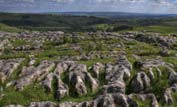
Malham
Yorkshire, England The landscape and scenery around the village of Malham in the Yorkshire Dales are among the most interesting in the UK. The rocks underfoot are mostly limestone – the legacy of carbonate sediments deposited in carboniferous sub-tropical seas. The same thing occurs in the Caribbean today. But millions of years of tectonic movements and erosion have raised this submarine world into a landscape of towering cliffs, deep gorges, impressive valleys, beautiful waterfalls and bare limestone pavement – parcelled into blocks called grykes, with exotic flora nestling in the intervening crevices, or clints. Hidden below ground there is an even more spectacular world of subterranean caverns, some of the best caving routes that Britain has to offer. Back to top Thornton Force
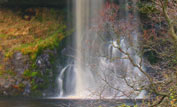
North Yorkshire, England In one of the most beautiful and accessible waterfalls in Britain, the River Twiss tumbles over slabs of 330 million year old limestones from the Carboniferous period, and crashes onto sandstones from the older Ordovician period. But something is missing. For in the 20 feet or so that the water falls, there is a time gap of over 150 million years of geological history; ancient erosion has stripped away rocks of the intervening Devonian and Silurian periods. Geologists call such a time gap an 'unconformity' and here in the Yorkshire Dales is one of the classic unconformities in Britain. Back to top Stair Hole
Dorset, England Just to the west of Lulworth Cove (itself one of Britain's most classic geological sites) lies a small but remarkable cove where the effects of Alpine mountain building on Britain can clearly be seen. Steeply dipping limestone strata have been beached by the sea, which has eaten into softer and weaker shale layers. This chiselled out a small cove with natural arches that expose the spectacular folded architecture of the underlying rocks. Back to top Dawlish Cliffs
Devon, England These impressive cliffs show some of the finest exposures of ancient desert sands in Britain. Their dramatic red colouration is a striking feature of the coastline around Torbay. In the Permian period, 260 million years ago, winds piled up these sands over a gravelly desert floor, so these are really fossilised sand dunes. But it's the modern sculpting by wind and weathering that produces the amazing patterns and forms that makes these cliffs look like a massive slice of installation art. Back to top Black Mountain
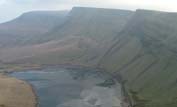
Powys, Wales and Herefordshire, England The Black Mountain straddles the English and Welsh border, forming the eastern rampart to the Brecon Beacons, the first National Park in the United Kingdom to achieve Geopark status. This is a landscape scoured by ice and pockmarked by glacial lakes, like the enchanting Llyn y Fan Fach shown here. But the rocks underfoot tell a very different story, for the layercake of strata that make these forbidding north-facing cliffs are a legacy of the old red sandstone continent, desert sandstones dating back to the Devonian period when the northern and southern landmasses of Britain were sutured together in the arid interior of the supercontinent Pangea. Back to top Black Ven landslide
Dorset, England In the heart of Britain's so-called 'Jurassic coast', the shoreline between Lyme Regis and Charmouth is classic fossil-hunting territory. The ancient marine rocks that crop out here date back to the middle of the Mesozoic era, between 208 million and 144 million years ago. It was a time when life flourished in the world's oceans. These Jurassic seas have not only left dinosaur parts here, but also the beautiful coiled ammonites whose polished remains grace most of the local gift shops. The muddy coastal cliffs are constantly being refreshed, because erosion by the sea keep the slopes above are the move – Black Ven is one of Britain's most active landslide complexes. Back to top Cheddar Gorge
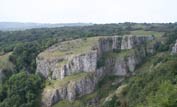
Somerset, England Home to the largest gorge in Britain, some of the our most famous caves, and our oldest complete human skeleton (the 9,000 year old Cheddar Man), Cheddar Gorge is a special place. In a recent poll it was voted the second greatest natural wonder in Britain, surpassed only by Dan yr Ogof caves in West Glamorgan. What's special about the place isn't just the near-vertical cliff-face that spectacularly exposes the carboniferous limestone strata that are flexed over these Mendip hills. But also the fact that this deep gorge was only formed during the recent ice ages. During ice-age periods, the normally permeable limestone became impervious to percolating waters, and repeated torrents of meltwater gradually incised a winding river valley through the rock. When the ice retreated and the ground thawed, the limestone became permeable again, so any water on the surface seeped directly into cave systems below, leaving the gorge high and dry. Back to top Wenlock Edge
Shropshire, England Wenlock Edge is most famous Silurian site in the world. Here a 400 million year old coral reef is exposed as a long ridge of woodland set amongst the Shropshire hills. Because the Silurian saw a general rise in sea level after the ice ages that gripped the planet during the earlier Ordovician period, many land areas were inundated by shallow seas. Coral reefs flourished in areas of shallow water that were free of heavy deposition of mud. As well as the many limestone quarries that line the Edge, there are numerous limekilns. A reminder that Shropshire's geology was a significant factor in the start of the Industrial Revolution. Coalbrookdale, just to the north, was the first place in the world to mass produce quality iron and steel. Back to top The Lake District
Cumbria, England The scenery of the Lake District may have been carved out by repeated glaciations over the past two million years, but the rocks beneath have a remarkable history that goes back 500 million years. The first 100 million years were especially violent. Muds laid down on the floor of a shallow sea were squeezed up by shuddering land movements as explosive volcanic eruptions spread vast quantities of lava and ash. It is hard to imagine that this idyllic lakeland was once the southern margin of a plate collision zone as geologically turbulent as modern Japan. Or that the rocky landscape of Wastwater began as part of a vast underground network of granite that had been injected into the heart of the colossal mountain range which ultimately arose along this ancient collision zone. Back to top Millook Haven
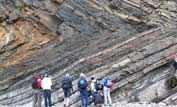
Cornwall, England The spectacular zig-zag folding in the coastal cliffs of North Cornwall are a window into the heart of an ancient mountain range, dubbed the Cornish Alps. As the continental mass of southern Europe ploughed northwards towards Britain, thick sequences of sands and muds on the floor of the intervening Rheic ocean were crumpled, scraped and uplifted. The collision zone between the two great land masses runs from Pembroke in South Wales to London, but the jagged peaks that once rose above southern Britain have been worn down by rivers and planed away by the sea. Here folded strata is revealed. Three hundred million years ago these were several kilometres inside the mountain belt. Back to top Alum Bay
Isle of Wight, England These famous multi-coloured sandy layers were laid down in the ocean in the aftermath of the extinction of the dinosaurs 65 million years ago. They were then unceremoniously upended by the earth movements related to the building of the Alps far to the south. The spectacular uparching of the rocks underfoot gives the Isle of Wight its lozenge or diamond shape, with a ridge of vertical chalk strata forming an east-west spine through the island. Few spots in Britain of similar size contain more objects of geological interest or such a diversity of fossil life. The island's southern half of mostly Cretaceous strata is famed for its dinosaur remains. Its northern half of younger (tertiary) limestones, clays and sands (such as here at Alum Bay) boast shells and plants, the bones of fish and turtles and the teeth of crocodiles and sharks. Back to top Hunstanton Bay
Norfolk, England One of the most beautiful exposures of the geological unit that best epitomises south-east England - the chalk. Deposited in the warm seas of the Upper Cretaceous period, the chalk is renowned for its creamy-white appearance but here at Hunstanton it sits directly on a lower chalky layer that formed during the Lower Cretaceous that is bright red in colour. Both the white and red chalk have fossils in them, though rock falls make the cliff face dangerous, so would-be collectors should hunt amidst the pebbles of the foreshore. Back to top Page: 1 23 |