UK rock's greatest hits (Scotland)
Choose a country:England | Scotland | Wales | Northern Ireland Suilven, Cul Mor and Quinag
North-west Highlands, Scotland Amidst the dramatic geology of north-west Sutherland is a remarkable 'geopark' that celebrates this corner of Britain's truly ancient past, when the mountains here were as high as the Himalayas and the rocks underfoot were part of North America. Sitting proud of the prodigiously old basement of Lewisian gneiss are the mountain peaks of Cul Mor, Suilven, Canisp and Quinaig. These are Scotland's pyramids – triangular ridges made from desert sand dunes first laid down 1,200 million years ago, but now sculpted by hundreds of millions of years of wind, water and ice. These are arguably the most distinctive mountains in Britain. Back to top Schiehallion
Tayside This beautiful mountain, in the heart of Highland Perthshire, was where the planet was weighed. In the summer of 1774, a team of surveyors led by the Astronomer Royal to King George III made measurements and astronomical observations from a number of locations around the slopes of this hill. A plumb bob was used to assist in these observations and it was noted that there was a significant gravitational attraction of the plumb bob by the mountain. That data led 20 years later to the calculation of the mass of our planet. Today we understand that to be a staggering 5.9 billion trillion tonnes, which is just 1% different to that which had been calculated two centuries before. Back to top The Storr
Isle of Skye, Scotland The geology of this part of eastern Skye may be ancient – marine rocks from the Jurassic period capped by 60 million-year-old lava flows – but its most spectacular feature is remarkably young. Under the weight of the lava flows (approximately 300 metres thick), the weaker Jurassic clays, shales and sandstones have given way and huge blocks slid seawards to form what is the largest landslide complex in Britain. The largest of these slides is Quirang, at over 2km in width, but the most impressive is the Old Man of Storr, a teetering pinnacle of lava which moved in a great landslide 7,000 years ago. Although Quirang and Storr are currently believed to be stable, other parts of the complex are still active. Back to top Salisbury Crags
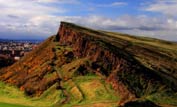
Edinburgh It was here, amidst Edinburgh's imposing volcanic crags, that in October 1840 the Swiss geologist Louis Agassiz first recognised scratches on the rock surface as clear signs of the past work of ice on the Scottish landscape. Under a headline in The Scotsman newspaper titled 'Discovery of former glaciers in Scotland, especially in the Highlands', the notion of the Ice Age was first announced to the wider world. The crags themselves date back to a time between 350 and 400 million years ago when volcanoes were erupting right across Fife and the Lothians. Today, the castle that so dominates Edinburgh's skyline is the most prominent legacy of the city's molten past. Back to top Great Glen
Scotland The site of a huge fault line which, when active several hundred million years ago, would have been Britain's match of the San Andreas Fault in California. In its heyday, this was one of the great tectonic fault lines along which a united Britain assembled, as lands that were part of eastern North America crumbled into lands that were the leading edge of Europe. Now distant from the nearest plate boundary, it remains a belt of minor seismic rumbles. Larger earthquakes in the past may be the root of one of its most famous inhabitants – Nessie, a monster whose mythical home lies in the unfathomable depths of this ancient fissure. Back to top Loch Glencoul
North Highlands, Scotland The Glencoul area of Assynt is where the story of the Scottish Highlands began to unravel. In the early 1880s, to settle an acrimonious controversy about the order of the ancient rock strata, the Geological Survey dispatched their best field geologists, Benjamin Peach and John Horne. Their painstaking field work discovered that one huge slice of rock had been thrust forcibly over by another, and led to one of the most revered geological accounts ever written, The Geological Structure of the NorthWest Highlands of Scotland, published exactly a century ago, in 1907. A century on it remains a place of pilgrimage for geologists around the world. Back to top Glen Tilt
Perthshire, Scotland It was in this idyllic setting that the father of modern geology, James Hutton, found a piece of clinching evidence for his 'Theory of the Earth'. At a time when many argued that all rocks had settled out from a 'universal ocean' – geology consistent with Biblical Floods – Hutton proposed that some had been molten and injected upwards molten from below. It was a clash of ideas that became known as the Neptunists versus the Plutonists, and a site here in this glen where solid granite could be seen injected in into the broken strata above, helped Hutton's Plutonists carry the day. Back to top Page: 1 2 3 |