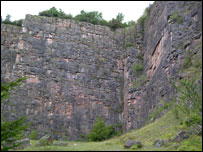
Shropshire Wildlife Trust's Llanymynech Rock nature reserve is quite possibly the county's most astounding landmark. Out of almost nowhere, one of Shropshire's most dramatic scenes towers above you - with harsh cliffs rising almost vertically to a height of over 200 feet. This impressive landscape is the result of successive years of quarrying, scraping at the cliff face. Inevitably, over 2000 years of mining and quarrying have left their mark. Llanymynech Rocks is composed almost entirely of limestone, which has been removed for a number of purposes, particularly for agricultural use (turned into quicklime). Originally, this limestone was crystallised out of sea water during the carboniferous period, around 360 million years ago. At that time, this area was lying on the equator, slowly journeying north. This was a hot, tropical environment, with rapid evaporation slowly laying down the limestone that makes up these tall cliffs. 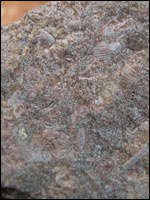 | | Fossilised shellfish |
This area's full of fossils. A few moments scurrying around the scree will soon turn up a rock full of sea shells or fossilised crinoids. According to Liz, these look like "Polo mints". These circular crinoid fossils would have originally been tubular animals - stems rising up in the warm sea to feed on passing plankton. Today, the cliffs provide a perch for jackdaws, sparrowhawks, buzzards and even peregrine falcons. The grass and heathland attracts plenty of insects and butterflies. Meanwhile a wealth of plants make the most of the limey soil. In spring and summer, you can see some of Shropshire's rarest orchids teeming around the heathland. This reserve offers a home to over 300 plant species. Acid RainThe cliffs look all the more dramatic because of the weathering which has darkened the rock. Acid rain has also played its part. Limestone is particularly prone to acid rain. If you drop a little vinegar onto limestone, you'll soon see it fizzing. Although acid rain is nowhere near as strong as vinegar, given enough time it will do plenty of damage. 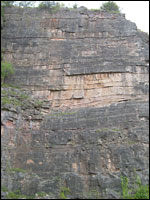 | | Weathered cliffs at Llanymynech Rocks |
Acid rain is created as carbon dioxide is dissolved in water. We've always had a small amount of carbon dioxide in our atmosphere, so we've always had acid rain. This has become much worse (and more concentrated) over the last 200 years or so, due to the increase in carbon dioxide, caused by pollution. Acid rain, coupled with general erosion means that there are also occasional rockfalls in this area, and it's far safer to avoid walking directly under the cliffs. The clearly-marked footpaths keep you a safe distance from the cliffs and offer a great view. This nature reserve lies right on the border with Wales and a short walk along the footpath will allow you to travel from one country to the other. If you do want to go fossil hunting, gather a few rocks from the scree (fresh rockfalls are a good place to look), and then retreat a safe distance before carefully investigating what might be in your rocks. 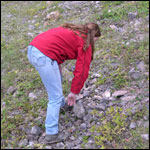 | | Looking for fossils |
Afterwards, leave the rocks behind. But if you find something that looks really special, contact the Wildlife Trust - you never know, you might have discovered the find of the century! See more of Llanymynech RockTake a photo tour or view one of two panoramic views taken at Llanymynech Rock by clicking on the links below or on the top right of this page. Fancy a trip?The nature reserve is signposted off the main A483 in the village of Pant. From the Oswestry direction, take the right turn into Underhill Lane and follow it to the car park. Alternatively, if you don't fancy the uphill walk, follow signs from the A483 up the hill to Llanymynech Golf Course, but turn off into a tiny car park on the left. |