 | 13 November 2014 |

| |
| BBC Homepage | | |
| |||
| Contact Us | | |
Nature FeaturesYou are in: Shropshire > Nature > Nature Features > From coal mining slag heap to nature reserve 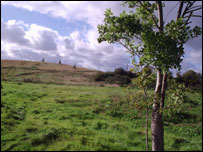 Ifton Meadows From coal mining slag heap to nature reserveCoal mining might have left Ifton Meadows at St Martins many years ago, but evidence of its industrial past is never far away. We discover that Ifton's legacy is born of its geology. Our guides were Gordon Hillier and ex-Ifton miner Wal Chorlton. This 19.6 hectare site is today very peaceful and a popular area for those out for a walk in the Oswestry area, or just looking for a spot for quiet contemplation. 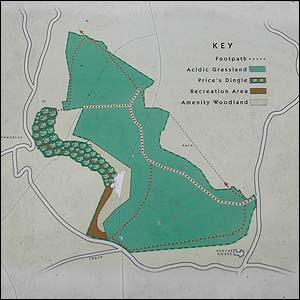 Plan of Ifton Meadows nature reserve However, until as recently as 1977/78 this area looked very different. The name Ifton Meadows (it's also known as Glyn Morlas) took its name from the fact that colliery waste from deep underground was dumped here. Ifton was an area of heavy industrial activity, with numerous mines sunk deep into the rich coal measures. At its peak 1,300 men worked here in especially tough conditions - especially tough because the coal seam sloped downwards at about 45 degrees, making even the simplest task a nightmare. Until it closed in 1968, 400 tonnes of coal were mined here every day and sent by train down to Weston Rhyn, where it joined the Chester to Shrewsbury line. To the west lie the hills of Wales and rocks of a much older period. Then we come to the carboniferous limestones (formed in a shallow, tropical sea) and so to the coal measures. The geology of this area dates back around 300 million years. Before the mines, Ifton would have been covered with glacial drift deposits (evidence of the far more recent Ice Age) - very common in north Shropshire. But much of the flora and fauna of Ifton Meadows owes its presence to the site's mining past, rather than its geological history. 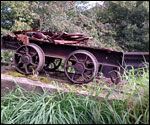 Remains of mining at Ifton Meadows Until the late 1970s the site was still dotted with dark grey spoil heaps which were so acidic that very little grew on them. In the wake of the colliery's closure, Oswestry Borough Council bought the site and obtained a grant from the Government which allowed the heaps to be re-landscaped and the land reclaimed for nature. Soil was imported onto the site, hedges were planted and footpaths restored. Using the height of the slag heaps, a viewpoint across to the Clwydian Hills was retained, and tree planting took place around the semi-natural woodland of Price's Dingle, a steep stream bank caused by the waterflow cutting into the Triassic bed rock on the western edge of the site. This semi-natural woodland, which has been here for at least 300 years, is one of four distinct habitat types to be found at Ifton Meadows. There is also a specially-planted woodland area, with a small pond and a recreation area, and an area of grassland which is home to acid-loving plants. Some of the acidic grassland area remains bare, perhaps because of the presence of toxic heavy metals in the soil. 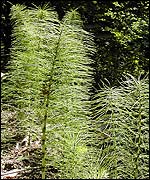 A horsetail in Price's Meadow And Oswestry borough's first local nature reserve has proved successful in attracting wildlife, not least the skylark, which has suffered serious loss of its farmland habitat in the past 20 years. Ifton Meadows provides an ideal habitat for the birds, which nest on the ground, and there are now six or seven breeding pairs on the site. Their clear, warbling song is unmistakable on a summer's day. While the areas of the spoil tips are regarded as ecologically poor, they do support a huge range of insects such as butterflies and grasshoppers, which in turn bring the birds to feed on them. The original areas of grassland, uncontaminated by mining waste, support a wider range of plants and animals. As well as the skylark, the site also provides a breeding ground for meadow pipits, while red-legged partridge and curlew are thought to nest nearby. The site was finally officially designated a local nature reserve in 2005, and in the last couple of years a lot of work has gone into improving access and removing invasive species such as sycamore, and non-natives like snowberry and cherry laurel, which had threatened to take over. 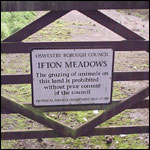 Ifton Meadows Locals recently marked the 25th anniversary of the site's opening to the public. Records show that mining in the area dates back to the 1600s. The coal measures dip from west to east, meaning that west of Ifton, the coal practically reached the surface and was easily gathered. People in the area soon realised that the coal seam continued east and small bell pits were dug to exploit the mineral-rich landscape. However, it wasn't until the start of the Industrial Revolution that coal became vital, the very lifeblood of industry. Despite the volume of coal coming out of Ifton until 1968, the measures had plenty left to yield. Ex-miner Wal Chorlton remembers hitting a huge coal seam that climbed 250 feet above him... a seam that was never mined. Similarly, while trying to gauge the amount of coal in the area, two bore holes were plunged, one mile apart, west-east at Pentre and Caia Lane. It was estimated that 100 million tonnes of coal were waiting to be mined - none of which ever saw the light of day. Today the only evidence of its heavy industrial heritage are a few humps and mounds, which our guide Gordon Hillier immediately recognised as a flattened and landscaped tip heap. The only other suggestions are the remains of a few tramlines. Wal Chorlton believes that this now beautiful site should be dedicated to the men who lost their lives in the Ifton mines. Getting thereIfton Meadows is hidden away to the west of the village of St Martins - you're unlikely to find it by accident. From the A5 at Gledrid roundabout take the B5070 to St Martins and follow it as it becomes the B5069. After the Stan's superstore, go straight across the mini roundabout and then turn left into Colliery Road. Take the first left into Glyn Morlas Lane and then the right at Pentre Nurseries. The site and a car park are a few hundred metres on your left. Alternatively, keep going down the single track lane. There's a very small layby opposite the southern entrance to the site on the right hand side, but it's only big enough to hold a couple of cars and you may need to park further back up Glyn Morlas Lane. Remember, dogs must be kept under control on the site, especially during skylark nesting season from March to September. last updated: 01/10/2008 at 15:12 Have Your SayComment on this article kate Wooodhead Marlene Hopley Marcus Rheade-Edwards Marcus Rheade-Edwards Molly Hughes Steve Hughes James Laurence Faux Kenneth Lowndes Sue Panton (jones) John Atkin james jones ED Patrick (Web Producer) Nigel Roberts Nigel Roberts SEE ALSOYou are in: Shropshire > Nature > Nature Features > From coal mining slag heap to nature reserve    5 DAY FORECAST The latest forecast for your area from BBC Weather [an error occurred while processing this directive] |
| | About the BBC | Help | Terms of Use | Privacy & Cookies Policy |
