| |  | | | | | | | | | Welcome to part two of our wheel building guide. Here, Richie (a mechanic at Dales), explains how to true a 48 hole wheel.
Tools:
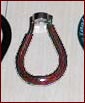
Spoke Key. If you're using a Park tool for this, they're colour coded and for BMX, it works out like this:
Red = factory built/cheap wheels
Green = Primo spokes
Black = DT Swiss
To start with, we're using a normal BMX frame as a jig. If you've got a truing stand then obviously that's better, but hardly anyone has one so we're doing it this way because it's the way most people would do it.
Before you start, we should mention that, like everything, wheel building/truing is something that you get better at with practice. Your first one probably won't be perfect, but they'll get better as you get more practice.
Richie also pointed out that although you should try and get them as true as possible, you shouldn't get too stressed about getting every wheel absolutely-dead-perfect-straight. The tyre/inner tube will take out a lot of the minor imperfections and anyhoo, you're going to go out and batter it, so as long as it's as straight as possible and nice and tight, you should be fine.
So here goes:
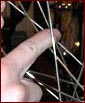
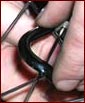
1) Start by making sure that all the nipples are screwed down to the end of the thread of each spoke. This way each spoke will have the same tension. When you've done that, slide your finger down on the cross section where each pair of spokes meet (see pic). This will help seat the spokes. You can now start tightening them up.
2) Put the wheel in the frame and tighten the bolts. Make sure you have the wheel slammed right into the dropouts as you need to make sure it's as straight as possible.
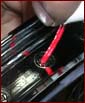
3) Spray (or drip) some lube onto each spoke through the nipples. This will make them easier to work with. Remember to always start at the valve hole, as then you'll know for sure when you've done a full 'lap'.
4) Starting at the valve hole, do a lap of the wheel, giving each spoke 1/2 a turn. When you're putting the initial tension on the spokes, you need to always make sure that you're putting the same amount on each spoke. Don't be tempted to give an extra few turns to a spoke that feels loose, or you'll end up with headaches later on. Consistency is the key here.
5) If the spokes are still loose, go round for another lap, giving each spoke a 1/2 turn. Keep doing this until you start getting a sense of resistance when turning the nipples.
| | | |
| |

|
|