

Decentralisation
Posted: Monday, 19 June 2006 |
I'm not very good at this blogging lark. Partly I'm too busy; partly I'm too esoteric (who cares about Red-rumped Swallows?); partly its the subjects I want to talk about. Are they too controversial?
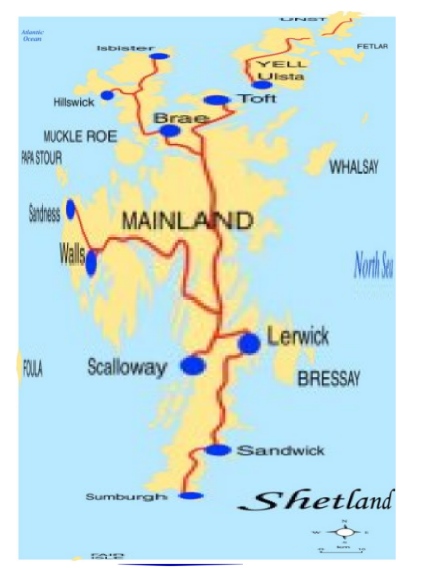
Take decentralisation. Now the SIC talks about it, but they don't actually do very much. When we had the meeting on Unst about the closure of RAF Saxa Vord, the SIC councillors and officials went a strange shade of purple whenever moving anything outside Lerwick was mentioned.
But if you spend your day in front of a computer screen does it matter if that screen is in Lerwick or in Baltasound? There seems to be this strangely quaint idea that generating council jobs outside Lerwick means moving whole departments, as though e-working has never happened. 'And you can't just move people if they don’t want to go' we were told. I know a few people who'd like that in writing!
Anyway, just as Unst has a glimmer on the horizon in the form of the proposed redevelopment of the camp, a report published recently threatens another kick in the teeth.
Now I probably can't say too much, so I'll give you this hypothetical situation. There are two islands, which we'll call A (nearest the Mainland) and B (furthest from the Mainland). Island A has a building that needs replacing (it was built in a bog, but we won't go into that now) and island B has a building that has the potential to be used more fully.
It seems likely that the building on island A does need demolishing - reasonable so far. If so, a new building is needed to replace it. O-k-a-y, that follows ... but surely that’s pricey. So the idea is that island B then closes its building and moves most of its users to the new building on island A.
Hang on! I've just detected a bit of a flaw here. Why not just move the users of the building on island A to island B, where there is already a building with spare capacity? That would save millions and surely moving from A to B is just the same as moving from B to A? Probably not, at least in the eyes of those in Lerwick - how can it possibly be right to move AWAY from the centre?
Well, ask the Norwegians, who know a bit about decentralisation and preserving rural communities. They're always put forward as the ideal that Shetland should be working towards, but few can see much evidence of their philosophy being adopted here. If they had a situation like the hypothetical islands A and B they would concentrate the facilities on B, the furthest island, to help encourage settlement away from the Mainland, even (in fact, especially) if they built fixed links.
Whereas you suspect that Lerwick-based agencies would like everything in Lerwick, or on Mainland, or, if absolutely necessary, on an island but as close to the ferry (bridge, tunnel) as humanly possible.
If you live on island you know what I mean: 'sorry, can't come today, the ferries might be cancelled' (used on any day with winds higher than force 4); 'the roads may be bad' (used on any day on which a snowflake is sighted); 'we'll see you first thing. That's about 11 as we won't leave Lerwick till 9. And we need to leave about 1 to get the ferries as we need to be in Lerwick before 5.' Doesn't apply the other way though, does it? We're expected to be in Lerwick for 9.
No, overall I don’t think that many of the people in high places have really understood the concept of decentralisation.
But I know one thing, taking facilities away from Unst just when it is trying to attract new blood is hardly the sort of encouragement we want to see. Leaving things as they are would make sense, at least until it is clear what is going to happen to Unst and the issue of fixed links may have been resolved. Full marks to our councillor Brian Gregson for trying to get an amendment to remove Unst from the considerations – unfortunately the motion was narrowly defeated.
Time to remind the SIC that the word Islands in it’s name is plural – there is more to Shetland than just the Mainland.
Shetland as viewed from Lerwick
Take decentralisation. Now the SIC talks about it, but they don't actually do very much. When we had the meeting on Unst about the closure of RAF Saxa Vord, the SIC councillors and officials went a strange shade of purple whenever moving anything outside Lerwick was mentioned.
But if you spend your day in front of a computer screen does it matter if that screen is in Lerwick or in Baltasound? There seems to be this strangely quaint idea that generating council jobs outside Lerwick means moving whole departments, as though e-working has never happened. 'And you can't just move people if they don’t want to go' we were told. I know a few people who'd like that in writing!
Anyway, just as Unst has a glimmer on the horizon in the form of the proposed redevelopment of the camp, a report published recently threatens another kick in the teeth.
Now I probably can't say too much, so I'll give you this hypothetical situation. There are two islands, which we'll call A (nearest the Mainland) and B (furthest from the Mainland). Island A has a building that needs replacing (it was built in a bog, but we won't go into that now) and island B has a building that has the potential to be used more fully.
It seems likely that the building on island A does need demolishing - reasonable so far. If so, a new building is needed to replace it. O-k-a-y, that follows ... but surely that’s pricey. So the idea is that island B then closes its building and moves most of its users to the new building on island A.
Hang on! I've just detected a bit of a flaw here. Why not just move the users of the building on island A to island B, where there is already a building with spare capacity? That would save millions and surely moving from A to B is just the same as moving from B to A? Probably not, at least in the eyes of those in Lerwick - how can it possibly be right to move AWAY from the centre?
Well, ask the Norwegians, who know a bit about decentralisation and preserving rural communities. They're always put forward as the ideal that Shetland should be working towards, but few can see much evidence of their philosophy being adopted here. If they had a situation like the hypothetical islands A and B they would concentrate the facilities on B, the furthest island, to help encourage settlement away from the Mainland, even (in fact, especially) if they built fixed links.
Whereas you suspect that Lerwick-based agencies would like everything in Lerwick, or on Mainland, or, if absolutely necessary, on an island but as close to the ferry (bridge, tunnel) as humanly possible.
If you live on island you know what I mean: 'sorry, can't come today, the ferries might be cancelled' (used on any day with winds higher than force 4); 'the roads may be bad' (used on any day on which a snowflake is sighted); 'we'll see you first thing. That's about 11 as we won't leave Lerwick till 9. And we need to leave about 1 to get the ferries as we need to be in Lerwick before 5.' Doesn't apply the other way though, does it? We're expected to be in Lerwick for 9.
No, overall I don’t think that many of the people in high places have really understood the concept of decentralisation.
But I know one thing, taking facilities away from Unst just when it is trying to attract new blood is hardly the sort of encouragement we want to see. Leaving things as they are would make sense, at least until it is clear what is going to happen to Unst and the issue of fixed links may have been resolved. Full marks to our councillor Brian Gregson for trying to get an amendment to remove Unst from the considerations – unfortunately the motion was narrowly defeated.
Time to remind the SIC that the word Islands in it’s name is plural – there is more to Shetland than just the Mainland.
Shetland as viewed from Lerwick
Posted on puffinbillyunst at 23:20
 Unst in Shetland, Britain's Most Northerly Island
 RSS Feed