 | GrowthThese two useful sources highlight the effects of the oil industry on everyday life in Shetland. In the first source the Director of Education in Shetland describes how schools had to be extended and new schools built for the children of the oil workers. At the same time, teaching staff had to cope with oil workers' families moving in and out of the islands on a regular basis. The statistics in the second source shows how the local council had to plan for a huge increase in the population of those areas in Shetland closest to the Sullom Voe oil terminal.
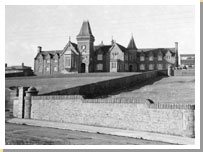 | Anderson Educational Institute taken, 1968 |
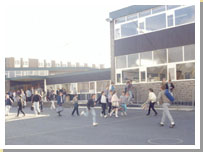 | Anderson High school Lerwick, 1985 |
BBC Radio Scotland series 'The Story of North Sea Oil' (1999) Robin Barnes Director of Education "Between 1976 and 1981 there were altogether eleven schools built and another four with really massive extensions. The Anderson High School in Lerwick which is the senior Secondary School for the island they had an increase of classrooms numbering seventy, so it was a massive building programme. The school at Mossbank which was built especially for the oil workers and their families, you could always say you would have the same number of pupils at the beginning and end of a session but they would be different faces. Because they would be coming and going all the time." Statistics from 'Shetland's Oil Era' published Shetland Island Council. Sullom Voe Area
Oil related housing developments | | Village | Population 1971 | Estimated Annual Increase Per Year | Estimated Houses built by 1980 | Estimated Population 1980 | Estimated eventual no. of Houses to be built | Estimated eventual Population | | Voe | 220 | 10 families per year - 30 people | 50 | 370 | 125 | 600 | | Brae | 320 | 35 families per year average* | 175 | 820-920 | 275 | 1120-1220 | | Mossbank | 120 | 25 families per year average* | 125 | 420-520 | 250 | 800-900 | | Firth | 6 | 50 families per year average | 200 | 550-600 | 350 | 1000+ | | * Average figure is not a true reflection of the phasing of development. 40 dwellings per year 1974/76 expected; 20 per year thereafter. |
|  | |
|


