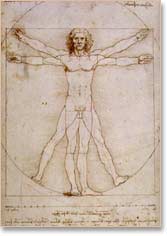
You are here: BBC Science > Leonardo da Vinci  | | Vitruvian man | | | | | This sketch, and the notes that go with it, show how Leonardo understood the proportions of the human body. Each separate part was a simple fraction of the whole. For example, the head measured from the forehead to the chin was exactly one tenth of the total height, and the outstretched arms were always as wide as the body was tall.
These ideas were not Leonardo's, but were taken from the writings of the Roman architect Vitruvius. Both men believed that the same principles should be used when designing buildings.
However, Leonardo tried to take these ideas further, and spent much of his life searching for connections between the structure of the human body, and other patterns in nature. Elsewhere in his notes, he proclaimed that "Man is the model of the world."
Vitruvian man may also give us an insight into another problem that occupied Leonardo for much of his life; that of 'squaring the circle'. This involves drawing a circle and square that have the same area without measuring. Some argue that this diagram shows that Leonardo had a sophisticated understanding of the problem, which other mathematicians would not develop until much later.
|
| | |
|  Look For - Leonardo has marked the bottom of the image with fractions to measure the proportions of the body. Look For - Leonardo has marked the bottom of the image with fractions to measure the proportions of the body.
| |
| | | | | | Go further
| | |
 University of St Andrews University of St Andrews
More about squaring the circle
Aiwaz.net
The Maths behind Vitruvian Man
(The BBC is not responsible for the content of external sites.)
|
|
|
|
|