| | | | | PROGRAMME INFO | | | |
| | | Nature offers a window on global natural history. Each week Mark Carwardine rubs shoulders with animals and experts, providing a unique insight into the natural world, the environment, and the magnificent creatures that inhabit it.
nhuradio@bbc.co.uk | | | | | LISTEN AGAIN 30 min 30 min | | | |
|
|
| | PRESENTER | | | |
|  | | | | "What I enjoy most about Nature is the incredible variety of subjects. One week we could be fishing for zooplankton off the coast of Iceland and the next we could be hunting for fossils in Dorset. We're also very fortunate in meeting many of the world's experts - all of whom are really passionate about their subjects. It's good being able to bring all of these experiences into one programme that truly explores the natural world."
Mark Carwardine | | |
| | | | | | PROGRAMME DETAILS | | | |
| 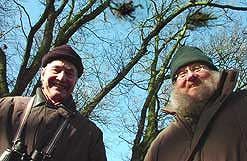 | | | Richard Bland and Lionel Kelleway at the Slimbridge rookery |
Rooks and Crows
With lambing upon us and snowdrops and daffodils in flower, the first signs of Spring are showing in the countryside. For one of our earliest Spring breeders, the rook, it's also time to get the nursery ready for this year's young. In Nature this week, Lionel Kelleway is in the company of local naturalist Richard Bland at the Wildfowl and Wetlands Trust centre at Slimbridge where there is a large rookery which holds up to 300 nests when it's full. Richard has studied rookeries in the Bristol area for many years.
Rooks belong to the corvid family which in this country includes crows, ravens, magpies, jackdaws, jays and choughs. This large family of birds, species of which are found throughout the world, are thought of as being slightly smarter than the rest. Just last year, the extraordinary behaviour of some New Caledonian Crows being studied by scientists at Oxford University raised a number of questions about the birds' problem-solving abilities and their perceived intelligence. As Lionel discovers in this programme, other crow species found in different parts of the world also seem to find their own novel ways to continually solve new problems they are faced with.
The rook too is a fascinating bird to watch and study - they are the only species of crow to nest colonially in rookeries. These extraordinary structures are home, for about six months of the year, to an extended family of rooks. Older established pairs return to the rookery in February to start repairing their previous year's nest or they will start building a new one if the old one has not survived the winter. Meanwhile, young rooks born there return after a two year absence to their home rookery as they are now ready to start breeding themselves. But it's a case of the early bird getting the best nest - the more established older birds take up residence in the heart of the rookery while the younger less experienced rooks have to make do with building their first nests on the fringes. The older birds are ahead of the game and having settled into the rookery earlier will start breeding and will lay their eggs before the younger pairs which give the older birds' chicks a better chance of survival.
What limits the size of a rookery is the availability of food nearby - rooks rely on invertebrates and specifically healthy worm populations on the farmland around them. In winter, when it's harder to find invertebrates, they will take advantage of any grain they come across in fields. Perhaps the most noticeable thing about a rookery is its sound. While the trees are still bare and the landscape around us seems to be still locked in winter's grip, the constant cacophony coming from the rookery as its residents get noisily underway with nest renovations and greeting the new arrivals are a sure sign that Spring will soon be with us. | | |
RELATED LINKS
Radio 4 - Frontiers, Bird Brains
Daniel Cristol, College of William and Mary
Renee Ha, University of Washington
The BBC is not responsible for the content of external websites
| |
| | |