| | | | | PROGRAMME INFO | | | |
| | | Nature offers a window on global natural history. Each week Mark Carwardine rubs shoulders with animals and experts, providing a unique insight into the natural world, the environment, and the magnificent creatures that inhabit it.
[email protected] | | | | | LISTEN AGAIN 30 min 30 min | | | |
|
|
| | PRESENTER | | | |
|  | | | | "What I enjoy most about Nature is the incredible variety of subjects. One week we could be fishing for zooplankton off the coast of Iceland and the next we could be hunting for fossils in Dorset. We're also very fortunate in meeting many of the world's experts - all of whom are really passionate about their subjects. It's good being able to bring all of these experiences into one programme that truly explores the natural world."
Mark Carwardine | | |
| | | | | | PROGRAMME DETAILS | | | |
|  | |
Sparrowhawks
Over the summer, there's been one visitor to the garden bird table that hasn't always been welcomed, its the Sparrowhawk.
"I do not feed the birds to feed the sparrowhawks", says one distressed garden bird feeder in Northumberland, where a Sparrowhawk has not only been helping itself to a family of young partridges which come into her garden to be fed, but has also made a bee-line for the red squirrels which feed alongside the birds at her garden bird table.
In Nature, this week, Mark Carwardine examines the city habits of this magnificent bird of prey, which has gained something of a reputation as a garden thief. But just why is the Sparrowhawk, traditionally associated with woodlands and farmland, becoming so prevalent in our urban gardens? And is there anything garden bird feeders can do to save the diners at the bird table from becoming dinner for the Sparrowhawk - or indeed should we be interfering with Nature?
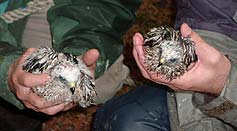
In his quest to find some answers, Mark first joins Martin Davidson, an ornithologist and licensed bird ringer in Northumberland and gets a close view of some chicks, when he helps Martin ring 5 young birds in Kielder Forest, Northumberland. Mark then travels to Oxford, to get not only a Sparrowhawk's eye view of some urban gardens but also a revealing insight into the predator's tactics, with Dr Will Cresswell, Royal Society University Research Fellow at Oxford University. Like all hawks, sparrowhawks are capable of bursts of high speed, reaching 25mph. At the same time, they are capable of great manoeuvrability. The element of surprise plays a large part in their success of prey capture. One of the most striking comments that Will makes is that "Almost all of the behaviour that you see amongst small birds in Britain is in reponse to the threat of predation from Sparrowhawks."
In the programme, we also hear from Professor Ian Newton, (based at the Centre for Ecology and Hydrology, at Monks Wood, Cambridgeshire) author of The Sparrowhawk, (published by Poyser), who has spent a lifetime studying Sparrowhawks, for an insight into the bird's chequered history, and the effects of urban predation on our songbird population.
The population of Sparrowhawks declined in the 1960's following the introduction of organochlorine pesticides, including DDT. Egg shell thinning led to increased mortality and a decline in the population. The decline was most noticeable in eastern areas of the country where there were more arable crops and the greatest use of pesticides. Population recovery followed successive restrictions on pesticide use and a total ban in the mid-1980s.
More recently, the change in agricultural practices has resulted in a decline in the population of song birds in arable areas, and so sparrowhawks have switched to an urban lifestyle in search of food. Many urban gardens with bird tables placed in an open lawn provide a perfect restaurant for sparrowhawks on the hunt for a meal!
Ian Newton suggests that if you find the Sparrowhawks' behaviour in your garden upsetting, then either don't feed birds in your garden(!), or alternatively, place your bird table near a hedge or bush, so that small birds can make a dive for cover if a Sparrowhawk swoops upon the bird table. For many people however, such as Bristol garden bird feeder Annie Bates, the sight of a Sparrowhawk in her garden is a unique and exciting event... and she feels priviledged to see one of nature's exciting events happening right in front of her eyes! | | |
RELATED LINKS
BBC Nature Wildfacts: Sparrowhawk
Birds of Britain: Sparrowhawk
The BBC is not responsible for the content of external websites
| |
| | |