| | | THE LATEST PROGRAMME | | | |
| | The BBC's former Asia correspondent, Chris Gunness, uses the region's traumatic past to explain its troubled present. | | | 
| | | 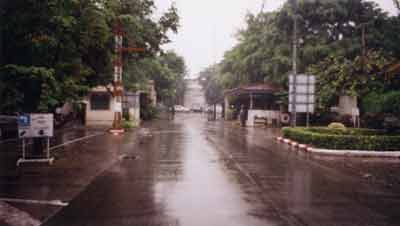 | | | Gates of Chitrlada Palace which was the centre of the demonstrations and violence in 1973. | This week Chris is in Thailand, the home of the world's longest serving monarch. Bhumibol Adulyadej The Great has been King since 1946. Most Thais revere Rama IX, as he also known, as a God-King. Though he is a constitutional king with no real political power, his aura is that of an absolute monarch. Criticism of him is unheard of, and certainly not tolerated within Thailand. After reigning more than five decades, his supreme position in Thai society is one which few in the UK can appreciate.
Yet his rule has been over troubled times. Born in the US and educated in Switzerland, he ascended the throne after his own brother, Rama VIII, was found dead in his room with one of his favourite revolvers close by. Although several people were executed for the crime, the mystery of his death has never been fully explained.
| 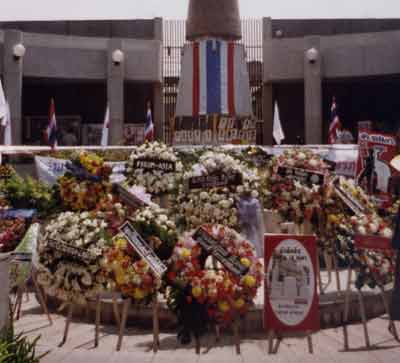 | | | Memorial to the victims of 1973. | For much of King Bhumibol's reign Thailand was governed by a succession of military dictatorships. But at crucial times in the country's history, the King has stepped forward to intervene. In 1973, for example, when the police and army fired on demonstrating students, killing scores of them, the King opened the Palace gates to give the students shelter. And more recently, in 1992, when more demonstrations and violence broke out, the King ordered the two main political opponents to his palace and gave them a very public, televised, dressing down. It led to the end of their careers and a return to civilian government.
The King has also been at the forefront of development in his country. His royal projects can be found across the country. The King has always been fascinated by technical matters, designing, amongst other things, a rice mill and a gun mounting system for helicopters.
| 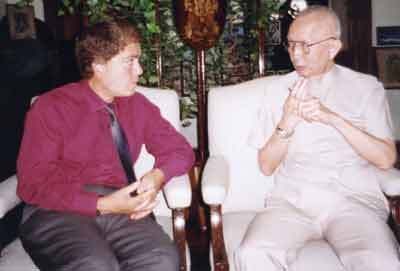 | | | Vasit Dejkunchorn, Head of the King's Security in 1973. | The King's predecessors, too, have been instrumental in the unfolding of Siamese history. King Mongkut (Rama IV), rather inaccurately portrayed by Yul Brynner in "The King and I", and his son, King Chulalongkorn (Rama V), were particularly effective in keeping Siam/Thailand free of western colonial rule - the only country in south east Asia not to be colonised.
The Thai monarchy is, undoubtedly, steeped in the past and surrounded by pomp and ceremony that is often impenetrable to western minds, but it has also played a crucial role in forming modern Thailand. For most Thais, the monarchy is Thailand. The question for many observers of the country - though a question that cannot be discussed openly within Thailand - is how much longer that will be the case.
|
| | |