| | | THE LATEST PROGRAMME | | | |
| | The BBC's former Asia correspondent, Chris Gunness, uses the region's traumatic past to explain its troubled present. | | | 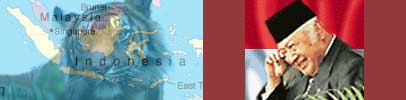
| | Image in the right above is of former President Suharto. | In the third of four programmes, the BBC's former Asia correspondent, Chris Gunness, uses the region's traumatic past to explain its troubled present. Each programme examines a single historical phenomenon which still reverberates today. Through oral history, archive recordings and lively narrative, Chris brings the past to life.
This week Chris is in Indonesia, looking at world's largest resettlement project. Transmigration or transmigration, as the official Indonesian policy was called, was supposed to relocate Javanese, Madurese and Balinese to the archipelago's outlying and sparsely populated islands. | | 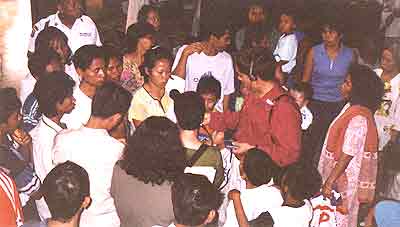 | | Chris Gunness speaking to 'transmigrants' laying siege to Transmigration Ministry.
| | transmigration was a central policy of former President Suharto but its origins date from 1905, during the time of Dutch colonial rule. With over 80 per cent of the population of the archipelago crammed onto Java, Madura and Bali, moving families to the outlying islands was supposed to alleviate population pressure in Indonesia's central islands and bring greater development to the country as a whole. But, from the beginning, the policy has been dogged with controversy. | | 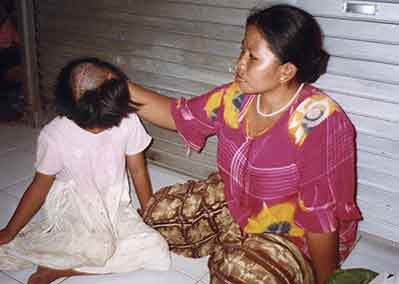 | | Eight year old Nafir and Nulia - Madurese survivors of attacks by Dayaks in central Kalimantan in Feb 2001. Nafir was showing the wounds in her head.
| Persuading people to leave their homes, even with some financial encouragement, and start new lives far away was not straightforward. The first 155 families moved from Java to the province of Lampung in south-east Sumatra in 1905. After the end of the Second World War, when Indonesia gained independence it was Lampung once again that became the focus for the new transmigration programme. But it was in the 1970s and 1980s that transmigration reached its peak, under President Suharto's military regime. Much of the financial backing for the policy came from the West and organisations like the World Bank.
| 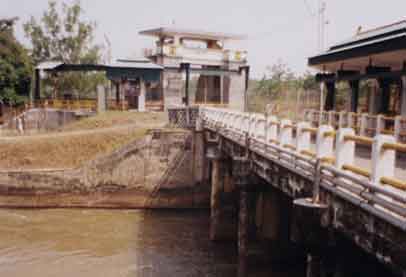 | | | Dam built by Dutch in 1935, Lampung, S.E. Sumatra. | | However, it became clear that transmigration was not the answer to Indonesia's population and economic problems. Poorly planned and executed, it often added to the problems. Even at its peak, the movement of people out of Java was never going to keep up with population growth. Others argued that the government's predominant concern was to increase its control across the archipelago through a process of "Javanisation" or "internal colonialisation." Environmental and human rights groups also became increasingly concerned at the widescale destruction of Indonesia's hardwood rainforests and the impact the policy was having on Indonesia's indigenous peoples as land they traditionally felt was theirs was taken for new transmigration sites.
| 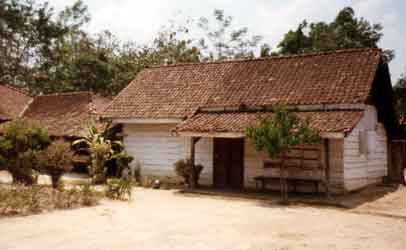 | | | Typical old style transmigrant houses, Lampung, S.E. Sumatra. | | Tensions between transmigrants and the local populations grew. In some areas these boiled over with murderous consequences. The conflict between the Dayaks and Madurese migrants on the island of Kalimantan is one example. In two particularly gruesome outbreaks of violence, in late 1996/early 1997 and early last year, hundreds of people were killed, including young children, many of them hacked to pieces and decapitated. Hundreds of thousands of Madurese fled their homes. Many are still living in cramped conditions in temporary camps.
Following years of economic and political turmoil across the archipelago, the situation remains explosive across much of the country. While transmigration has not been the sole cause of the violence, it has undoubtedly aggravated tensions and provided another fault line across this fragmented country. Four years after the official transmigration policy was quietly dropped by the post-Suharto government, many of its negative consequences are still being felt today and some critics argue that it is continuing under another guise. With little sign that the new democratically elected government is willing to tackle the problems created and exacerbated by transmigration, including land disputes, deforestation and massive environmental damage, and social tensions, the outlook for peace across the Indonesian archipelago seems remote.
|
| | |





 Listen to the programme
 View more images from prgramme recording