| | | THE LATEST PROGRAMME | | | |
| | Jonathan Freedland looks for the past behind the present. Each week, The Long View, recorded on location throughout the British Isles, takes an issue from the current affairs agenda and finds a parallel in our past.
Have you got a good subject for a future programme?
Send us your suggestion.
| | | 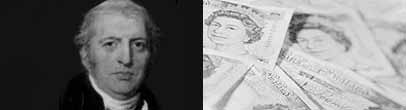
Taxing times for Lord Liverpool |  Listen to the programme again after the broadcast Listen to the programme again after the broadcast
THE TROUBLE WITH TAX
London 1816 - The Repeal of Income Tax In the spring of 1816 the Tory Lord Liverpool was Prime Minister, his Chancellor was Nicholas Vansittart. This was a time of poverty, middle-class discontent and growing popular radicalism. The Napoleonic Wars had ended with Britain's victory in 1815 but post-war Britain was suffering from a collapse in trade and the cost of paying off the enormous debts incurred over almost 20 years of warfare. People felt they were being taxed to the hilt. They were paying a range of indirect taxes, including duties on consumer goods, but were also paying income or property tax. When the Napoleonic wars finally ended, it was assumed that income tax would be scrapped. In fact, faced with enormous economic problems, Liverpool and Vansittart proposed that income tax should be continued. This resulted in a wave of protest - petitions were signed across the country - 22,000 signed in the City of London alone, an unprecedented number, and contemporary cartoons called for tax cuts - the abolition (or more properly 'expiry') of the income tax. The protesters were those who were eligible to pay income tax, essentially the electorate, which, before the Reform Act of 1832 meant the elite - wealthy tradesmen, businessmen, the upper middle classes and landowners. The income tax, sometimes referred to as the property tax or income and property tax, taxed people on their total income. As today, this was done through schedules - a system introduced in 1803 and still used now. | | On Location | | 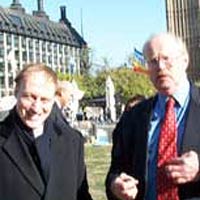 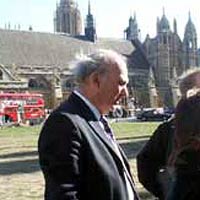 | | Left: Andrew Roberts and Philip Ridd
Right: Vincent Cable |
Not surprisingly, the payers of income tax were keen to see the tax abolished, particularly as they considered it unjust. They were particularly incensed by Vansittart's plans to reform the way that the tax was collected. Vansittart and Lord Liverpool's plan for reform would have replaced trusted commissioners with men appointed by the Inland Revenue - government bureaucrats. This was seen as particuarly despotic and an example of an over-mighty state trampling on the liberties of Englishmen and the independence of the City of London. Income tax was also seen by many as a tax that saddled the virtuous and hard-working namely the business and middle classes, a nineteenth century version of Middle Britain, with paying off the state's debts. The enormous national debt run up during the Napoleonic Wars had to be serviced, and income tax revenue helped to pay the interest. The aristocracy were seen to be benefitting from this as they were more likely to have money in government bonds. Thus while the middle class struggled to pay the tax and keep the economy afloat, the very wealthy appeared to be the lucky beneficiaries. While Liverpool endeavoured to cut government expenditure, he did so in part by rooting out corruption and extravagance. To do so, he set up Commissions of Inquiry, which did indeed find corruption and extravagance - sleaze. For the majority of the electorate however, Liverpool's intentions counted for nothing. They remembered the sleaze but not the reasons why it was being exposed. So to those protesting against it, income tax seemed the unjust tool of an overmighty state, paid by the virtuous for the benefit of a corrupt and parasitical elite, hence the outraged protests of spring 1816. On March 18th 1816 a parliamentary debate settled the matter. Vansittart, spoke in defence of income tax against calls for its repeal from MPs such as Henry Brougham, the future Lord Chancellor, and the banker Alexander Baring - both of whom had been key movers in orchestrating the nationwide campaign against the retention of income tax in peacetime. The debate begins with the presentation of numerous petitions of complaint from all around the country. The 'inquisatorial' character of income tax, and the proposed reform of its collection, was a particular ground for complaint. In Parliament Vansittart argued that "This tax would press less on the lower orders of society than any tax which could be devised… it was a tax more upon the rich than upon the poor… when the act was revised, it would be found the least oppressive and the least objectionable of any tax that had been ever been imposed… A small portion of the property tax would be less burthensome than those taxes on consumption, which, though less immediately felt, were ultimately more burthensome and less productive". Despite Vansittart's defence, he and Lord Liverpool's government were defeated by 238 votes to 201 following a stormy parliamentary debate. | | On Location | |   | | Left: Michael Howard
Right: Frank Field |
Lord Castlereagh, a member of Liverpool's Government, wrote to the Prince Regent that day, "With much regret to inform your Royal Highness that the Property Tax has been rejected by the House of Commons by 238 to 201 - majority 37. The calculation of the Treasury this morning was that we should carry it by 40, but this was defeated by numbers of the friends of the Government going away and some going against, whose support had been calculated upon... This defalcation leaves us with but 12 millions of clear revenue to meet this year's expenditure of 30 millions, and taking the future peace establishment at 20 millions a year, there will exist a serious deficiency of means to meet the charge." Income tax records were then supposedly incinerated in the Old Palace Yard at Westminster. Whether this bonfire really took place we can't say. Several historians who have studied the period refer to the event as a story or legend that may have been true. Perhaps the most convincing evidence are reports that, in 1842, when Peel re-introduced income tax, albeit in a less contentious form, the records were no longer available. Another story is that those burning the records were unaware of the fact that duplicates had been sent for safe-keeping to the King's Remembrancer. They were then put into sacks and eventually surfaced in the Public Records Office. What we do know was that the Government was defeated, although it did not fall, and income tax was repealed. On the following morning London was said, at least by opponents of the Government, to have been in 'an uproar of joy' at news of the repeal. Contemporary cartoons show income tax as a multi-headed monster slain by Brougham, John Bull and the British lion, while Vansittart and Liverpool slink away | | Contemporary cartoon | | 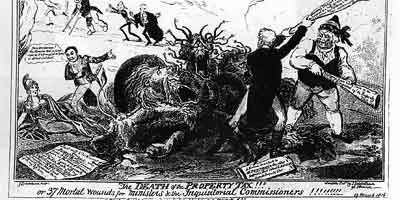 | | The Death of the Property Tax
| For most of those who had previously paid the tax, its repeal was welcome. Forced to make up the shortfall in revenue, the Government increased indirect taxes, many of which, for example taxes on tea, tobacco, sugar and beer, were paid by the poor. Between 1811 and 1815 direct taxes - land tax, income tax, all assessed taxes - made up 29% of all government revenue. Between 1831 and 1835 it was just 10%. So the wealthy benefitted. The Repeal resulted in rising prosperity for the middle and upper classes but increased poverty for the working class. Most historians of the Industrial Revolution now reckon that it was not until the second half of the nineteenth century that the poor began to benefit from increased national wealth. Indeed by the 1830s and early 1840s, there was real fear of popular unrest, even revolution. That's when, in 1842, another Tory Prime Minister, Sir Robert Peel, re-introduced income tax to help to rebalance the system. Unlike Liverpool, his approach, including going back to the old system of tax collection, was less controversial. It also helped that unlike Liverpool, he didn't alienate the taxpayers, rather he seemed one of them, a businessman, a cotton man, modern, prudent, trustworthy. Not like Liverpool whose regime was seen as riddled with 'the old corruption', cronyism, sleaze and run for the benefit of the aristocratic elite.
Contributors:
Andrew Roberts - Historian
Philip Ridd - The Solicitor of Inland Revenue
Frank Field - MP Labour
Michael Howard - MP Conservative Shadow Chancellor
Vincent Cable - MP Liberal Democrat Shadow Chancellor
| | | |
| | |