| | | THE LATEST PROGRAMME | | | |
| | Jonathan Freedland looks for the past behind the present. Each week, The Long View, recorded on location throughout the British Isles, takes an issue from the current affairs agenda and finds a parallel in our past.
Have you got a good subject for a future programme? Click here to make your suggestion. | | | 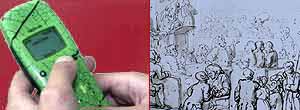
Mobile phones - a common target of street crimes. A radical and brutal experiment was implemented against street crimes some 200 years ago.
| | Sentencing is a live debate in Britain today - whether it's four years for stealing a mobile phone or weekend only prison. This week the Long View looks back to the time of the "Bloody Code", when stealing a loaf of bread was a capital crime.
Jonathan Freedland is joined by actor Robert Hardy to explore the story of the 1785 Essex Azzises where the Bloody Code was implement in full, an extraordinary moment in British justice. It is a story that has never been told, which was the subject of a cover up at the highest level.
At the Essex Azzises, 10 men were found guilty of street crimes, crimes not a million miles away from mobile phone theft or car-jacking. They all received the death penalty. They were all executed.
During the course of the programme we hear from the man at the heart of sentencing policy in Britain today, the Lord Chief Justice, Harry Woolf, who explains his reasons for backing tough treatment of those found guilty of mobile phone theft.
| | | On Location | | 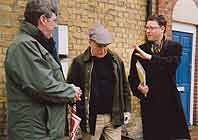 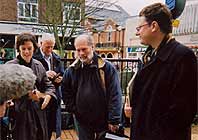 | | Left-hand picture:Paul Hayley, Robert Hardy and Jonathan Freedland in Chelmsford.
Right-hand picture: Virginia Crompton, the programme producer, Andrew von Hirsch, Peter King and Jonathan Freedland.
 to Lord Woolf to Peter King to Lord Woolf to Peter King
to Andrew von Hirsch to Paul Hayley
to Robert Hardy | | 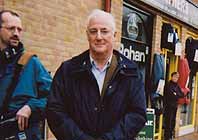 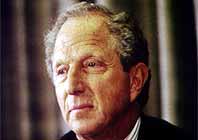 | | Left-hand picture: Andrew von Hirsch
Right-hand picture:Lord Woolf, Chief Justice of England and Wales.
| | We travel to Chelmsford with Professor Peter King, the historian who has pieced together what really happened. We hear about Robert Hardy's personal contact with one of the last men to be hanged in Britain. Criminologist Professor Andrew Von Hirsch discusses the morality and rationality of punishment.
And at the site of the mass execution of 1785, Paul Hayley, the new Governor of Chelmsford Prison, a notorious institution described by the Inspector of Prisons in 2000 as a "college of crime", gives his take on the purpose of prison and the challenges faced by the prison service at a time when, in his opinion, we are sending too many people to jail.
Those who were hanged, Essex Summer Assizes, Friday 22 July 1785
Edward Green, Highway robbery in Wanstead, aged 20
Edward Smith, Highway robbery, South Minster, aged 40
John Morgan, Highway robbery, aged 21
Thomas Wheeler, Highway Robbery Wanstead aged 23
William Jones, Breaking and entering, Dagenham, aged 25
Michael Wadcock, West Ham highway, robbery, aged 27
William Moore, West Ham highway, robbery, aged 18
John Williamson, for the same highway robbery in West Ham, aged 17
Thomas Abrahams, for stealing linen from an outhouse, 430 yards worth £30, aged 50
Thomas Littler, for the same crime, aged 58
FURTHER READING
Crime, Justice and Discretion in England 1740-1820, by Peter King, Oxford. |
| | |