| | | THE LATEST PROGRAMME | | | |
| | Jonathan Freedland looks for the past behind the present. Each week, The Long View, recorded on location throughout the British Isles, takes an issue from the current affairs agenda and finds a parallel in our past.
Have you got a good subject for a future programme?
Send us your suggestion.
| | | 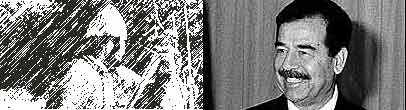
The manhunt for Hereward the Wake and Saddam Hussein |
THE SEARCH FOR HEREWARD THE WAKE The invading forces sweep across the border. The regime change is dramatic, but a feared leader has gone to ground. He and his men are picking off a few of the soldiers who search for them each day. Protected by the local people and living off the fat of the land, he has every advantage. He knows the terrain. He speaks the language. He blends into the population. He is a magnate for resistance. No, it isn't the search for Saddam Hussein. This week Jonathan Freedland seeks out Hereward the Wake in the marshes and fenlands of East Anglia. The Conqueror's men were frustrated in their efforts to capture 'Hereward the Wake' for over a year. In 1070 he and his men made a daring raid on the monastery at Peterborough which marked him as a dangerous and effective resistance leader. William and his army gradually closed on Hereward until he withdrew to the Isle of Ely where he lived in comfortably - out of reach of the invading force. | | On Location | | 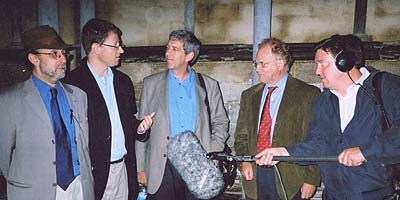 | | Adel Darwish, Jonathan Freedland, Lt Col Garth Whitty, Robert Fox, Richard Earle
| In the 11th century the Isle of Ely was a substantial region of raised land, surrounded by marshes, waterways and swamps. Here, with ample supplies of meat, fish and birds, with fresh water in abundance and the luxuries of monastic wealth to enjoy, Hereward and his men taunted William's army. Protected by the local population - living comfortably. William determined to catch his man. There were ways to cross the marshes, but the Normans didn't know what they were. William decided to lead a direct attack on the Isle. | | On Location | | 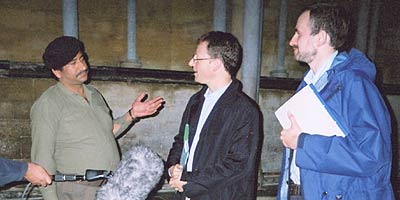 | | Jeff Mirza, Jonathan Freedland, Dr Carl Watkins
| The southern-most tip of the Isle was an Anglo-Saxon hamlet of Aldreth, almost completely surrounded by water, and separated from the mainland by a couple of miles of marsh. Today Aldreth is still a small village, perched on the edge of rich arable lands crossed by a lonely country lane. Known as the Aldreth Causeway, this was once the route William the Conqueror chose to lead his army into battle. To cross the water they decided to built a timber causeway - a massive task since it must stretch well over a mile. Egged on by the price on Hereward's head the Norman army marched onto the causeway - which sank under the weight of men and chain mail. The next attempt smacks of desperation. William employed a local witch to curse the local inhabitants - but "psychological operations" Norman-style were also a failure. The witch fell off her tower and broke her neck when Hereward's men set fire to the reed bed. It was finally betrayal that brought the Conqueror's army onto the Isle. But even then, Hereward slipped away - out of the historical record, and into the realm of myth.
Contributors:
Dr Carl Watkins - Medieval History, Cambridge University
Adel Darwish - author of Unholy Babylon
Robert Fox - The Daily Telegraph
Lieutenant Colonel Garth Whitty - former head of British National Search with experience of manhunts in Iraq
Jeff Mirza - EMMA award winning actor for Walking with Muslims
| | | |
| | |






 Listen to introduction