| | | THE LATEST PROGRAMME | | | |
| | Jonathan Freedland looks for the past behind the present. Each week, The Long View, recorded on location throughout the British Isles, takes an issue from the current affairs agenda and finds a parallel in our past.
Have you got a good subject for a future programme? Click here to make your suggestion. | | | 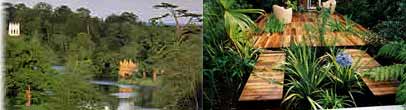
Painshill Park and a garden makeover carried out by the BBC's
Home Front. |
Painshill Park, near Cobham in Surrey, was created by the Hon. Charles Hamilton (1704 -86), the fourteenth child and youngest son of the Earl of Abercorn. Greatly influenced by the Italian landscapes he had seen when on the Grand Tour, Hamilton began work on Painshill in 1738, leasing 125 acres of rather unpromising land on the edge of a heath. Determined to create a garden that would be both fashionable, beautiful and fun, he embarked on a hugely ambitious garden makeover, drawing on the limited funds which he had inherited from his father.
| | | On Location | | 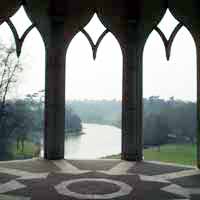 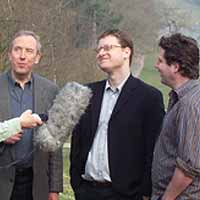 | | Left-hand picture:Gothic temple looking towards the lake
Right-hand picture:Teige O'Brien,Jonathan Freedland, Diarmuid Gavin. | | 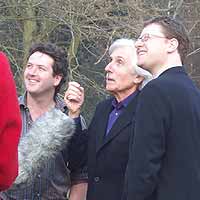  | | Left-hand picture: Diarmuid Gavin, Sir Roy Strong, Jonathan Freedland,
Right-hand picture:Sian Thomas. |
Inspired by the landscape paintings of artists such as Poussin and Salvator Rosa, Hamilton's design was hugely ambitious. His first task was to fertilise the rather barren soil - a problem he resolved through an ingenious and novel scheme. He ordered that the heathland be first burnt and the resulting ashes spread across the ground. The ashes then enabled Hamiliton to grow turnips as fodder for sheep, whose droppings manured the land, further increasing its fertility and ensuring that a wide range of plants could prosper at Painshill.
An avid collector of plants, Hamilton imported exotic species and planted a great variety of trees and shrubs, including rhododendrons, magnolias and pines. The park was landscaped and a serpentine lake and series of architectural features added, including a Grotto, Gothic temple, Chinese bridge and Hermitage - home, at least for a few weeks - for an initially enthusiastic hermit. Caught sloping off to the pub, his contract was rapidly terminated but Painshill itself continued to flourish and was greatly admired by Walpole, Defoe and other visitors, who hailed Hamilton's creation as a masterpiece. One of the greatest eighteenth century English landscape gardens, the theatricality of Painshill was carefully staged with a variety of eye-catchers, water-features and spectacular vistas arranged along a circuit route that took visitors through the park, stimulating their minds and emotions as they walked.
Unfortunately for Hamilton, and his guests,after thirty years of garden improvements the enormous cost of the venture eventually forced him to sell Painshill and move to Bath. Several centuries later, gardening is more popular than ever and while few British gardeners can now design on the scale that Hamilton did, they do spend billions of pounds a year on their gardens. What's more, several aspects of Charles Hamilton's garden compare with the characteristics of many modern gardens, particularly those made-over in television shows such as 'Groundforce' and 'Homefront in the Garden'.
| | | On Location | | 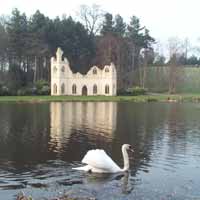 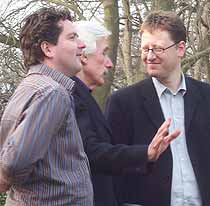 | | Left-hand picture:The ruined abbey.
Right-hand picture: Diarmuid Gavin, Sir Roy Strong, Jonathan Freedland. | | 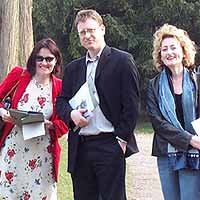  | | Left-hand picture:The producer Jane Ray, Jonathan Freedland, Sian Thomas
Right-hand picture: Diarmuid Gavin. |
Hamilton was a great traveller and brought artefacts and ideas from other cultures home to Painshill: a Turkish tent, rare plants from North America, designs for a Chinese bridge and Italian sculpture. In much the same way, garden centres now sell many plants and products that remind customers of their summer holidays - you can have a Tuscan terrace or Provencal patio wherever you live. Similarily, both Hamilton and modern gardeners look to the past for inspiration. The grand classical allusions of Painshill take the visitor back to ancient Greece and Rome, today gardeners are more likely to recreate the more humble features of the Victorian cottage garden.
New technology was also a great feature of Painshill, where the creation of the lake was made possible by the installation of a cleverly-designed water wheel, much commented on by Hamilton's contemporaries. Today we are beseeched to buy solar powered lights and water fountains, sonic mole scarers and squirrel-proof bird feeders. Above all, perhaps, modern garden design focuses, once again, on the creation of an outside room - an artfully designed space where the atmosphere is carefully created. Today we do it with lights, water and sometimes even flowers - for Charles Hamilton, a dream-like grotto, Turkish tent, ruins, temple and hermit were the elements through which magic was created.
Contributors
Sir Roy Strong - historian
Diarmuid Gavin - garden designer and broadcaster
Teige O'Brien - historian of Painshill
Sian Thomas - actress
| | |
RELATED LINKS
www.painshill.co.uk
Please note the BBC cannot be held responsible for the content of external websites. | |
| | |






 Listen to Introduction